KIF projects 3.1% growth next year; semiconductor concentration and domestic-demand disparities remain challenges
- Input
- 2026-11-10 15:36:25
- Updated
- 2026-11-10 15:36:25
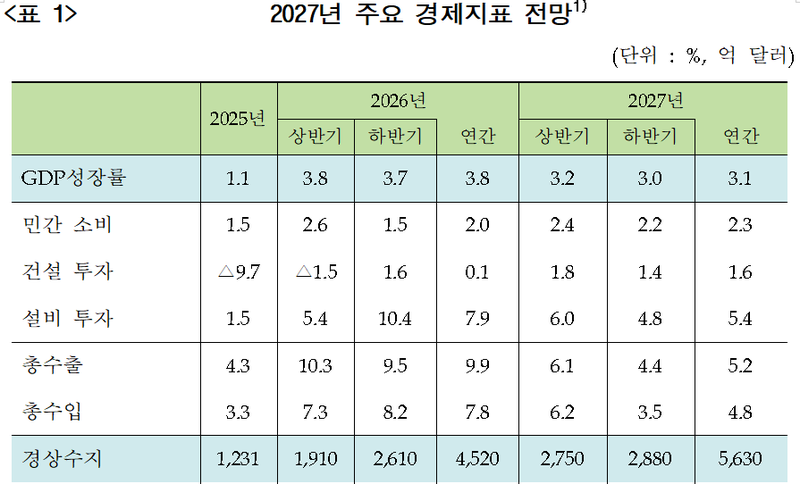
Growth forecast at 3.1% next year
The Korea Institute of Finance (KIF) projected real gross domestic product (GDP) growth of 3.8% this year and 3.1% next year at its “2027 Economic and Financial Outlook Seminar” on the 10th. It forecast that export growth would slow next year compared with this year, but that facility investment, private consumption and proactive fiscal management would support growth.Private consumption is forecast to grow by 2.3% next year, up from 2.0% this year. The analysis said that strong exports, including semiconductors, would gradually feed through to higher wages and household incomes, while increased disposable income from expansionary fiscal policy would also contribute to a recovery in consumption.
Growth in construction investment is expected to rise from 0.1% to 1.6% over the same period. The rebound is expected to be driven by a base effect following this year’s low growth and a recovery in building starts, a leading indicator. However, the KIF assessed that the recovery would be gradual due to factors including high construction costs.
Facility investment and exports are also expected to continue growing, supported by semiconductor demand driven by the global buildout of artificial intelligence (AI) infrastructure. Growth in facility investment is forecast to slow from 7.9% this year to 5.4% next year, and total export growth from 9.9% to 5.2%, respectively, but both are expected to sustain growth.
The current account surplus is forecast at $452 billion this year and $563 billion next year. The KIF said that export volumes would also increase as production capacity expands, while semiconductor export prices remain high.
The employment rate is forecast to rise by 0.1 percentage point from this year to 62.9% next year, while the increase in the number of employed people is expected to grow from 140,000 to 180,000. Consumer price inflation is projected to fall from 2.7% to 2.4% over the same period, but remain above the inflation target, while the average annual yield on three-year Treasury bonds is forecast to rise from 3.7% to 4.1%.
Semiconductor concentration and uneven growth are “challenges”
Despite the solid growth outlook, how much of the semiconductor boom will spread to other industries and people’s livelihoods remains a challenge.The KIF assessed that corporate profits and workers’ incomes within the semiconductor ecosystem would rise significantly, but that the capital-intensive nature of the industry would limit the spread of benefits through employment. It also said the impact on services output would be limited.
Kim Hyun-tae, head of the KIF’s Macroeconomic Research Office, said in his presentation, “We need to prepare for the possibility that a stronger won could constrain exports from other sectors,” adding, “There are concerns that the competitive environment in non-semiconductor export markets could deteriorate structurally, including as pressure from export competition with China intensifies.”
This reflected concern about the possibility of “Dutch disease” resulting from the semiconductor boom. Dutch disease is a phenomenon in which foreign currency inflows from a boom in a particular industry raise the value of a country’s currency, weakening the competitiveness of its other export industries.
The KIF also saw the potential for greater shocks from changes in conditions for AI investment, given that semiconductors have become the main driver of growth. If semiconductor demand is adjusted downward due to data centers’ financing burdens, power shortages or construction delays, it could affect not only exports and investment but also consumption.
Another factor is that a recovery in domestic demand could add to inflation and interest rate burdens. Even if the semiconductor boom boosts incomes and consumption, persistent inflationary pressure could leave highly indebted households and self-employed people having to bear high interest costs for longer.
The KIF therefore recommended using the additional fiscal revenue generated by the semiconductor boom to diversify the industrial structure and strengthen the competitiveness of non-semiconductor industries. It urged caution about expanding permanent spending based on volatile revenue, and called for targeted fiscal support for vulnerable households facing heavy living expenses and principal and interest repayment burdens.
Kim said, “Despite solid growth, the recovery is expected to remain uneven across sectors,” adding, “We need to consider how to connect the semiconductor industry’s boom to other industries and extend its benefits to marginalized groups.”
In a related discussion, Lim Hong-gi, director of the Economic Analysis Division in the Economic Policy Bureau at the Ministry of Economy and Finance, said, “We are preparing next year’s policies along two lines: fostering future growth engines beyond semiconductors, and ensuring that the money earned from semiconductors reaches neighborhood businesses and people’s livelihoods.”
[email protected] Ye Byung-jung, Lee Hyun-jung Reporter