Korea Institute of Finance: “Growth of 3.1% next year” ... Semiconductor boom to spread, driving a recovery in domestic demand
- Input
- 2026-11-10 10:10:45
- Updated
- 2026-11-10 10:10:45
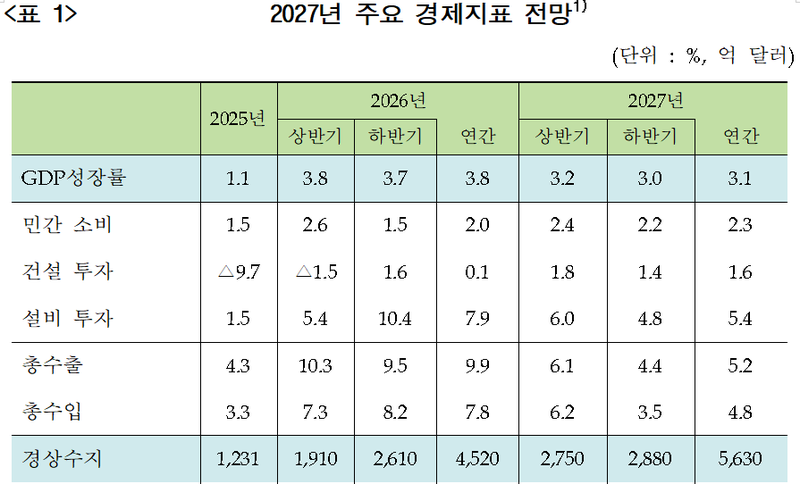
At its “2027 Economic and Financial Outlook Seminar” on the 10th, the Korea Institute of Finance said, “Next year, our economy is expected to maintain solid growth in the 3% range, with the recovery in domestic demand continuing on the back of strong facility investment, a gradual recovery in private consumption and active fiscal management.”
The growth forecasts for Korea’s real gross domestic product (GDP) presented by the institute that day were 3.8% for this year and 3.1% for next year. It said a key question was how far the benefits of the semiconductor boom would spread across domestic demand, including consumption and construction.
By category, private consumption is forecast to grow by 2.3% next year, up from 2.0% this year. The analysis said that strong exports, including semiconductors, would gradually feed through to higher wages and household income, while increased disposable income resulting from expansionary fiscal policy would support a recovery in consumption.
The growth rate of construction investment is projected to rise by 1.5 percentage points, from 0.1% to 1.6%. The institute cited a base effect from this year’s low growth rate and a recovery in construction starts, a leading indicator, as factors behind the gradual rebound.
The institute expects facility investment and exports to underpin growth, supported by strong semiconductor demand stemming from the global buildout of artificial intelligence (AI) infrastructure. However, growth in facility investment is expected to slow from 7.9% this year to 5.4% next year, while total export growth is projected to ease from 9.9% to 5.2%. It expects total import growth to decline from 7.8% to 4.8% over the same period.
The employment rate is forecast to edge up from 62.8% this year to 62.9% next year, while the increase in the number of employed people is expected to grow from 140,000 to 180,000.
The current account surplus is expected to rise from $452 billion this year to $563 billion next year, continuing an unusually strong run of surpluses.
The average annual yield on three-year government bonds is forecast to rise from 3.7% this year to 4.1% next year. Annual consumer price inflation is expected to ease somewhat, from 2.7% to 2.4% over the same period.
The institute explained, “Next year, exchange rates and oil prices will fall compared with their 2026 levels, but demand-side inflationary pressures will increase due to factors such as improved consumer and investment sentiment amid economic growth in the 3% range and the effects of fiscal expansion.”
[email protected] Ye Byung-jung Reporter