Fire service budget to come from the Future Fund too? ... Battle over 162 trillion won ‘slush fund’ intensifies
- Input
- 2026-11-10 08:19:44
- Updated
- 2026-11-10 08:19:44
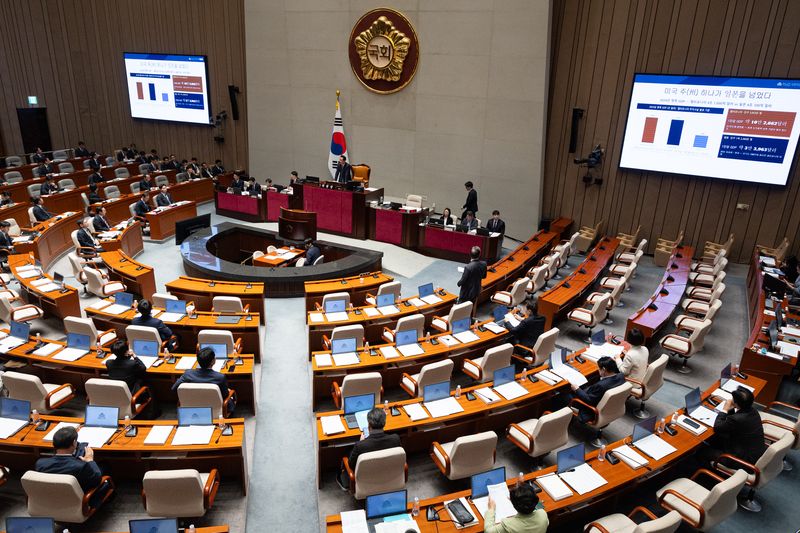
[Financial News] The 162 trillion won Future Fund, which the government is pursuing to secure future growth engines, has emerged as the biggest point of contention in the review of next year’s budget proposal. More than half of the fund’s program spending has been found to involve transferring or restructuring existing programs, and controversy is growing as the government pursues an additional 2 trillion won in funding for fire services, prompting discussion of whether the fund could be used. The People Power Party criticizes the fund as liable to become a “slush fund” the government can dip into whenever it wants, while the Democratic Party counters that it is a mechanism for future investment and fiscal stabilization.
The National Assembly’s Special Committee on Budget and Accounts will hold a plenary meeting on the 10th and conduct a second day of ministry-by-ministry reviews of economic ministries on the 2027 budget proposal. The ruling and opposition parties are expected to continue their dispute over the Future Fund’s appropriateness and how it should be operated, following the previous day’s debate.
At the heart of the controversy is how the fund will be used. According to an earlier analysis of the budget proposal, 26.4959 trillion won of the Future Fund’s 45.4 trillion won in program spending next year—58.4% of the total—involves transferring or restructuring existing programs. This means a substantial share of existing government-funded programs is being moved into the fund, contrary to its original aim of concentrating resources on new investments in the future.
Recurring annual spending also accounts for a substantial amount. According to an analysis by the National Assembly Budget Office (NABO), ongoing programs account for 46.7% of next year’s fund spending, or 21.1973 trillion won. Meanwhile, additional tax revenue, a key source of the fund, is projected to cease from 2029 onward. Critics warn that increasing permanent spending on the back of a temporary tax revenue boost from a semiconductor boom could increase the fiscal burden in the future.
The controversy is widening as the government and ruling party consider providing around 2 trillion won in additional support for fire services. At the Special Committee on Budget and Accounts the previous day, People Power Party lawmaker Park Jeong-ha raised the possibility of using the Future Fund and pointed out, “That means it will ultimately have to be used as a slush fund.” Minister of Planning and Budget Park Hong-keun also responded that “there could be debate” over whether funding for fire services is in keeping with the fund’s purpose.
The People Power Party issued a statement that day, escalating its criticism. Chief Deputy Floor Spokesperson Choi Soo-jin criticized the proposal as “a shallow attempt to take credit by using a one-off fund, rather than the regular budget, to cover even the lives and safety of firefighters, for which the state must bear ongoing responsibility,” and asked, “Is the 162 trillion won Future Fund the administration’s all-purpose safe?”
Choi, the party’s chief deputy floor spokesperson, claimed that consumption-related spending made up 38.7% of next year’s fund spending and took issue with the rural basic income program, the Youth Culture and Arts Pass, and 5.672 billion won to secure official residences for ministers and vice ministers. Choi argued that “the government can change 30% of program spending as it pleases without a vote by the National Assembly, rendering even the Assembly’s oversight powerless.”
The Democratic Party, by contrast, maintains that temporarily increased tax revenue should be used for future growth and fiscal stability rather than spent on ordinary government expenditures. The previous day, Democratic Party lawmaker Lee Yeon-hee stressed, “The Future Fund is being established to use temporary resources generated by the semiconductor boom for investment in future generations and as reserves, rather than for ordinary spending,” adding, “The policy goal is to expand future growth potential.”
There are also calls within the ruling party to improve transparency in the fund’s management. Lee said, “There is a need to make reporting to and oversight by the National Assembly routine,” and proposed disclosing quarterly returns on the management of surplus funds and implementation results for each program, as well as requiring assessments by outside experts and reports to the National Assembly.
The way the fund is financed is also a point of contention. The People Power Party argues that setting aside in the fund resources that should be prioritized for repaying national debt could undermine fiscal soundness. Citing academics’ assessment that it is “a massive accounting trick that postpones repayment of national debt while issuing government bonds to build up cash worth about 104 trillion won that is, in reality, debt,” Choi, the party’s chief deputy floor spokesperson, criticized the proposal, saying, “If we get carried away by a fleeting semiconductor tax windfall and simply ramp up populist spending, the enormous bill will come back in full as debt for future generations.”
Debate over the Future Fund’s scope and the National Assembly’s oversight mechanisms is expected to continue in the Budget Proposal Adjustment Subcommittee. After wrapping up its review of economic ministries that day, the Special Committee on Budget and Accounts will review non-economic ministries on the 11th and 12th and begin operating the subcommittee from the 16th. The budget proposal for next year submitted by the government totals 820.9 trillion won, up 12.8% from this year’s original budget. The statutory deadline for passage is the 2nd of next month.
[email protected] Kim Kyung-min Reporter