Autonomous-driving pilot vehicles to reach 3,000 next year... Europe urges unified rules, saying “business viability is key”
- Input
- 2026-11-10 06:59:00
- Updated
- 2026-11-10 06:59:00
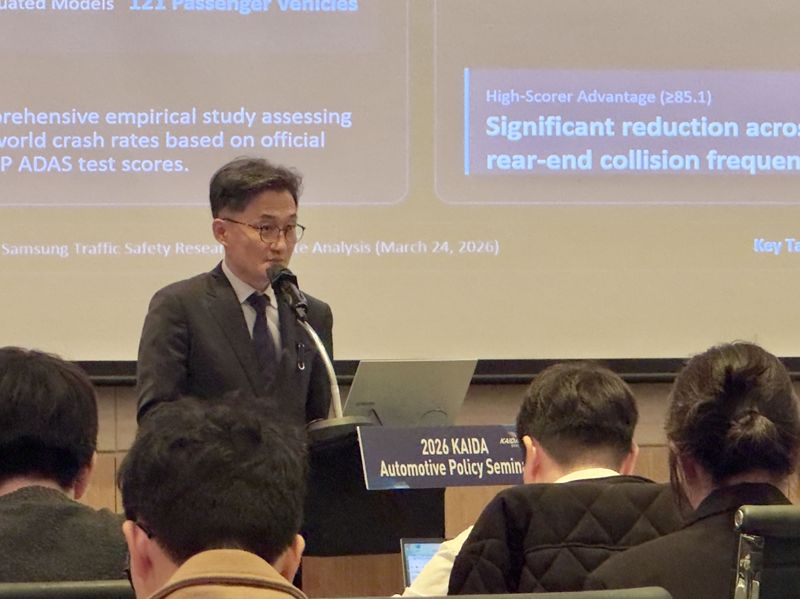
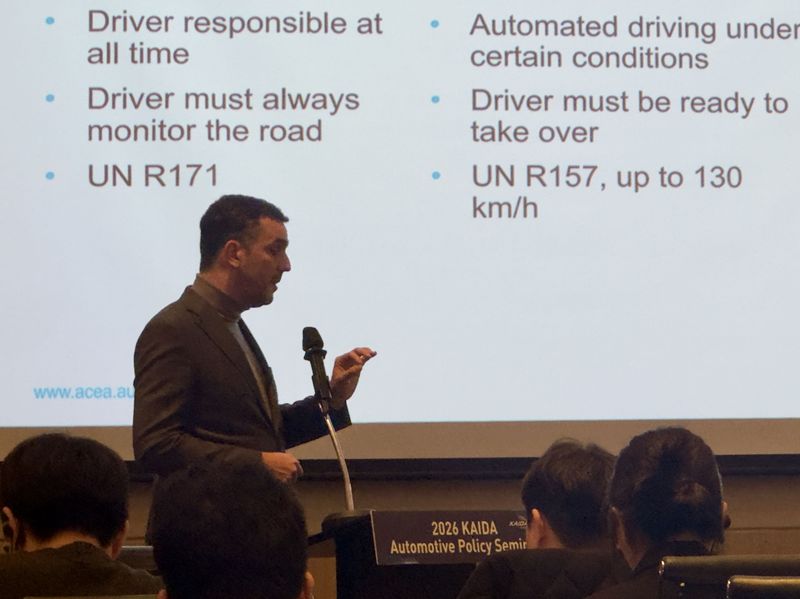
Min Gyeong-chan, head of research planning at the Korea Automobile Testing & Research Institute (KATRI) of the Korea Transportation Safety Authority, and Pierre Millet, chief technology officer (CTO) of ACEA, each presented on “Autonomous Vehicle Certification Systems and the Direction of Certification Policy” and “Global (European) Policy and Technology Trends in Autonomous Vehicles and Their Implications,” respectively, at the 2026 KAIDA Automotive Policy Seminar, held at FKI Tower in Yeongdeungpo District, Seoul, on the 9th.
■“A problem with one vehicle can become a problem for thousands... The entire fleet must be validated”
Min stressed that although news reports say Korea’s autonomous-vehicle regulations are stricter than those in the United States or China, “in practice, the system is quite flexible and lenient.” In California, the permit alone costs 5 million to 7 million won. Buying a surety bond to cover a $5 million guarantee costs about $50,000 more, or around 100 million won including fees and other expenses. In China, the cost is about 40 million won per vehicle. By contrast, in Korea the permit fee is 1,800 won, and insurance costs 200,000 to 300,000 won. This makes it easy for universities and small and medium-sized venture companies with limited funds to begin test driving, he explained.
The next step is the pilot operation zones. Special exemptions allow autonomous vehicles to provide paid services carrying passengers or freight in designated areas. There are currently 55 such zones across 17 local governments nationwide. According to Min, highways have also been designated as pilot operation zones, and services are transporting freight autonomously between logistics centers.
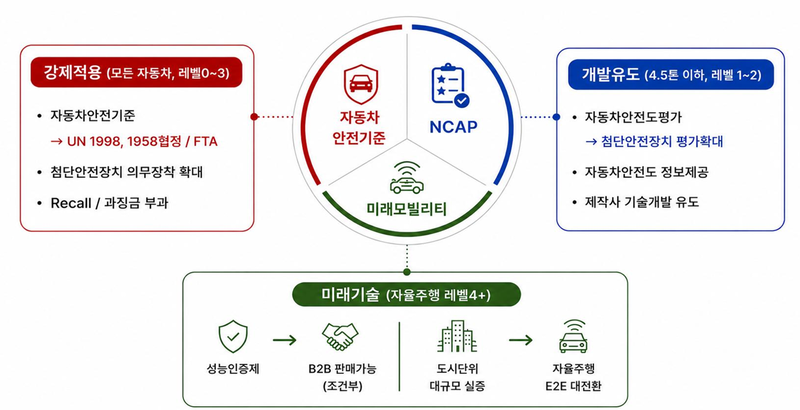
A performance certification system is in place for Level 4 autonomous vehicles. Level 4 is the stage at which a vehicle can handle failures or unexpected situations on its own, without handing control over to a driver, under specified conditions. The system allows vehicles that meet certain performance requirements to be sold to transport companies or local governments on a business-to-business (B2B) basis even before formal safety standards are issued. About two companies are reportedly preparing to seek certification.
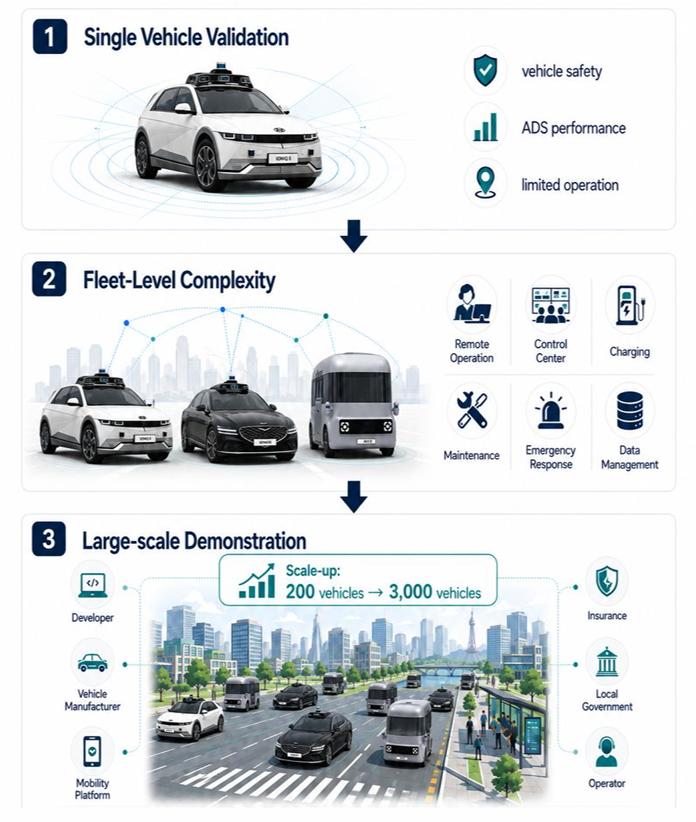
The government will expand next year to at least 3,000 vehicles the large-scale pilot that began this year in Gwangju with 200 vehicles. Min noted that “a problem that affects a single vehicle could spread to an entire fleet.” As the number of vehicles grows, every aspect of operations—including dispatch, remote operation, maintenance and charging—becomes more complex. As in a recent case in which several robotaxis stopped at once due to communications problems and caused traffic congestion, a defect in one vehicle could affect thousands simultaneously. This means that not only vehicle performance but also service continuity and emergency response capabilities must be validated.
Based on the pilot results, the government plans to adapt the Level 4 regulations of the United Nations Economic Commission for Europe (UNECE) to Korea’s roads and regulatory environment and revise Level 4 safety standards by next year. The new international regulations assess a manufacturer’s overall safety management system rather than testing each prescribed scenario one by one. The manufacturer sets out its safety concept and submits evidence to support it, and the government assesses whether the manufacturer has the capacity to meet its responsibilities. Organizational capability and safety culture are also subject to review.
Asked about improving the functions of already-sold Level 2 vehicles through over-the-air (OTA) software updates, he replied, “If the update adds functions that differ from those covered by the initial self-certification, it should be treated as a recertification.”
■“Europe focuses on commercial operations... Rules that differ by member state are a major obstacle”
He said manufacturers’ interest in Level 3 is waning. Level 3 is the stage at which the system drives under certain conditions, such as on highways, while the driver must be ready to take over at any time. “If you build a Level 3 vehicle, in practice it isn’t very different from Level 4,” Millet said. As a result, Level 3 is being limited to premium cars, while the market is splitting between Level 2, which offers driver-assistance features, and Level 4, which allows driverless operation under specified conditions, he explained.
On the regulatory front, the UN set out new international regulations on automated driving systems last June. Europe is moving toward a system next year that will approve Level 4 vehicles without restrictions on their use. Since it is impossible to test every driving situation, the approval process combines simulations and testing on proving grounds and public roads with manufacturers’ “safety cases,” or reports demonstrating vehicle safety.
He cited differences in operating rules among member states as an obstacle. Vehicle safety approvals are handled at the EU level, but each member state sets the rules for service operations and remote operation. “Very few European countries have established operating rules for highly automated vehicles,” he said, calling this “a major constraint at present.” ACEA plans to work toward harmonizing rules among member states next year and to cooperate with the European Commission (EC) on issuing guidance to them.
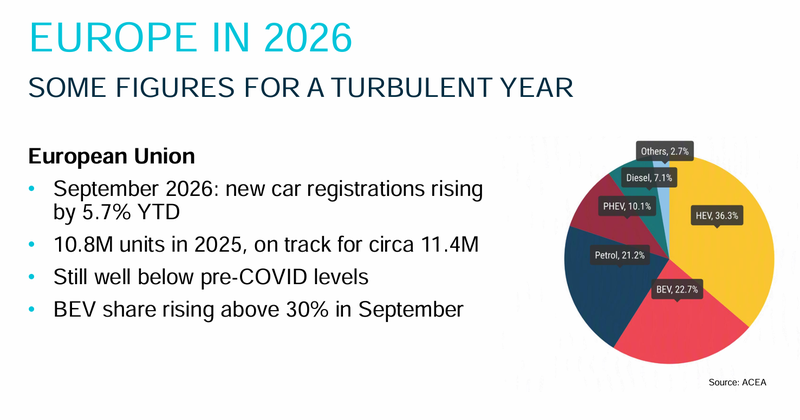
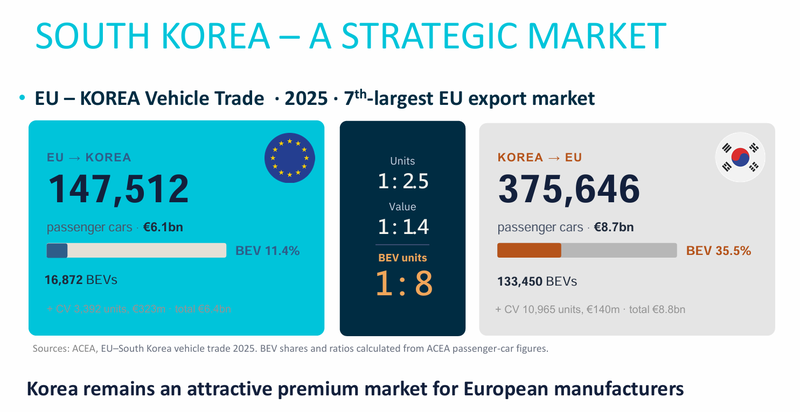
He also emphasized the importance of the Korean market. As of last year, Korea was the EU’s seventh-largest automobile export market. “For many of our member companies, Korea is their third- to fifth-largest market,” Millet said, adding that “consumers prefer premium cars, and interest in autonomous-driving technology is much higher than in Europe.” He said Europe’s experience safely introducing Level 2 driver assistance systems (DCAS) under UN regulations could also help Korea.
He also urged Korea to adopt international standards. “I hope Korea will continue contributing to discussions on UN regulations and adopt them when drawing up its own rules,” he said. On revisions to the automotive annex to the EU–South Korea FTA, he said, “There has been progress this year, and some issues are still under discussion, but I’m confident we will reach a positive conclusion,” adding that “faster progress is needed on adopting UN regulations.”
Asked about Chinese autonomous-driving technology, he replied, “It is not as much of a concern in Europe as it is in Korea.” He said, “European consumers are less interested in autonomous driving than Korean consumers,” adding that “the bigger concern is the competitiveness of electric vehicles and batteries.” He also said, “Some European manufacturers are very advanced in autonomous driving, but they simply don’t show it because it isn’t their core business.”
[email protected] Kim Dong-chan Reporter