The Return of U.S. Manufacturing ... ‘It’s America Again’ Examines New Opportunities for South Korean Companies [New Book]
- Input
- 2026-11-10 07:00:00
- Updated
- 2026-11-10 07:00:00
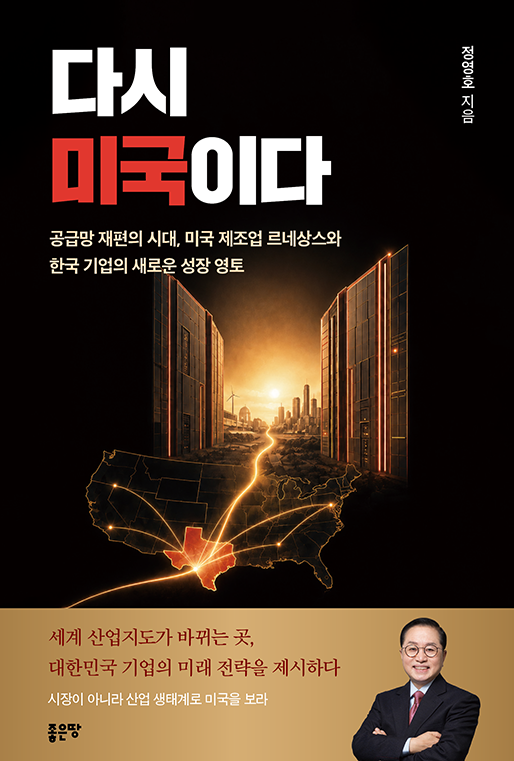
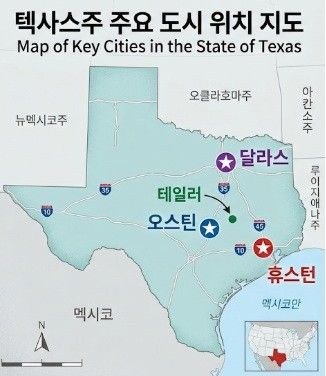
The reason is that Houston, Dallas, Austin and Taylor—all within the jurisdiction of the Consulate General in Houston—are being transformed into some of the world’s leading hubs for advanced industries, offering South Korean companies boundless business opportunities. Houston is evolving beyond energy into a manufacturing innovation platform where aerospace and biotech converge. AI-related facilities and data centers are being established in Dallas, while the world-class semiconductor production base in Austin and Taylor is rapidly expanding.
Last year, Texas, one of the settings for the author’s work, had a gross domestic product (GDP) of $2.94 trillion, ranking ninth in the world in a Visual Capitalist comparison that counted U.S. states as separate economies. Its economy was larger than those of individual countries such as Russia, Italy and South Korea. Against this backdrop, the author, former Consul General Jeong Yeong-ho, argues in the book that “we need to change how we view the United States amid the realignment of global supply chains and the restructuring of the world economy.”
Rather than seeing the United States simply as a market for exporting or selling good products, he says, it should be viewed as an industrial platform at the ecosystem level, where capital, technology, talent and production capacity come together.
This means combining allies’ technology, capital, and production and operational capabilities with the U.S. industrial ecosystem to build production capacity in the United States—what is known as ‘allied industrial base cooperation’ or ‘allied onshoring.’
The author notes that this shift in the United States “is creating a tremendous opportunity for South Korea, which has some of the highest manufacturing capabilities in the free and democratic world” (p. 47). The reasoning is that South Korea, facing fierce competition from China in key manufacturing industries such as semiconductors, displays, batteries, automobiles, shipbuilding and defense, can solidify its foundation for growth and further strengthen its advanced capabilities through broad cooperation with the United States.

One strength of the book is that it connects analysis of international developments, such as the return of U.S. manufacturing and shifts in industrial locations, with practical challenges for businesses, including strategies for entering the local market, and explains them from multiple angles. In particular, it shows how semiconductors, AI, biotech and the space industry are becoming structurally interconnected through Texas’s industrial landscape, while clearly outlining practical issues companies preparing to enter the U.S. should consider, including location, taxes and regulations, and local organization and operations.
In conclusion, the author emphasizes that “the United States is not simply a market but a place where a new future order is taking shape,” and that “we must elevate the United States from an overseas business operation to a ‘future growth headquarters’ and get ahead of business opportunities” (p. 295). That is because our next 10 or 20 years depend on a changing America. In that respect, this book is a practical strategy guide to understanding the transformed United States accurately and responding to it.
[email protected] Jang In-seo Reporter