High interest rates widen the gap between winners and losers among card companies... Delinquency-rate disparity triples [fn Market Watch]
- Input
- 2026-11-09 20:20:13
- Updated
- 2026-11-09 20:20:13
According to a report released on the 9th by NICE Investors Service, titled “Credit Card Industry Performance and Financial Soundness Outlook and the Potential for a Widening Gap Among Card Companies,” the standard deviation of delinquency rates at Korea’s seven specialized credit card companies increased 3.1-fold, from 0.17% at the end of 2020 to 0.55% at the end of June this year. The gap between the highest and lowest delinquency rates also widened from 0.5 percentage points to 1.4 percentage points.
Differences in financial soundness among card companies are clear. As of the end of June this year, Woori Card had the highest delinquency rate, at 2.4%, followed by Lotte Card at 2.2% and Hana Card at 2.0%. By contrast, the rates at Samsung Card and Hyundai Card were just 1.0% and 1.1%, respectively. The gap in financial soundness is widening even among card companies with the same AA+ credit rating.
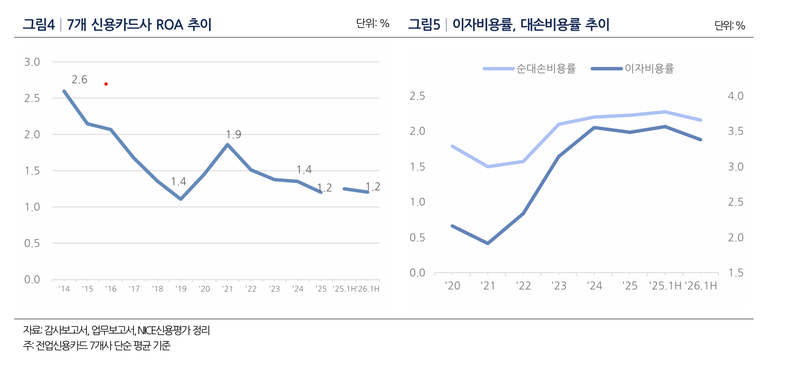
Profitability is also becoming increasingly polarized. The gap between the highest and lowest return on assets (ROA) among the seven card companies doubled, from 0.9 percentage points in 2020 to 1.8 percentage points last year. In particular, the ROA gap among the three companies rated AA+—Samsung Card, Shinhan Card and KB Kookmin Card—also widened over the same period, from 0.4 percentage points to 1.1 percentage points.
Kim Seok-woo, an analyst at NICE Investors Service, said, “The standard deviation of interest expenses as a share of total assets at each card company surged 3.7-fold last year compared with 2020,” and analyzed, “The gap in funding competitiveness, rather than differences in card earnings, selling and administrative expenses, and credit-loss cost management, drove the polarization of profitability.”
Last year, Samsung Card’s interest expense rate was 3.1%, compared with 3.8% at Lotte Card and 3.7% at Hyundai Card. This shows that even in the same interest-rate environment, the burden varied depending on funding structure, creditworthiness and the maturity structure of borrowings.
Card companies’ cuts to customer benefits in an effort to protect profitability are also notable. Installment-fee income as a share of total card assets rose from 1.8% in 2020 to 2.5% in the first half of this year. NICE Investors Service said the increase reflected higher fees on interest-bearing installment plans, reduced benefits for interest-free installments and shorter installment periods, among other factors.
The possibility of further interest-rate increases is a concern. NICE Investors Service warned that in a pessimistic scenario where the base rate exceeds 3.5% and high rates persist over the medium term, the combined burden of funding costs and credit-loss costs could widen performance gaps among card companies to levels seen during previous rate-hiking cycles.
The analysis suggests that further rate increases could trigger defaults among borrowers with multiple debts and those with high debt-service ratios (DSRs), at a time when financially vulnerable borrowers have less ability to repay than in the past.
Kim said, “Going forward, when assessing the creditworthiness of credit card companies, differences even among companies with the same rating—in funding-cost management, borrowing-maturity diversification, risk-asset composition and nonperforming-loan management performance—are expected to become more pronounced.”
[email protected] Kim Hyun-jung Reporter