Google unveils two TPUs specialized for security and large-scale data processing
- Input
- 2026-11-09 22:00:00
- Updated
- 2026-11-09 22:00:00
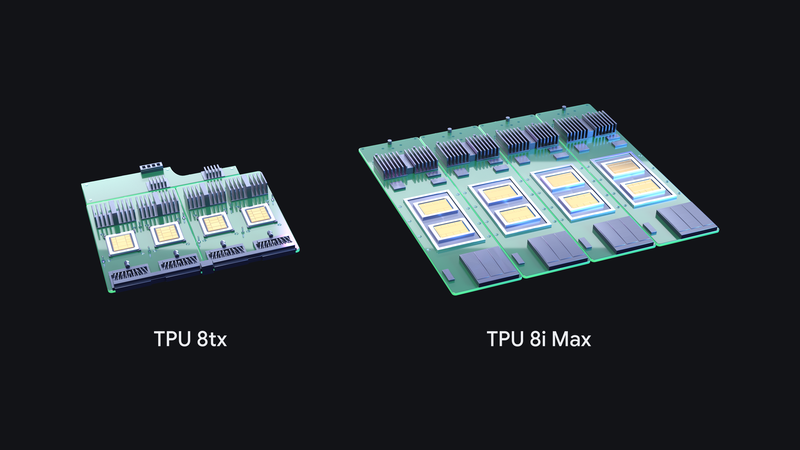
According to industry sources on the 9th, Google unveiled two new 8th-generation TPU systems, the “TPU 8tx” and “TPU 8i Max.” Following the “TPU 8t” for large-scale training and the “TPU 8i” for real-time inference, which it announced last April, the company has added two more systems, bringing its 8th-generation lineup to four in total. This is the first time Google has introduced four TPU systems in a single year.
The new products are focused on addressing data security and memory bottlenecks that arise when running enterprise AI agents.
The TPU 8tx is designed for businesses and government agencies that handle sensitive information. Data is generally encrypted while stored or transmitted, but it often needs to be decrypted during computation. Google designed the TPU 8tx with hardware-based security features that protect and isolate sensitive data and AI model weights even during computation.
The TPU 8tx combines the same semiconductor as the existing TPU 8t with a custom central processing unit (CPU) host from Advanced Micro Devices, Inc. (AMD) and a low-latency network. According to Google, it reduces latency by up to half compared with the TPU 8t while minimizing performance loss. Businesses can fine-tune AI models and carry out reinforcement learning without moving sensitive data to a separate cluster.
The TPU 8i Max is specialized for AI agents that process vast amounts of information simultaneously. It is designed to reduce memory bottlenecks that occur when dozens of AI agents analyze large software codebases or several hours' worth of video.
Google combined two TPU 8i chips in a single package, doubling compute performance, static random-access memory (SRAM) capacity, and high-bandwidth memory (HBM) bandwidth compared with the existing TPU 8i. By fitting more computing resources into the existing server-rack footprint, the system can also improve space and power efficiency in data centers.
Google is also expanding the software ecosystem for TPU users. Its recently open-sourced “TorchTPU” enables developers to run existing PyTorch code and Hugging Face models on TPUs without rewriting them.
Google also introduced the “Agent Compute Engine,” which reduces unnecessary use of computing resources while AI agents wait for the results of external tasks, and “TPU Sync,” which optimizes data movement between memory.
Amin Vahdat, Google's senior vice president of AI infrastructure and chief technology officer (CTO), said, “As computing scales up from being centered on people to being centered on AI agents, businesses are demanding accelerators capable of handling the vast context of AI models.”
[email protected] Jang Min-kwon Reporter