From an 8 million won shoe cabinet to a 1.4 million won puffer jacket... Scrutiny over Park Soo-hong’s family for “showing off their wealth” [Issueconomy]
- Input
- 2026-11-10 05:40:00
- Updated
- 2026-11-10 05:40:00
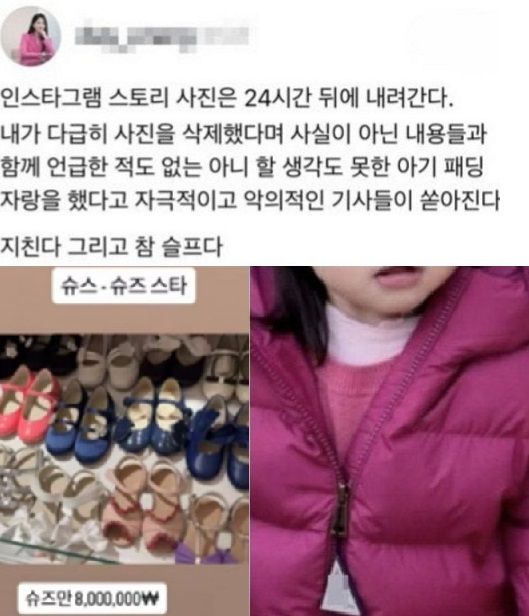
[Financial News] As Kim Daye, wife of broadcaster Park Soo-hong, voiced frustration over a controversy surrounding her daughter, who is just over a year old, wearing an expensive luxury puffer jacket and accusations of “showing off wealth,” the exceptionally high prices and luxury-brand bubble in the “angel industry” (the infant and toddler industry)—which has grown disproportionately amid the trend of low birth rates—have once again come under scrutiny in the retail sector.
“1.4 million won M-brand puffer jacket”: She offers an explanation, but the luxury market for children is overheated
On the 8th, Kim Daye strongly denied accusations of “showing off money” and “deleting it in a hurry” over the M-brand jacket worn by her daughter, Jaei, from a French premium puffer-jacket brand and priced at around 1.4 million won. She explained that it was simply an Instagram Story, which disappears automatically after 24 hours, not an intentional deletion, and that she had no intention of mentioning or flaunting the price. Park Soo-hong’s side also explained that the garment was a gift from an acquaintance.
In fact, the retail prices for the M-brand children’s (“enfant”) down-jacket line at the center of this controversy are comparable to those of adult products. Even lightweight jackets for infants and toddlers (baby and toddler sizes) start at 700,000–900,000 won, while heavy down jackets and models with fur trim command around 1.3–1.6 million won at department-store list prices. They use less than a third of the material area and filling of adult puffer jackets (priced at around 2.5–3.5 million won), with about 100 grams of goose down, yet cost roughly half as much as adult versions.
Outgrown after one season, yet costing well over 1 million won... The roots of a grotesque “price bubble”
Retail experts say the extreme price premiums in the luxury clothing market for infants and toddlers are “a textbook marketing bubble, detached from the cost of raw materials and manufacturing.”
Even allowing for the demanding sewing processes particular to children’s clothing, the total amount of fabric and filling, such as goose down, used is only 30–40% of that in adult clothing. Nevertheless, the head office’s brand-logo and patch licensing fees are added in full, and retail prices easily top one million won.
The short useful life typical of products for infants and toddlers also fuels debate over the price bubble. Because children grow so quickly, clothes no longer fit after just one season (2–3 months), so the depreciation rationale for adult clothing worn for five to ten years or more does not apply. Yet the market is squarely targeting parents’ conspicuous-consumption mindset: “Even if they wear it just once, dress them in the best.”
Behind this distorted structure are the increasingly prevalent “gold kids” and “ten pockets” phenomena amid low birth rates. As the whole family—from parents and grandparents to maternal grandparents, maternal aunts, and uncles—opens its wallet for a single child, sales of children’s luxury goods at department stores have continued to post double-digit growth. This is fueling global luxury brands such as Dior Baby and Burberry Children to stick to what amounts to “brazen pricing,” raising prices by 5–10% every year.
“Widening consumer polarization” vs. “Parents’ freedom to choose”
Views are divided over the luxury-goods craze for children. Critics say it fuels relative deprivation and encourages children to flaunt their possessions from an early age. Others counter that, with families having just one child, buying and giving them premium products is a matter of personal choice. The two views remain sharply opposed.
A retail-industry source analyzed the trend this way: “Luxury clothing for infants and toddlers is less a functional product for the child than a form of ‘trophy consumption’ that strongly reflects the parents’ social status or tastes. Even though such items can depreciate by 50–70% or more on secondhand platforms, the price bubble in the children’s luxury market is unlikely to burst easily for the time being, in tandem with the social-media culture of posting proof photos.”
Even a news moment we laugh off contains the principles of the market. At Issueconomy—“Issue” + “Economy”—we explore the economic stories hidden behind the moments making headlines.
[email protected] Moon Young-jin Reporter