NVIDIA expands its “physical AI” reach with Samsung, SK and LG—from semiconductor research to robot trials
- Input
- 2026-11-09 17:43:01
- Updated
- 2026-11-09 17:43:01
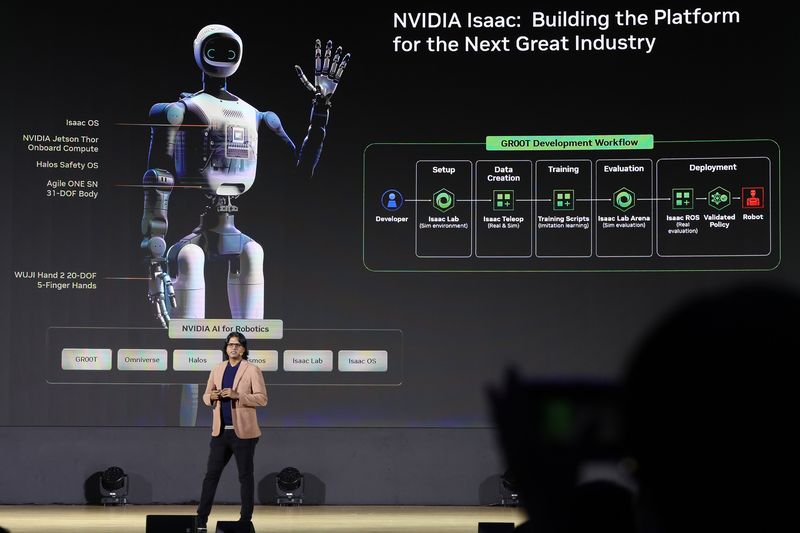
[Financial News] NVIDIA and domestic companies are expanding their collaboration to bring physical artificial intelligence (AI) into manufacturing operations. The approach involves training and validating robots in virtual environments, then deploying them in actual production processes to improve their performance. By combining the manufacturing experience of Korean companies with NVIDIA's AI technology, they are speeding up the development of robots capable of performing a wide range of complex tasks.
In a keynote address on “The Current State and Future of Physical AI” at NVIDIA AI Day Seoul 2026, held at COEX in Seoul's Gangnam District on the 9th, Deepu Talla, NVIDIA's vice president of Robotics and Edge AI, said, “Korea has consistently performed beyond expectations in heavy industry, automotive and electronics manufacturing. General-purpose robotics will soon become a reality.” He added, “Korea will play a key role in the development of physical AI over the next 10 years.”
LG Electronics continues to collaborate with NVIDIA on simulation technology for training and validating robots. It trained NVIDIA's robot AI model GR00T on the movements of skilled workers and simulation data, then deployed and tested a humanoid robot in a process that involves hanging a washing machine top panel weighing about 4 kg on a hanger.
The companies are also working together to improve the performance of robots trained in virtual environments so they can work reliably in actual factories. To address performance drops caused by differences between on-site backgrounds and training environments, they used NVIDIA's Cosmos to generate training data featuring a range of backgrounds. They also recreated production processes in a virtual environment to validate robot movements, and applied TensorRT to physical robots to increase inference speed.
Park Jeong-seop, head of LG Electronics' Robotics Intelligence Team, said, “To deploy robots on factory floors, it is extremely important to ensure they can perform continuous operations reliably. Factory floors may seem like places where things happen in highly standardized environments, but when you actually go into a factory, there are many variables depending on the production plan, and the layout and parts change as well.”
SK hynix is collaborating with NVIDIA to speed up simulations needed for semiconductor research and development. Using NVIDIA's AI development tool PhysicsNeMo, it developed an AI model that predicts how a material's shape changes as it is etched away. The approach produces results comparable to those of conventional simulations dozens of times faster, enabling the company to obtain data needed to examine a range of process conditions.
Kim Jeong-han, head of SK hynix's TCAD Intelligence Team, who spoke at the event, said, “We plan to develop AI solutions for the semiconductor sector rapidly going forward. We expect our collaboration with NVIDIA to accelerate that process even further.”
Samsung Electronics is also developing a workflow using NVIDIA's AI simulation technology PhysicsNeMo to analyze thermal and mechanical properties at the semiconductor chip level.
In one case where the “AI homogenization” technique—which combines effective material properties predicted by AI with GPU acceleration—was applied, the actual speed was reportedly increased by about 1,600 times, and a simulation that had taken about 18 hours was completed in 41 seconds.
[email protected] Park Ji-yeon Reporter