“Automotive carbon rules must cover the entire life cycle, not just tailpipe emissions” ... Academics and government differ over EV assessments
- Input
- 2026-11-09 18:13:55
- Updated
- 2026-11-09 18:13:55
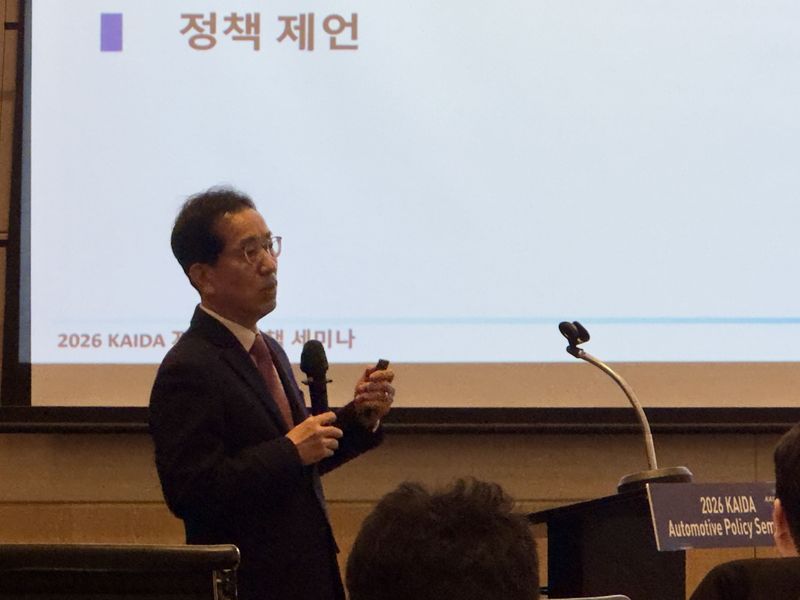

Min Kyung-deok, a professor in the Department of Mechanical Engineering at Seoul National University, and Park Jun-hong, head of the Mobility and Environment Research Center at the National Institute of Environmental Research, each gave a presentation at the 2026 KAIDA Automotive Policy Seminar at FKI Tower in Yeongdeungpo District, Seoul, on the 9th. Their topics were “Proposals for Automotive Environmental Policy in an Era of Major Transformation in the Automotive Industry” and “The Current State of Environmental Regulations for Motor Vehicles Manufactured in Korea and Future Directions,” respectively.
■ “EVs also emit as much carbon as internal-combustion vehicles”
Professor Min pointed out, “All of our country’s current policies, regulations and incentives are determined by whether CO2 or exhaust gases come out of the tailpipe.”
He said, “Nitrogen oxides (NOx) and fine particulate matter (PM) have an immediate impact on city residents, but CO2 is a global problem,” adding, “It is somewhat more appropriate to view CO2 from an LCA perspective.” Air pollutants harm the areas where they are emitted, whereas CO2 contributes to global warming no matter where it is released.
As supporting evidence, he cited LCA data released by Hyundai Motor. Total carbon emissions across the life cycle, from production to disposal, were 39.9 tCO2eq (tonnes of CO2 equivalent) for the internal-combustion version of the Hyundai Kona and 33.2 tCO2eq for the Hyundai Kona Electric. The electric commercial vehicle Hyundai ST1 recorded 42.3 tCO2eq, while the second-generation Hyundai Nexo recorded 39.2 tCO2eq, including 3.6 tonnes from parts manufacturing. EVs emit less while being driven, but produce substantial carbon emissions during battery manufacturing.
Professor Min explained, “People think EV emissions are zero, but from an LCA perspective, EVs emit no less carbon than internal-combustion vehicles,” adding, “Much more CO2 is emitted when batteries are made.”
LCA is already being factored into subsidies overseas. France converts the carbon footprint of production and transport into an environmental score and provides subsidies only for EVs scoring 60 or higher. The United Kingdom sets subsidy levels according to the electricity carbon-emissions factors of the countries where vehicles are assembled and battery cells are produced. The system means that cars made in countries with a higher share of coal-fired power receive smaller subsidies.
In Korea, a draft notice on “Regulations on Methods for Life-Cycle Assessment of Greenhouse Gas Emissions from Motor Vehicles” was announced for public comment on the 7th of last month. However, manufacturers submit the information voluntarily if they choose, so it is not yet linked to regulations or subsidies. Professor Min proposed that subsidies and other systems should also shift to an LCA basis over the long term.
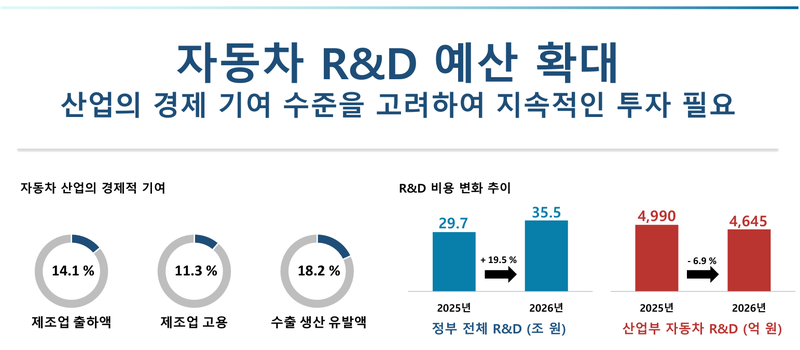
On hybrids, he said, “They can certainly play a role for the next 20 to 30 years,” adding, “To do that, their efficiency must also improve.” He also called for increased investment, noting that although the government’s overall R&D budget rose 19.5% this year, the Ministry of Trade, Industry and Energy’s automotive R&D budget fell 6.9%, from 499 billion won to 464.5 billion won.
■ “LCA is still an estimate ... support for small and midsize parts suppliers to increase”
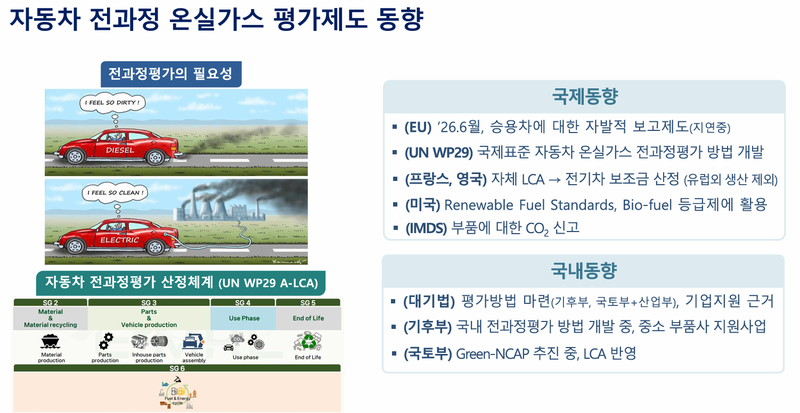
LCA is divided into Levels 1 through 4 according to precision. Levels 1 and 2 estimate a vehicle’s carbon emissions using average values from commercial databases. Starting at Level 3, measured data—including the energy used in the actual manufacturing process and the proportion of recycled materials—is incorporated for key components that account for a large share of carbon emissions. Greater precision increases reliability, but also places a heavier burden on parts suppliers, who must calculate the data themselves.
The United Nations World Forum for Harmonization of Vehicle Regulations (WP29) considers Level 3 the minimum required to use LCA for regulations or government reporting. The idea is that calculations need to be more precise when used for policymaking. France and the United Kingdom, however, set EV subsidies using less detailed calculations. Under the two countries’ systems, vehicles produced outside Europe are excluded from subsidy eligibility.
Center Director Park said, “They use simple Level 1 or 2 calculations for subsidies,” adding, “You can probably guess why.” He was pointing out that LCA is being used to favor vehicles produced domestically or within the region, rather than to assess carbon emissions precisely.
His view differed from Professor Min’s on EV assessments. LCA assumes a vehicle is used for 15 to 20 years and calculates emissions over that period as well. Center Director Park said, “If the expansion of renewable energy over that time is also factored in, the figure for EVs could be lower than the values currently known.” In other words, as electricity generation becomes cleaner, the carbon emissions associated with the electricity used to charge EVs also fall.
He said, “A few years ago, some results showed hybrids and EVs were comparable, but recent results seem to show that the gap is growing.”
On institutionalizing LCA, he said, “There is a very long way to go,” and stated that the government would take a phased approach. First it will establish a calculation method, then proceed to voluntary reporting by manufacturers, and then introduce standards. Incentives will also be considered as part of the process.
He also outlined plans to expand support for small and midsize parts suppliers. Center Director Park said that large manufacturers such as Hyundai Motor are building up their capabilities, while smaller suppliers further down the supply chain are facing considerable difficulties.
He said, “Under a 2025–2026 pilot program, we are spending around 1.2 billion won a year to support small businesses with their calculations,” adding, “We plan to sharply increase the level of support next year.” The plan is to broaden assistance beyond calculation and verification to include consulting on emissions-reduction technologies. He said the specific amount could be disclosed after the National Assembly’s budget review.
■ “Cars as a main source of fine-dust pollution is an outdated notion” ... Greenhouse gas standards pressure automakers to “switch power sources”
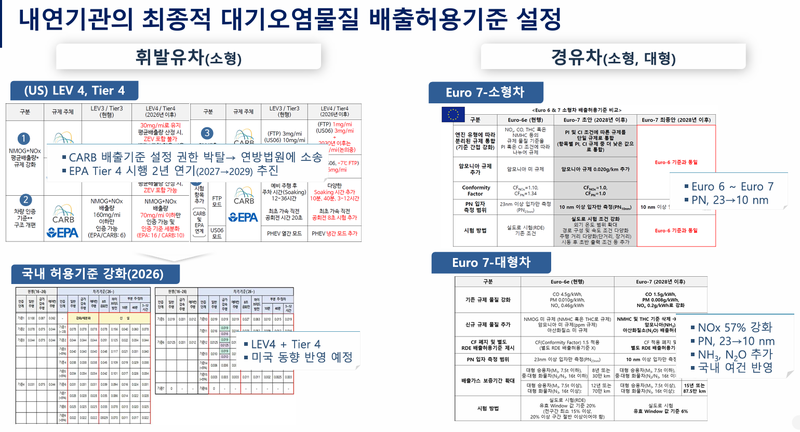
Center Director Park stressed, “Vehicle exhaust emissions have fallen so much that I can say the claim that cars are a major source of fine-dust pollution is no longer valid.”
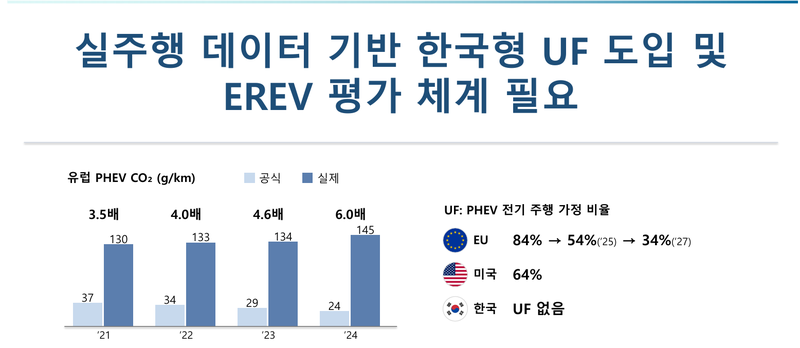
On greenhouse gas standards, he explained, “They may appear to regulate tailpipe CO2, but in practice they are a system that requires a shift in power sources.” As the standards become stricter, improving the efficiency of internal-combustion vehicles alone will no longer be enough to meet them, making a successive shift to hybrids, plug-in hybrids and EVs unavoidable.
According to Center Director Park, hybrids, too, have difficulty reducing CO2 emissions below 90 grams per kilometer because of the characteristics of their systems. Meeting the 2030 standard of 70 g/km with room to spare would require plug-in-hybrid-level performance. In July, the government announced for public comment a proposal to tighten the standard to 54 g/km. By August this year, the share of zero-emission vehicles (EVs and hydrogen vehicles) among new passenger cars had exceeded 24% for the first time.
Regulations are also being prepared for pollutants produced beyond the tailpipe. These are fine particles generated as brakes and tires wear down, and are considered a source of fine dust and microplastics. The European Union (EU) began applying standards for wear particles to newly introduced brake systems this month, and Korea is also considering adopting them.
For tires, discussions on international testing methods are being delayed because results from tests conducted on actual roads do not match those from indoor drum testing equipment. The government is pursuing domestic legislation, in consultation with industry and importers, for the Euro 7 heavy-duty vehicle standards that take effect in 2028.
[email protected] Kim Dong-chan Reporter