“Should people with chronic kidney disease stop eating meat?” ... Cutting back too much raises the risk of kidney failure
- Input
- 2026-11-10 06:00:00
- Updated
- 2026-11-10 06:00:00
[Financial News] Evidence has emerged suggesting that the “protein restriction” that had been a basic principle of chronic kidney disease management for more than 100 years should be reconsidered.
The Korea National Institute of Health at the Korea Disease Control and Prevention Agency said that a long-term follow-up of chronic kidney disease patients not receiving dialysis found higher risks of kidney failure requiring dialysis or a kidney transplant, as well as death, among patients with very low protein intake. The findings were published in the international journal JAMA Network Open.
Excessive restriction can lead to malnutrition and muscle loss
People with chronic kidney disease restrict their protein intake to reduce the burden on their kidneys. This is considered a key principle for preserving kidney function. But concerns have persisted that excessively restricting protein in daily life can lead to malnutrition and muscle loss—that is, a state of “protein-energy wasting,” in which the body’s protein and energy reserves decline—and negatively affect health and survival over the long term.
International guidelines are also changing. The International Society of Nephrology’s clinical practice guidelines (2024 KDIGO) recommend that patients with non-dialysis chronic kidney disease consume protein at a level of 0.8 g per kilogram of body weight per day—the appropriate amount for a typical adult—instead of following a uniform, strict restriction. For an adult weighing 60 kg, that amounts to 48 g per day, equivalent to about 185–240 g of beef tenderloin. However, patients at risk of disease progression are advised not to exceed 1.3 g per kilogram per day.
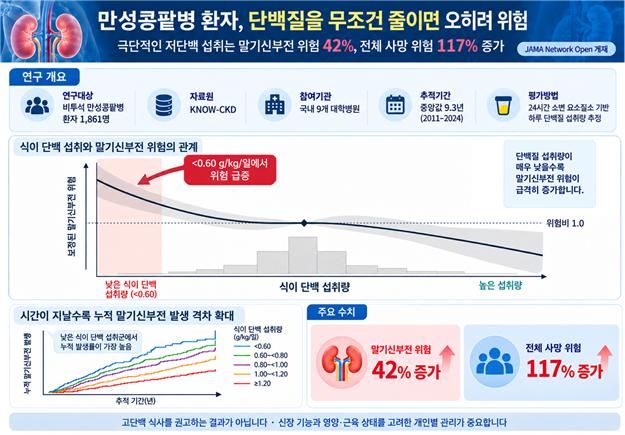
Low protein intake linked to 42% higher risk of end-stage kidney disease and 117% higher risk of death
A research team led by Professors Kim Su-wan and Seo Sang-heon of the Division of Nephrology at Chonnam National University Hospital estimated daily protein intake and analyzed the risks of kidney failure progression and death among 1,861 patients with non-dialysis chronic kidney disease at nine university hospitals in Korea between 2011 and 2024. Protein intake was estimated based on the amount of urea nitrogen excreted in urine after ingested protein was broken down. The study used data from the Korean long-term follow-up cohort for chronic kidney disease (KNOW-CKD).
The analysis found that patients with low protein intake had a 42% higher risk of progressing to end-stage kidney disease requiring dialysis or a transplant, and a 117% higher risk of death from any cause. The results were unchanged after adjusting for key factors such as age, sex, baseline kidney function (eGFR) and diabetes status.
Professor Seo said, “Protein restriction has been a principle of chronic kidney disease management for more than 100 years, but there has not been enough evidence that it actually reduces the risks of kidney failure and death in modern treatment settings. This study uses long-term follow-up data to show that automatically reducing protein intake may not benefit every patient.” He added, “This does not mean that we recommend a high-protein diet,” and emphasized, “It is important to determine an appropriate intake for each patient by assessing kidney function, nutritional status and muscle mass together, under the guidance of medical professionals and clinical dietitians.”
Kim Won-ho, head of the Division of Chronic Disease Convergence Research at the Korea National Institute of Health, said, “International guidelines are also shifting toward considering adequate intake and nutritional safety together, rather than imposing uniform protein restrictions, but there has been a lack of long-term clinical data from Korea to support this approach. This study is significant because it provides a basis for dietary management of Korean patients with chronic kidney disease and warns of the risks of ‘self-directed dieting’ that severely restricts protein.”
[email protected] Medical Correspondent Jeong Myeong-jin Reporter