“Two in three care workers have experienced violence or harassment” ... Depression risk also 4–7 times that of the general population
- Input
- 2026-11-09 16:15:24
- Updated
- 2026-11-09 16:15:24
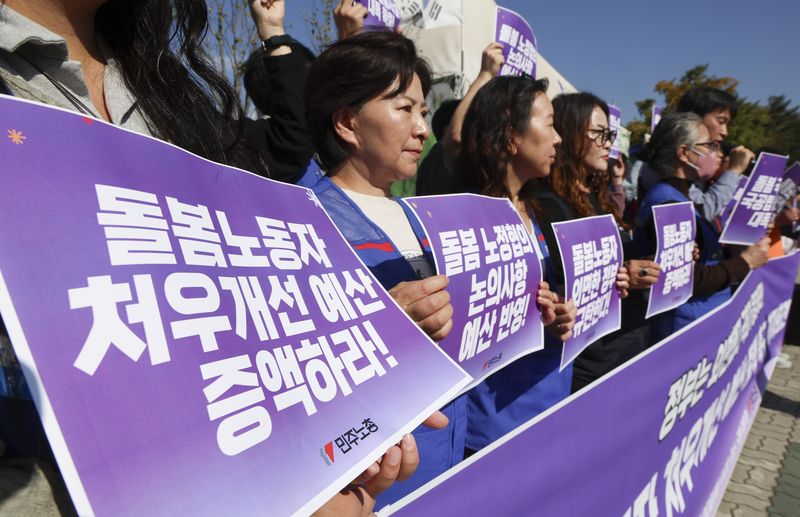
[Financial News]“Most care workers are exposed to danger again because there are no replacement workers, even when they are subjected to violence by care recipients.” (Special education instructor A)“After I was sexually assaulted, I reported it to the center, but no meaningful action was taken. I even heard insulting remarks from the guardian and eventually quit.” (Care worker B)Two in three care workers were found to have experienced violence or harassment at work. The rate of moderate or more severe depressive symptoms among those who had experienced it was at least six times that of those who had not. Violence and harassment occur not only at the hands of care service users and their guardians but also within the workplace, prompting concerns that institutional safeguards to protect affected workers are inadequate.
According to a survey presented by Yang Jae-won, a professor in the Department of Psychology at the Catholic University of Korea, at a forum titled “Workplace Harassment in Care Settings: The Reality and Tasks for Institutional Reform,” held at the National Assembly on the 9th, 237 of 367 care workers (64.6%) said they had personally experienced violence or harassment at work. The survey included 105 care coordinators, 79 special education instructors, 40 care aides and 31 social workers, among others.
Violence and harassment occurred frequently not only at the hands of care service users and their guardians but also within the workplace. Among respondents, 75.2% said they had experienced verbal abuse—including insulting criticism, shouting or swearing—from a service user or guardian in the past year. The rates of sexual harassment or sexual violence and physical violence were 48.5% and 47.7%, respectively.
The rate of verbal abuse by workplace supervisors or coworkers was 72.5%, while the rates of sexual harassment or sexual violence and physical violence were 41.4% and 36%, respectively. In other words, care workers were exposed to violence not only from service users and their guardians but also from the coworkers and supervisors they work alongside.
The gap in mental health outcomes associated with experiences of violence and harassment was also pronounced. Overall, 20.4% of respondents showed moderate or more severe depressive symptoms. This was about 4–7 times the rate of depressive symptoms in the general population cited for comparison (3–5.4%). Moderate or more severe anxiety symptoms were also reported by 15.5%, more than three times the rate among general adults (4.5%).
Unreasonable work demands outside the scope of care services were also identified. In in-depth interviews with 13 care workers, Kim Hye-jin, a full-time activist with the Korean Alliance for the Elimination of Precarious Work, found cases in which workers were asked to prepare side dishes for service users’ families or clean couples’ bedrooms and rooftops. The workers said they found it difficult to push back, fearing that refusing unreasonable demands could end their service contracts or cost them their jobs.
The problem is that under the current system, care workers may not receive adequate protection even when they experience violence or harassment from service users or their guardians. The Labor Standards Act’s provisions on workplace harassment cover conduct in which an employer or worker takes advantage of a superior position or relationship. As a result, the provisions are difficult to apply to harassment by third parties, such as care service users and their guardians.
Experts stressed the urgent need for a protection system that accounts for the nature of care work and covers violence and harassment by third parties. At the forum, attorney Lee Jong-hui of the legal office of the Korean Public Service and Transport Workers’ Union said institutional reform was needed to address violence and harassment by third parties, with International Labour Organization (ILO) Convention No. 190 as a key reference.
[email protected] Lee Dong-hyeok Reporter