Ruling and opposition parties agree on 2 trillion won in support for fire services, but disagree on funding
- Input
- 2026-11-09 16:51:54
- Updated
- 2026-11-09 16:51:54
[Financial News] On the 64th anniversary of Firefighters’ Day, President Lee Jae-myung pledged to secure stable funding for fire services and expand investment, drawing attention to a plan by the ruling party and government to provide around 2 trillion won in financial support for the sector. As the proposed Future Fund, which is slated to be established next year, is being discussed as a possible source, another proposal under consideration is to redirect the local education tax on tobacco consumption, which is due to expire at the end of this year, to fire service funding. The People Power Party, however, is calling for the money to be included in the regular budget instead of coming from the fund, so disagreement over how to secure the funding is expected to continue.
According to the Ministry of the Interior and Safety and political circles on the 9th, the Democratic Party of Korea, the government and the presidential office agreed at a high-level tripartite consultation on the 8th, a day before Firefighters’ Day, to consider providing local governments with around 2 trillion won in central government funding for urgent, essential investment in fire services. They also agreed to include in next year’s budget the funding needed for firefighting equipment, training facilities and the expansion of specialized medical services for firefighters. They will discuss additional ways to increase funding for fire services, with the specific amount of support to be finalized during deliberations at the National Assembly.
Speaking at the Firefighters’ Day ceremony in Sejong that day, President Lee said, “We will do our utmost to ensure that everyone receives equal and comprehensive fire safety protection, regardless of where they live,” adding, “To that end, we will secure stable funding for fire services and further expand investment in public safety.”
The ruling party and government set out the scale of financial support for fire services the previous day, but have yet to decide how to fund the 2 trillion won.
The first option being discussed is to use the local account of the Future Fund, which is slated to be established next year. At a plenary meeting of the National Assembly’s Special Committee on Budget and Accounts that day, Minister of Planning and Budget Park Hong-keun said the possibility of using the Future Fund to support fire service funding “can be considered from the perspective of stabilizing local finances.”
In response to a question from Park Jeong-ha, a People Power Party lawmaker, Minister Park explained, “The local account was created within the Future Fund to supplement local governments’ fiscal capacity,” adding, “Fire service budgets have placed a burden on local finances.”
He added that discussions were underway on how to address, during National Assembly deliberations, the funding needed for fire service personnel costs, aging equipment and equipment related to fire safety.
Yoon Ho-jung, Minister of the Interior and Safety, also said at a press briefing on Oct. 29 that he hoped the urgent shortfall in fire service funding would be covered by the Future Fund’s local account.
The Future Fund is financed using additional and excess tax revenues, among other sources. Under the government’s budget proposal for next year, the local account will have 15.3 trillion won to manage, of which 10.3 trillion won is allocated for project spending and the remaining 5 trillion won is to be managed as reserve funds. However, it has not been decided whether to adjust some of the allocated project spending, use the reserve funds or secure a separate source of funding. Even if reserve funds are available, they cannot be immediately directed to fire services. The procedures set out in the law establishing the fund and its management plan must be followed.
Separately from the proposed use of the fund, the ruling party and government are discussing redirecting the local education tax on tobacco consumption, which is due to expire at the end of this year, to fire service funding.
The Democratic Party of Korea’s position is that the entire annual amount of around 1.5 trillion won in local education tax on tobacco consumption should be converted into the Local Resource Tax for Fire Services. The government, however, says some of the revenue should also go to housing welfare, so further discussions are needed on the specific allocation ratio.
On Oct. 16, the Ministry of the Interior and Safety submitted to the National Assembly a bill to revise the Local Tax Act, converting the local education tax on tobacco consumption into a local housing welfare tax to fund public housing and improve housing conditions, among other purposes.
Boo Seung-chan, a Democratic Party of Korea lawmaker, also introduced as lead sponsor on the 27th of last month a bill to convert the same tax revenue into the Local Resource Tax for Fire Services. Both bills seek to convert the local education tax, which is due to expire at the end of this year, into a local tax for another purpose. The key issue is whether to allocate the revenue to fire services or housing welfare. The larger the share allocated to fire services, the less funding will be available for housing welfare as originally envisioned by the government.
The two approaches—using the Future Fund and redirecting the local education tax on tobacco consumption—draw on different kinds of funding. The Future Fund would allow the central government to support local governments through a fund, while the other approach would change the purpose for which a local tax can be used.
An Interior and Safety Ministry official said, “The local education tax on tobacco consumption is an existing source of local revenue, so redirecting it to fire service funding would not increase the total amount of local government finances.” The official added, “That is why local governments are seeking central government funding. The specific funding method is under discussion and is expected to be decided soon.”
The People Power Party also agrees on the need for financial support for fire services, but opposes using the Future Fund.
People Power Party leader Jang Dong-hyeok reiterated that day that he would increase the fire service budget by 2 trillion won to raise firefighters’ hazard pay and replace aging firefighting equipment, among other measures. Regarding the ruling party and government’s plan to provide financial support for fire services, Jang argued that the funding should be included in the regular budget, rather than come from a fund, to ensure stable implementation and continuity.
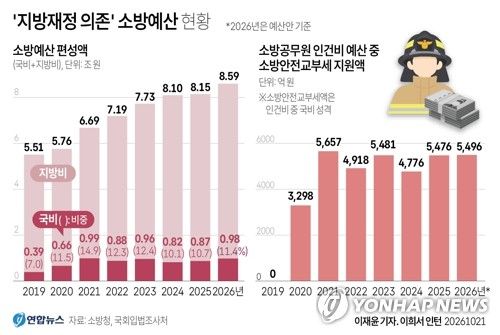
The debate over increasing funding for fire services stems from a system in which local governments continue to shoulder most of the budget even after fire service personnel became national civil servants.
In 2025, central government funding accounted for just 869.7 billion won, or 10.7%, of the total fire service budget of 8.1478 trillion won. That same year, of the 6.3632 trillion won budgeted for fire service personnel costs, just 547.6 billion won, or 8.6%, was funded through the Fire Safety Grant Tax, a source of central government funding.
The Fire Safety Grant Tax is funded by 45% of the total individual consumption tax levied on tobacco. The Ministry of the Interior and Safety said next year’s grant had decreased after tax revenue projections, reflecting declining tobacco sales, and the settlement of actual tax receipts for 2025 were factored in.
The Fire Headquarters of the Korean Government Employees’ Union also issued a statement urging the government and the National Assembly to fully fund fire service personnel costs from the national budget and establish an independent, external Fire Reform Committee.
[email protected] Lee Bomi Reporter