[Han Dong-ha's Herbal Anecdotes] Fragrance Paralyzed Her Limbs and Left Her Unable to Eat
- Input
- 2026-11-14 06:00:00
- Updated
- 2026-11-14 06:00:10
In the late Yuan dynasty in China, there was a renowned physician named Ge Qiansun in Changzhou, Jiangnan. His father, Ge Yinglei, was also famous for his medical skills and had even served as Superintendent of Medical Education in Zhejiang.
Ge Qiansun was powerfully built and immensely strong. In his youth, he was fond of martial arts and skilled with the sword and spear. Later in life, he devoted himself to scholarship and mastered yin-yang theory, calendrical systems, astronomy, and other subjects. He was also a gifted writer and sat the civil service examinations several times, but failed to achieve his goal. In the end, he followed in his father's footsteps and learned medicine.
He was rarely willing to treat patients. But on the occasions when he did, he would cure them by unusual methods. His reputation was said to rival that of Zhu Danxi, the renowned physician of his day.
One day, a servant from one of the wealthiest households in the county came to see Ge Qiansun. The family's only daughter, the servant said, had been suffering for a long time from an illness of unknown cause. At first, her arms and legs had tingled and grown weak, but her symptoms worsened over time, and now she could barely move her hands and feet. Her eyes were open wide but unfocused, and she had reached the point where she could hardly swallow food.
The wealthy household's master went to great lengths to cure his daughter. Whenever he heard of a renowned physician, he sent someone to fetch them from far away, and he spared no expense to obtain medicines said to be effective. Some physicians diagnosed a wind disorder and prescribed medicines to dispel wind; others said her qi and blood were deficient and prescribed tonics. Physicians also tried acupuncture, but none could cure the daughter.
Ge Qiansun followed the servant to the wealthy household. When he arrived, the master hurried out to meet him. He pleaded with Ge Qiansun to save his daughter, saying she was near death despite not yet having married.
Guided by the master, Ge Qiansun entered the daughter's bedroom. The moment he opened the door, a strong fragrance assailed his nose. Incense boxes of various sizes were scattered around the room, and heavily scented tassel ornaments hung in clusters around the bed. A strong fragrance also wafted from the silk quilts and curtains.
Wrinkling his nose, Ge Qiansun asked, “Why is the fragrance so overpowering in this room?” The master replied, “My daughter has loved fragrances ever since she was little. Whenever she heard of a fine scent, she would acquire it, no matter how much it cost, and burn incense day and night. She carried several scented sachets on her, and made sure the fragrance permeated her clothes and bedding. Without fragrance, she could hardly even sleep.”
Ge Qiansun silently looked around the room. A young woman lay on the bed. Her eyes were wide open but unfocused, and her arms and legs were limp. When spoken to, she could only move her eyes and could not give a proper reply.
Ge Qiansun felt the woman's pulse and examined her face and limbs. He then asked in detail when the illness had begun and how her symptoms had progressed. The master explained that his daughter had first complained of tingling and fatigue in her hands and feet, but that her limbs had gradually grown weak and, recently, she had become unable to eat properly.
Ge Qiansun paused to think, then gave an unexpected instruction. “First, remove all the incense boxes and tassel ornaments from this room.” The master was bewildered. The boxes and ornaments were his daughter's most cherished possessions, and some were expensive items that had been difficult to obtain from distant places. But Ge Qiansun ordered them to remove everything, including the incense boxes and the curtains and ornaments steeped in fragrance.
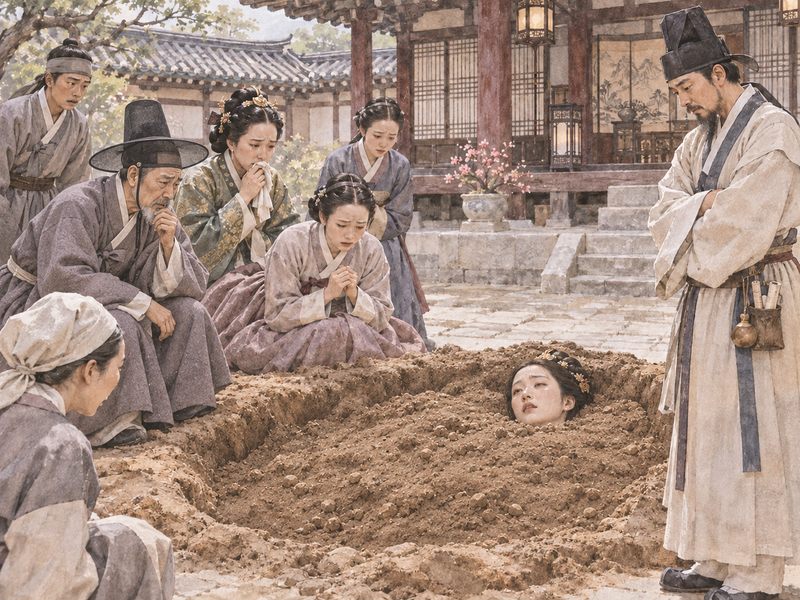
The servants rushed to carry the incense boxes and ornaments outside. But the fragrance that had seeped into the room over a long period did not fade easily. Ge Qiansun then gave another instruction. “Dig a pit in the courtyard, large enough for one person.” Startled, the master asked, “Why would you put my living daughter in a pit? Do you mean her illness is so advanced that there is no hope for her?”
The servants dug a pit in one corner of the courtyard. Once it was ready, they lifted the daughter and laid her inside. Bewildered, she continued to stare blankly, unable to move even a finger properly.
Ge Qiansun told the family to watch the woman closely and notify him immediately if she moved her hands or feet or made a sound. Then he waited without prescribing any particular medicine.
A good while passed. Then a faint groan suddenly came from the woman's mouth. At first, it was hard to tell whether it was a breath or a groan. Then her fingers began to twitch little by little. Her arms slowly lifted, and her legs began to move as well.
“Father!” the woman suddenly cried, raising both arms. The master jumped to his feet in astonishment. Only moments earlier, his daughter had been unable to move even a finger, but now she was lifting her arms and legs and even making a sound. The maid hurried to Ge Qiansun to report what had happened.
Only then did Ge Qiansun take a pill from his robe and tell them to give it to the woman. The master wondered what good a single pill could do, but since his daughter's arms and legs had already begun to move, he gave her the medicine without hesitation.
The astonishing turn came the next morning. The woman sat up by herself and climbed out of the pit. The family could not hide their joy as the daughter, who until the day before had been unable to move her limbs or even eat, emerged from the pit on her own. The master went to Ge Qiansun, bowed repeatedly, and expressed his gratitude. He then asked how Ge Qiansun had cured her with such an unusual method when so many physicians had failed.
Ge Qiansun explained, “Your daughter has always been excessively fond of fragrances. The scent eroded her spleen qi and caused these symptoms. I placed her in the pit to strengthen the qi of earth and revive her spleen qi.”
Only then did the master understand why Ge Qiansun had ordered the incense boxes and tassel ornaments removed from the outset. He had thought the cause of the illness lay solely within his daughter's body and had tried all kinds of medicines, never imagining that its cause might be in the very room where she spent every day.
Fragrance has been used as medicine since ancient times. Traditional Korean medicine has employed strong-smelling medicinal ingredients to promote the circulation of qi and dispel dampness and turbidity. But even a pleasant fragrance can be harmful in excess. Prolonged exposure to a strong scent, especially in an enclosed space, can cause symptoms such as headaches, dizziness, nausea, and respiratory irritation.
Artificial fragrances, widely used today, are no exception. Not all artificial fragrances are harmful, but depending on their ingredients and concentration, as well as the length of exposure, they can affect health. Fragrance, too, should be used in moderation.
Source for today's Herbal Anecdotes story
/ Han Dong-ha, director of Handong Han Clinic
[email protected] Jung Myeong-jin, Medical Correspondent Reporter