“Carbon neutrality and autonomous driving require regulatory consistency”... Korea Automobile Importers & Distributors Association (KAIDA) holds policy seminar
- Input
- 2026-11-09 15:14:57
- Updated
- 2026-11-09 15:14:57
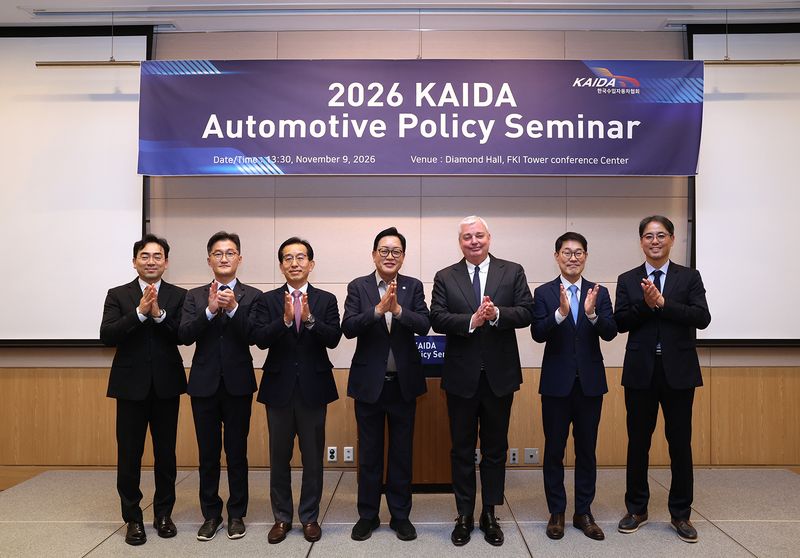
On the 9th, KAIDA said it had held the “2026 KAIDA Automotive Policy Seminar” at FKI Tower in Yeongdeungpo District, Seoul. The event brought together government and public-sector officials and industry representatives to discuss policy challenges facing the automotive industry amid the transition to carbon neutrality and advances in autonomous-driving technology.
KAIDA Chairman Till Scheer said, “I believe the association and its members have contributed to the expansion of supply chains for South Korean parts makers through their global procurement networks for imported cars, and have helped drive the adoption of electric vehicles and new technologies by investing in technology, infrastructure, talent and services.”
He added, “I hope the government’s regulations on environmental policy and autonomous driving will be managed in an integrated and systematic way,” and stressed, “The government and industry’s journey toward decarbonization and advanced mobility should not be delayed. We will continue open dialogue and practical cooperation among the National Assembly, the government, research institutions and industry.”
Min Kyung-deok, a professor at Seoul National University, said that various propulsion technologies need to be developed and adopted to meet the national greenhouse-gas reduction target (NDC). He also proposed establishing a vehicle life-cycle assessment (LCA) framework in stages. He explained that policy approaches should take into account the technological characteristics of each power source during the transition to carbon neutrality.
Park Jun-hong, head of the Mobility Environment Research Center at the National Institute of Environmental Research, said the institute plans to continue pursuing measures to reduce air pollutants and greenhouse gases throughout the entire life cycle of vehicles. He cited the transition to zero-emission vehicles, setting final permissible limits for tailpipe pollutants, and introducing regulations on brake and tire wear particles. He added that a greenhouse-gas LCA system based on international standards would be pursued as a long-term goal.
Min Kyung-chan, director of the Korea Automobile Testing & Research Institute at the Korea Transportation Safety Authority, recommended that countries pursuing autonomous-driving demonstration projects establish basic safeguards before gradually expanding the projects to include operation on public roads. Necessary elements, he said, include a legal basis and operating conditions for test runs and service demonstrations; advance definition of minimum safety requirements; designation of an accountable operator; data-management and emergency-response systems; and gradual expansion of operating areas and fleet sizes.
Pierre Millette, chief technology officer at ACEA, stressed that close cooperation is needed because South Korea is a major export market for European automobiles and a partner in battery, electronics and automotive technology. He recommended jointly addressing regulatory challenges related to new technologies, including autonomous driving, software updates and cybersecurity, and broadening mutual recognition of relevant UN regulations under the EU–South Korea FTA to promote the introduction of safe new technologies in both markets.
A KAIDA representative said, “We plan to continue sharing key issues and policy trends in the domestic and international automotive industries, communicating with the government and relevant organizations, and pursuing cooperative activities.”
[email protected] Kim Dong-chan Reporter