“Basic Act for Working People” and Worker Presumption System to curb employment... Small businesses fear mounting burdens
- Input
- 2026-11-09 16:43:55
- Updated
- 2026-11-09 16:43:55
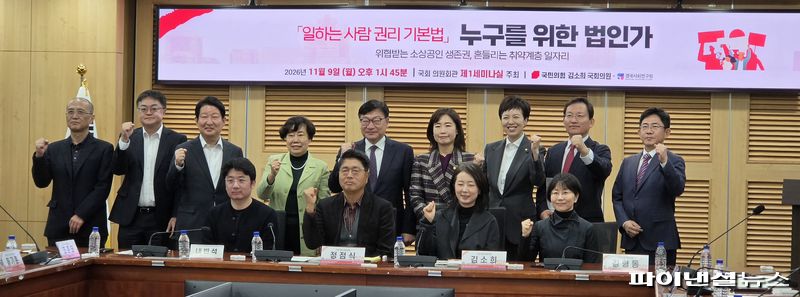
Rep. Kim Sohee of the People Power Party and the Economic and Social Research Institute held a forum titled “The Basic Act on the Rights of Working People: Who Is It For?” in Seminar Room 1 of the National Assembly Members’ Office Building in Yeouido, Seoul, on the afternoon of the 9th. The forum was organized to discuss the effects the introduction of the two systems could have on small businesses and jobs for vulnerable groups.
The Basic Act is a bill intended to guarantee fundamental rights for people in the blind spots of labor law, including freelancers, workers in special forms of employment and platform workers. Its key provisions include drawing up and providing written contracts, paying remuneration regularly and in full, prohibiting unilateral changes to or termination of contracts without reasonable grounds, and banning sexual harassment and bullying. The Worker Presumption System would presume service providers who meet certain criteria to be employees in disputes over their employee status, requiring business owners seeking to overturn that presumption to prove they are not employees.
Min Se-jin, a professor in the Department of Economics at Dongguk University who gave a presentation, said, “As an economist, my greatest concern is a decline in employment,” adding, “If the burden of disputes and documentation grows, business operators may reduce contracts and work assignments.” He voiced concern about broadly presuming even independently working freelancers to be employees, saying that disguised employment should be addressed by properly enforcing the current Labor Standards Act.
Professor Min also pointed to the gap between large companies and small businesses in their ability to respond, saying, “Costs are already incurred before a determination is made on employee status.” His point was that while large companies can maintain dedicated legal and labor-relations staff and record-keeping systems, small business owners have to respond to disputes themselves, increasing the burden of time and expense.
He went on to stress that “there are economically vulnerable parties on both sides of a contract,” saying the presumption system should be limited to a procedural mechanism for adjusting the burden of proof, with its eligibility requirements and scope clearly defined. He also proposed strengthening labor inspections targeting disguised employment, supporting the collection of evidence needed to establish employee status, and providing industry-specific standard contracts and guidance on settlements.
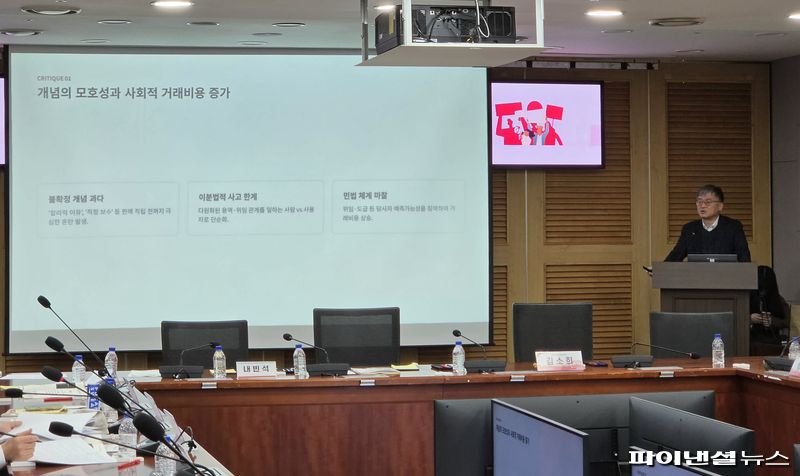
Professor Choi argued that blanket presumptions and shifting the burden of proof should be approached with caution, noting that courts have determined employee status by considering the specific circumstances of each case. He also voiced concern that shifting the burden of proof could conflict with the presumption of innocence if linked to criminal penalties.
As an alternative, he proposed addressing unfair trade practices by using the Act on the Fair Transactions in Subcontracting, the Fair Transactions in Franchise Business Act and the Monopoly Regulation and Fair Trade Act (MRFTA). Professor Choi stressed that a protective framework should take into account the characteristics of self-employed business owners and the variety of contractual relationships, saying, “We need to make active use of provisions on the abuse of superior bargaining position.”
Heo Gi-hun, head of the Labor Service Provider Support Division at the Ministry of Employment and Labor and a government representative at the forum, explained the inclusion of core rights from the Labor Standards Act in the Basic Act, saying, “When establishing a new labor order in the era of the platform economy, it is unavoidable that we absorb some of the DNA of core rights.” In response to concerns that the act could impose an obligation to pay severance, he drew a distinction, saying, “We have never applied the severance pay provisions to the Basic Act.” He also said that “reasonable grounds” for terminating a contract could be fleshed out through enforcement decrees and labor commission dispute mediation cases, and that while the right to receive “adequate remuneration” has been declared, there is no provision specifying it.
He also rejected the claim that the Worker Presumption System, combined with the Trade Union Act, would lead to demands for bargaining with principal contractors, saying, “Even using my imagination to the fullest, I can’t imagine how the dots connect. That’s an excessive worry.”
[email protected] Park Seong-hyeon Reporter