South Korean Companies Team Up with NVIDIA; Cooperation on AI Chips, Robotics and Autonomous Driving Picks Up Pace
- Input
- 2026-11-09 16:11:37
- Updated
- 2026-11-09 16:11:37
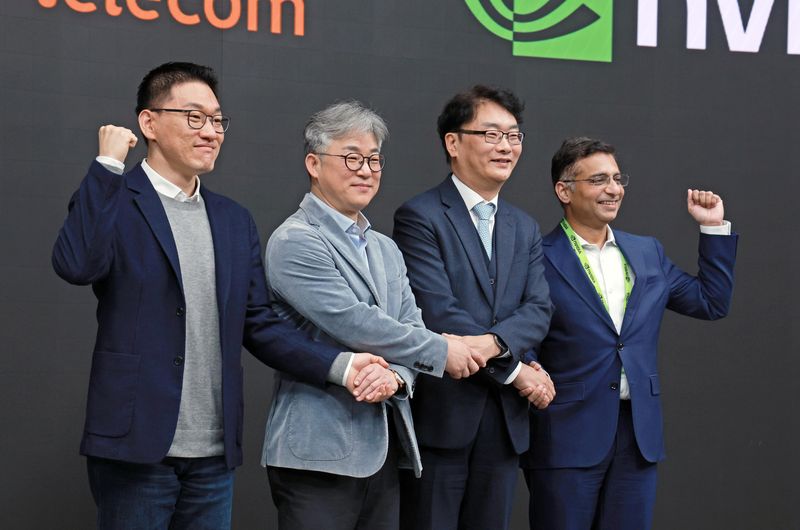
[Financial News] Homegrown artificial intelligence (AI) chips are set to enter NVIDIA’s global AI computing ecosystem in earnest, as SK Telecom and Rebellions embark on developing AI infrastructure that combines NVIDIA graphics processing units (GPUs) with homegrown neural processing units (NPUs). As cooperation between South Korean companies and NVIDIA expands beyond AI chips into robotics, autonomous driving, and AI models, global technology collaboration in South Korea’s AI industry is also gaining momentum.
According to the Ministry of Science and ICT on the 9th, NVIDIA, SK Telecom, and Rebellions signed an MOU that day to develop an integrated GPU-NPU system based on NVLink Fusion at NVIDIA AI Day Seoul 2026, held at COEX in Seoul.
Under the agreement, Rebellions’ next-generation NPU, Rebell R200, will be connected to NVIDIA’s platform, and an integrated system using MGX, the standard design specification for server racks, will be developed. The key is to use NVLink Fusion, NVIDIA’s high-speed interconnect technology, to enable different AI chips to operate in a single system.
In particular, the system will use “disaggregated inference,” which splits up the AI inference process. NVIDIA GPUs will handle the “prefill” stage, which analyzes users’ questions, while Rebellions’ NPUs will handle the “decode” stage, which generates responses. The aim is to increase AI processing speed and power efficiency.
SK Telecom is considering deploying the integrated system at AI data centers to verify its performance and reliability, and using it for applications including its proprietary AI model A.X K2 and its public AI service AI for Everyone. “It is the job of infrastructure providers to create an optimal environment in which globally optimized NVIDIA GPUs can be used alongside NPUs,” said SK Telecom CTO Chung Suk-geun.
The collaboration is significant as a step toward connecting homegrown AI chips with NVIDIA’s global technology ecosystem. Rebellions CEO Sung-hyun Park stressed that rather than localizing every technology, it is important to achieve self-reliance in core technologies and secure control over data and infrastructure. “It is important that today’s MOU lead not just to a declaration, but to tangible results in the form of entry into global markets,” said Lee Do-gyu, head of the Information and Communications Policy Office at the Ministry of Science and ICT.
The scope of cooperation is also expanding. Twenty-two South Korean startups, including Upstage, RLWRLD, Twelve Labs, and Furiosa AI, took part in the AI Startup Partnership Forum, jointly hosted by the Ministry of Science and ICT and NVIDIA. LG AI Research announced that it would make the application programming interface (API) for its improved K-EXAONE 2.5 available free of charge.
Cooperation is also continuing in the field of physical AI. LG Electronics is using NVIDIA’s robotics AI model GR00T and virtual-environment training technology to verify the operational stability of humanoid robots in washing machine production. Kakao Mobility signed an MOU with NVIDIA to advance Level 4 autonomous driving technology. The company plans to apply NVIDIA’s in-vehicle computing platform DRIVE AGX Thor, among other technologies, to its own autonomous driving AI model and pursue the commercialization of fully driverless autonomous driving.
[email protected] Yoon Hong-jip, Jang Min-kwon, and Park Ji-yeon Reporter