Daegu Mayor Choo Kyung-ho slams repeated service disruptions on Urban Railway Line 3
- Input
- 2026-11-09 14:54:13
- Updated
- 2026-11-09 14:54:13
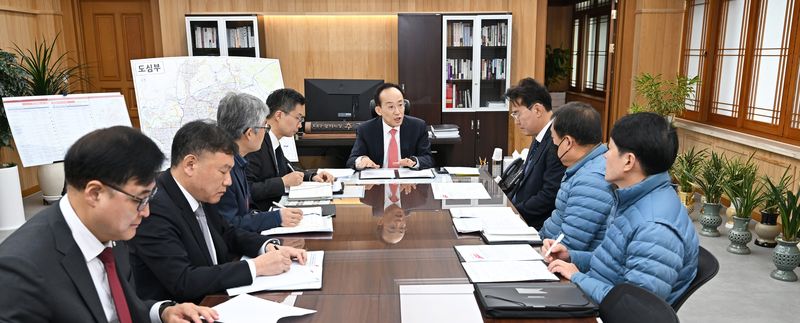
【Financial News, Daegu = Reporter Kim Jang-wook】“The safety of urban rail, a major means of transportation for citizens, is directly tied to their lives and cannot be compromised for any reason. I hope you will do your utmost until Line 3 once again becomes a mode of transport that citizens can trust and ride.”
Following a series of service disruptions on Urban Railway Line 3, Daegu Mayor Choo Kyung-ho strongly rebuked Daegu Transportation Corporation and relevant city departments at a meeting on measures related to the incidents on the 9th, and ordered intensive inspections across all areas of Line 3 and measures to prevent recurrence that would reassure citizens.
According to the city, a train malfunction (car-body grounding) on Urban Railway Line 3 around 2:20 p.m. on the 7th caused a 36-minute service suspension and delays.
Earlier, a ground fault (electrical leakage) in a lightning-protection wire cut power across the entire main line and halted service on September 7; trains were then delayed for 16 minutes because of a track-switching failure at Yongji Station during the morning commute on the 2nd.
In particular, a train service stoppage and delays occurred on the Jisan Station–Beommul Station section just after Daegu Transportation Corporation executives and the city’s Transportation Bureau had completed a special on-site safety inspection there over two days starting on the 5th.
At the meeting on measures related to the incident, Mayor Choo strongly rebuked them, saying, “The very fact that citizens have to ride trains while worried is unacceptable,” and, “Failing to uphold the most basic requirement of safe operations has directly betrayed citizens’ trust.”
On the recurrence of service disruptions immediately after the inspection, he said, “Perfunctory inspections, paper-based inspections and inspections staged for show can never prevent accidents,” and called for “a review of the entire existing inspection system, stronger work discipline among all employees, and firm action against any instances of laxity.”
In particular, he ordered the immediate implementation of five measures: identifying the causes across the organization; conducting intensive, comprehensive inspections of every aspect of Line 3; devising measures to prevent recurrence that citizens can see and feel; improving initial response and public information systems; and establishing a clear accountability framework.
Mayor Choo emphasized, “Everyone from the corporation’s president to frontline employees must work together across the organization to identify the root cause, and carefully reexamine all parts and equipment until it is determined,” adding, “Start the inspections over from scratch, verifying everything jointly with outside experts, and Daegu City should also closely monitor implementation.”
He added, “Measures must be developed with a focus on the field so that citizens can feel the difference,” and said, “It is just as important to inform citizens first and as accurately as possible when an accident occurs.”
Meanwhile, the Daegu-Gyeongbuk Green Alliance (hereafter, the Daegyeong Green Alliance) delivered a “Proposal to Strengthen Safety on Urban Railway Line 3” to Daegu City on the 8th. Along with six proposed areas for improvement, it called for a public-private joint consultative body involving the city, Daegu Transportation Corporation, experts and civil society.
The six proposals put forward by the Daegyeong Green Alliance are: identifying the causes of disruptions and disclosing the investigation findings; conducting detailed inspections of power and current-collection equipment and track switches; strengthening operational resilience, including by expanding intermediate turnback facilities; improving weather and emergency responses on elevated sections; improving public information and alternative transport systems; and clarifying responsibility and strengthening safety oversight.
It said technical options, including expanding intermediate turnback facilities and separating sections of the power system, should be considered to minimize cases where a disruption on one section leads to a suspension of service across the entire line. It also called for stronger passenger-rescue drills and evacuation drills for people with mobility challenges in case a train stops between stations.
[email protected] Kim Jang-wook Reporter