“Don’t pass the burden of education costs on to families”
- Input
- 2026-11-09 14:18:25
- Updated
- 2026-11-09 14:18:25
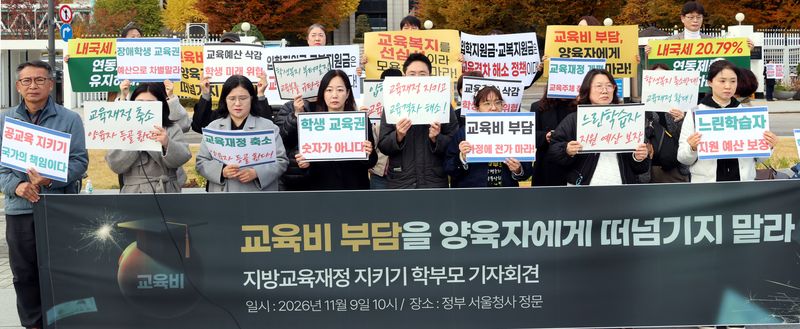
[Financial News] About 10 parent groups, including the National Parents’ Association for the Realization of Equal Education and the National Parents’ Association for True Education, held a press conference in front of the main gate of the Government Complex Seoul on the 9th, calling for the Ministry of Education to stop its push to strengthen cuts to education grants and for the withdrawal of an amendment to the Local Education Finance Grant Act.
The Local Education Finance Grant is a budget allocated to improve educational environments and fund educational activities at kindergartens, elementary, middle and high schools nationwide, using a fixed share of national taxes—in this case, a certain percentage of domestic taxes (currently 20.79%). The government’s proposed amendment to abolish the 20.79% linkage system would dismantle the statutory share of grants automatically allocated to education regardless of changes in tax revenue, and overhaul the way funds are distributed.
At the press conference, the parent groups announced five demands to the government and the National Assembly: halt the push to strengthen grant cuts that undermine student welfare; disclose whether student-support programs such as admission grants and school-uniform grants are subject to cuts, and the criteria for those cuts; guarantee student welfare and stop shifting education costs onto caregivers; maintain the 20.79% linkage to domestic tax revenue and withdraw the amendment to the Local Education Finance Grant Act; and ensure that education stakeholders, including students and caregivers, participate in decisions on education finance and student-welfare policies.
The groups argued that the government’s push to amend the Local Education Finance Grant Act would weaken public-education funding and increase the education-cost burden on families. According to a distributed press statement, applying the current law—the 20.79% linkage system—would bring grants to 109.8 trillion won in 2027. Under the government’s proposal to abolish the linkage system, only 78.9 trillion won would be allocated, leaving about 115 trillion won less than under the current system over the four years from 2027 to 2030, the groups said.
The groups went on to say that, under next year’s budget proposal drawn up in line with the government’s plan, 16 provincial and metropolitan education offices nationwide had been unable to budget a total of 7.3657 trillion won. They also pointed to cases in which personnel costs for school staff were not adequately covered and staffing fell short of statutory levels by 17,586 non-subject teachers and 4,663 special-education teachers. The groups further argued that the central government was placing a double burden on local education finances by seeking to reduce its share of funding for free high school education from 47.5% (943.9 billion won) in 2024 to 30% (578.5 billion won) in 2026 and, under the government’s 2027 proposal, to 15% (304.4 billion won).
Concerns were also raised that cuts to public-education funding would increase the burden of private education costs. The groups cited the fact that, in 2024, average monthly private-education spending per student receiving private education reached a record high of 604,000 won (among participating students), and argued that when public-education support is reduced, private academy fees fill the gap and add to families’ burden.
In remarks distributed at the rally, Jeon Eun-young, co-chair of the National Parents’ Network for Innovative Education, said of admission-preparation grants and school-uniform support, “They are policies designed to reduce educational disparities, so that every child can prepare for a new school life regardless of family circumstances and walk through the school gate with confidence, not intimidation, from the very first day.” She added, “Student guardians are outraged at the Ministry of Education, the government and the National Assembly for distorting this purpose by calling it ‘populist’ and ‘cash-based.’”
In remarks, Kim Seon-nam, co-chair of the Parents’ Emergency Coalition for Protecting Education Finance, also called for action, saying, “A decline in the number of students does not mean that the budget needed for education should also be reduced.” Kim urged the government to “ensure funding for special schools and special classes, support staff and care, and student mental-health support.”
[email protected] Kim Man-gi Reporter