“The Mainland’s Big Spender Is Back” ... K-Food Exports to China Ride a Second Straight Year of Growth Despite Hallyu Restrictions
- Input
- 2026-11-11 08:28:37
- Updated
- 2026-11-11 08:28:37
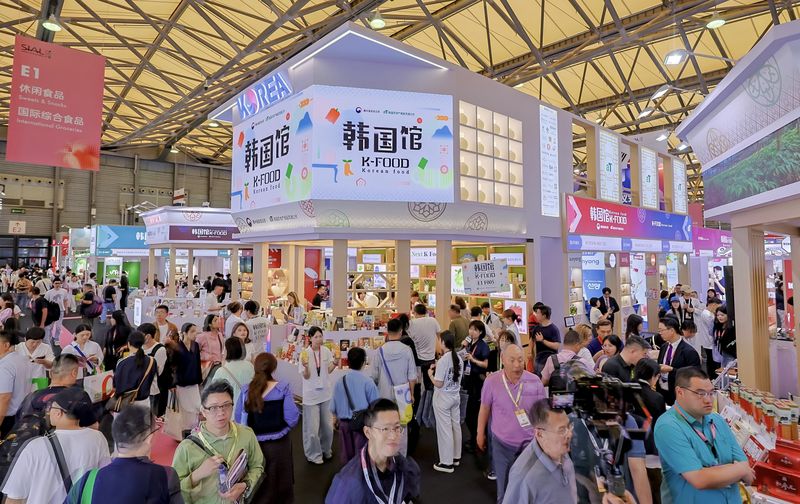
[Financial News] K-food exports to China, which had been losing ground amid restrictions on Hallyu and the spread of patriotic consumption in China, have rebounded for the second consecutive year after last year. The rebound is attributed to growing expectations that the Hallyu restrictions would be lifted after last November’s Asia-Pacific Economic Cooperation (APEC) Summit, as well as to domestic food companies’ successful market entry after revamping their local distribution strategies.
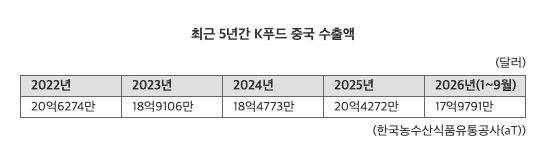
On the 11th, according to the Korea Agro-Fisheries & Food Trade Corporation (aT)’s Korea Agro-Food Export Information (KATI), cumulative K-food exports to China from January to September this year totaled $1,797,910,000, up $181,260,000 (11.2%) from $1,616,650,000 in the same period a year earlier.
K-food exports to China had been on a steady downward trend since controversy over the 2016 deployment of Terminal High Altitude Area Defense (THAAD), except during the COVID-19 years of 2020 and 2021. Annual exports fell from $2.06274 billion in 2022 to $1.89106 billion in 2023 and $1.84773 billion in 2024. As prolonged Hallyu restrictions and the effects of patriotic consumption in China caused sales volumes to plunge, many companies scaled back or withdrew from their local businesses.
But exports to China rebounded last year to $2.04272 billion, up $194.99 million (10.5%) from the previous year, returning to growth for the first time in three years. They continued to post double-digit growth through the third quarter of this year, settling into a growth trend for a second consecutive year.
A key driver of the export rebound was domestic food companies’ restructuring of their local distribution networks. They moved away from a high-cost model centered on directly operated outlets and large supermarkets, and their strategy of partnering with influential local distributors to reduce labor and sales-management costs while expanding market access paid off.
In 2024, Nongshim signed an exclusive distribution agreement with Yubei, a major local distributor with a network of at least 400,000 offline outlets—including supermarkets and convenience stores—across China, and is steadily expanding its distribution network into smaller cities. Orion Corporation has also reduced the share of direct sales and established an indirect sales model using regional wholesalers, a feature of China’s distribution system. Given the country’s vast size and complex distribution structure, working through these wholesalers can ease cost burdens and maximize sales efficiency.
A strategy of targeting warehouse-style discount stores to keep pace with changing consumption trends among China’s middle class has also paid off. Demand for Sam’s Club, a warehouse-style retailer like Costco, has surged in China recently. Pulmuone is moving quickly to develop new sales channels, becoming the first Korean food company to place frozen gimbap in Sam’s Club and driving strong sales. Also contributing positively was the recovery in local consumers’ favorability toward Korean food as relations between South Korea and China began to thaw after last year’s APEC Summit.
As exports and local sales have recovered simultaneously, the performance of major food companies’ Chinese subsidiaries has also improved. Orion Corporation’s China subsidiary posted first-half sales of 787.7 billion won this year, up 24.4% from the same period a year earlier. Over the same period, Nongshim’s China subsidiary recorded sales of 229.1 billion won and operating profit of 11.6 billion won, up 22.6% and 45.0%, respectively, from the first half of last year.
Samyang Foods Co., Ltd.’s China subsidiary, which is riding the Buldak Ramen craze, recorded sales of 208.9 billion won in the third quarter of this year, up 13.2% year on year. Lotte Wellfood Co., Ltd., which was hit by an intensive boycott during the THAAD crisis, has also recently stepped up efforts to rebuild its local client base and exports to China by hiring new overseas sales staff, particularly people with Chinese-language skills.
A food industry official said, “With the improving atmosphere in South Korea-China relations, we expect K-food sales to jump significantly during China’s biggest shopping season, including the upcoming Singles’ Day,” and predicted, “As major companies are reorganizing their local distribution networks, building new production facilities and expanding customs clearance, the recovery in exports to China is likely to continue for some time.”
[email protected] Park Kyung-ho Reporter