Samsung Heavy Industries to Co-Develop SOFCs with Japan’s Morimura, Targeting Ships and Data Centers
- Input
- 2026-11-09 14:45:15
- Updated
- 2026-11-09 14:45:15
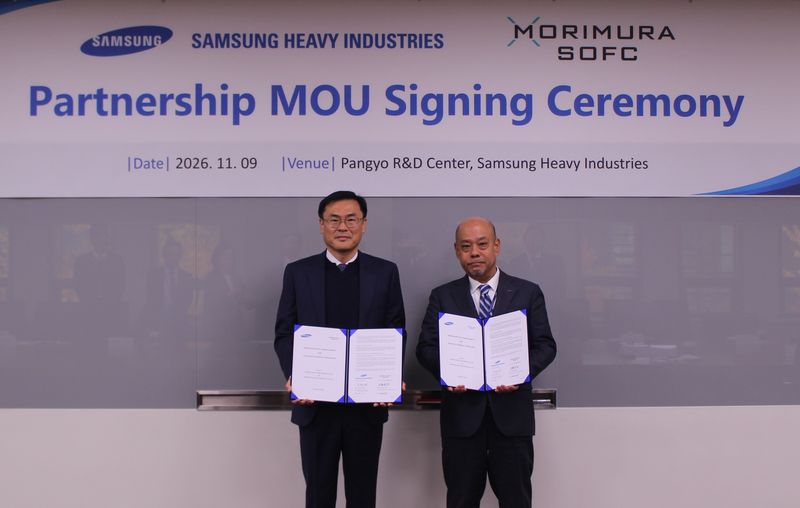
[Financial News] Samsung Heavy Industries is joining forces with a Japanese fuel cell specialist to develop solid oxide fuel cells (SOFCs) for use in ships and data centers. The strategy is to respond to tightening regulations on carbon emissions from ships while expanding into power solutions for new businesses such as floating data centers.
Samsung Heavy Industries said on the 9th that it had signed a memorandum of understanding (MOU) with Japan’s Morimura SOFC Technology for the development and commercialization of SOFCs at its Pangyo R&D Center in Seongnam, Gyeonggi Province. The signing ceremony was attended by Kim Kyung-hee, vice president and head of Samsung Heavy Industries’ Future Business Division, and Yoshikuni Sato, representative director and president of Morimura, among others.
The two companies plan to jointly research and develop SOFCs for ships and data centers by 2028. Samsung Heavy Industries will handle the engineering, system integration and commercialization of large-capacity SOFC products, while Morimura will supply cells and stacks, the key components of SOFCs.
An SOFC is a power-generation device that uses a solid electrolyte made of ceramic to produce electricity through the chemical reaction of fuels such as hydrogen or liquefied natural gas (LNG) with oxygen. It consists of a stack made by layering cells—the smallest units that generate electricity—along with fuel supply equipment and thermal management systems. Its advantages include higher power-generation efficiency than conventional engine-based power-generation facilities and the ability to reduce carbon emissions. Since it can also use existing fuels such as LNG, the burden of building a new fuel supply network is relatively low, giving it strong potential for use as a power source for ships.
Samsung Heavy Industries plans to install SOFCs on commercial vessels it builds in the future to meet carbon-emission regulations, and to use them in next-generation technologies for unmanned, autonomous and electric ships. The company expects that using SOFCs as a ship’s power source will enable remote diagnostics and maintenance from shore, helping automate maintenance. It is also considering SOFCs for floating data centers, for which it is seeking orders as a new product. Since securing a stable, large-scale power supply is essential for data centers, the company aims to extend the large-capacity power-generation systems developed for ships to serve as power sources for offshore data centers.
“Drawing on Samsung Heavy Industries’ network in the shipbuilding and marine sectors and Morimura’s technical expertise, we will work closely together to open up new markets,” said Kim Kyung-hee, vice president and head of Samsung Heavy Industries’ Future Business Division.
[email protected] Jung Won-il Reporter