AI Data Center Power Market: UC Gains Ground After Bus Ducts... LS Affiliates Ramp Up UC Business
- Input
- 2026-11-17 07:29:00
- Updated
- 2026-11-17 07:29:01
[Financial News] Ultracapacitors (UCs) are emerging as a new growth area in the power infrastructure market for artificial intelligence (AI) data centers. The business is expanding beyond bus ducts, which supply large amounts of power to data centers, to include UCs, which improve the stability of the power supply. As Korean power infrastructure companies move to gain an early foothold in the new market, LS Group is stepping up its UC business through a large-scale supply contract by LS Materials and LS Eco Energy’s investment in production facilities in Vietnam.■ Global UC Market to At Least Double in Four YearsAccording to industry sources on the 17th, surging power demand from AI data centers is drawing greater interest in hydrogen fuel cell-based distributed generation facilities and power stabilization devices. AI data centers need a stable supply of large amounts of electricity, but connecting them to the power grid often takes a long time, making on-site distributed power generation an emerging alternative.
UCs are energy storage devices that rapidly store and release electricity to compensate for instantaneous power fluctuations in hydrogen fuel cell power generation systems. According to market research firm Grand View Research, Inc., the global UC market is expected to grow from about $5 billion this year to $11.6 billion by 2030. This forecast covers the entire market, including the automotive, industrial and energy sectors, with AI data centers considered one of its emerging sources of demand.
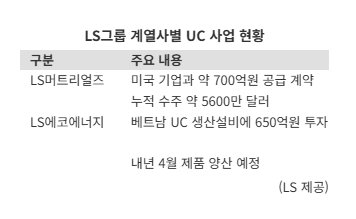
As new demand for UCs takes shape around AI data centers, Korean companies are also stepping up their efforts to enter the market. On the 13th of last month, LS Materials signed a contract with a U.S. hydrogen fuel cell company to supply UCs for AI data centers, worth about $51.5 million (about 70 billion won). Including an initial contract worth about $4.7 million (about 6.3 billion won), signed in July, cumulative orders amount to about $56 million. Revenue from the UC business is expected to begin this year, with deliveries under large-scale contracts set to ramp up next year. Given that LS Materials’ standalone revenue last year was about 29 billion won, the new contract is equivalent to about 2.4 times its annual revenue.■ LS Group Steps Up Efforts to Build a Production Base in VietnamLS Materials is also working with its affiliate LS Eco Energy to cut production costs. Under the arrangement, LS Materials will provide UC technology and its customer base, while LS Eco Energy will manufacture the products under an original equipment manufacturing (OEM) arrangement in Vietnam. The strategy is to improve cost competitiveness and expand global supply by leveraging Vietnam’s relatively low labor and utility costs.
On the 26th of last month, LS Eco Energy announced that it would invest about 65 billion won in LSCV, its production subsidiary in Vietnam, to build UC production facilities. It aims to begin mass production next April and reach annual revenue of 150 billion won by 2030. Its existing businesses are also growing. In the first nine months of this year, revenue totaled 987.3 billion won and operating profit reached 67.5 billion won, surpassing the full-year results for last year. Growth was driven by power cable exports and increased supplies of bus ducts for AI data centers in Southeast Asia.
LS Group’s AI data center business is also expanding beyond power supply centered on conventional power cables and bus ducts into power stabilization using UCs. An industry official said, “As power demand from AI data centers surges, the importance of power stabilization technologies is growing alongside the need to supply large amounts of power. We expect the UC market to grow as the deployment of distributed generation facilities expands.”
[email protected] Lim Su-bin Reporter