Retail investors and institutions pour 17 trillion won into a “bottomless pit”... Are they sinking into a quagmire of principal losses?
- Input
- 2026-11-09 16:29:57
- Updated
- 2026-11-09 16:29:57
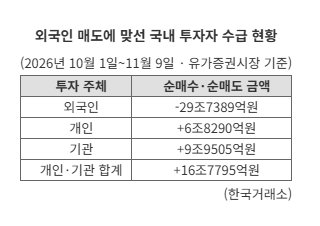
[Financial News] While foreign investors sold nearly 30 trillion won worth of shares in the domestic stock market, individuals and institutions poured in about 17 trillion won to absorb the shares put up for sale. Domestic investors mounted what was effectively an all-out defense against the massive foreign selling, but the market has struggled to rebound.
According to the Korea Exchange (KRX) on the 9th, foreign investors net-sold 29.7389 trillion won on the KOSPI market from October 1 through that day. Over the same period, individual investors and institutions were net buyers of 6.8290 trillion won and 9.9505 trillion won, respectively. The two groups invested a total of 16.7795 trillion won to absorb shares sold by foreign investors.
However, heavy buying by domestic investors failed to stop the index from falling. The KOSPI dropped from 6,971.35 in early October to 5,031.48 that day, plunging 27.83% in just over a month.
Individuals and institutions absorbed a substantial portion of the shares sold by foreign investors, but that was not enough to offset the downward pressure on the market. For domestic investors who bought shares believing prices had hit bottom, their investment has been exposed to the risk of further losses rather than generating returns.
Some analysts say the scale of foreign selling should not be taken at face value. In fact, despite the recent heavy selling, the foreign ownership stake remains around 39% and has not fallen to the roughly 36% level seen at the start of the year. In other words, foreign investors still have room to sell more.
An official at a securities firm explained, “The value of foreign selling has been somewhat inflated by the sharply rising share prices of leading stocks. Overall, foreign investors still hold more KOSPI shares than they did at the start of the year.”
The shares absorbed by domestic investors could also weigh on a future market rebound. The roughly 17 trillion won that individuals and institutions have net-bought over the past month or so could form an overhang of shares for sale.
Analysts say foreign selling needs to ease and investor sentiment recover before the domestic stock market can enter a sustained rebound. Individuals and institutions absorbing foreign selling alone is unlikely to reverse the index’s trend; supply and demand can return to balance only if foreign investors resume buying or at least reduce their net selling.
The official said, “For foreign investors to return to the domestic stock market, investor sentiment ultimately needs to improve. Since the market’s gains have been driven mainly by AI semiconductors, the domestic market is bound to be affected if U.S. big tech companies and hyperscalers falter.”
[email protected] Kang Jung-mo Reporter