“Where Should We Put the 4 Billion Won from Selling the House?” A Couple in Their 50s’ First Guide to Managing Financial Assets [A PB’s Money Recipe]
- Input
- 2026-11-10 05:00:00
- Updated
- 2026-11-10 05:00:00

[Financial News]#. Recently, A, an office worker in their 50s, sold one of the two apartments they jointly owned with their spouse. They did so in light of the higher capital gains taxes and property holding taxes faced by owners of multiple homes, as well as the costs of sending their two sons abroad to study. The sale put 4 billion won in cash in their hands. Although they now had a substantial amount of cash, they felt at a loss because this was their first time managing financial assets in earnest. They sought advice from people around them and looked into various financial products, but only became more unsure about which ones suited their circumstances.Experts advise that people managing financial assets for the first time, like A, should distinguish between money they will need to use and money they can invest for the long term before signing up for financial products, and plan how to allocate taxes, living expenses and investment assets across different time horizons.
Set aside money for taxes and distinguish it from funds available to invest
According to the financial sector on the 9th, more affluent people are selling real estate and managing their wealth through financial assets in light of higher capital gains taxes for owners of multiple homes and the burden of property holding taxes.
Experts advise these investors to first check their real estate-related tax obligations before looking into investment products. In particular, they should keep in mind that real estate-related policies may change.
Kim Yang-hee, a PB team leader at Shinhan PWM Jamsil Center who advised A and their spouse on managing their funds, urged them to set aside the money for taxes: “Since the taxes they have to pay and the payment schedule are fixed, those funds should be kept separate from investment funds and placed in short-term deposit products. Given the possibility of policy changes, it is also important to set aside separate funds for expected tax payments over the next 2–3 years, including property tax and comprehensive real estate tax on the homes they currently own.” The advice is to exercise caution, as the payment plan could be thrown off if they take on too much risk in an effort to boost returns on money needed for taxes and end up locking in losses during a market downturn.
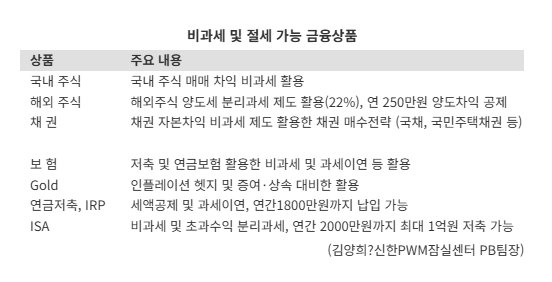
The next step is to divide the funds available for investment according to the length of time they can be invested. For medium- and long-term investments, it is advisable to use tax-advantaged accounts and products. As financial assets grow, financial income such as deposit interest and dividends may also increase. Even salaried workers may be subject to comprehensive taxation on financial income if their annual interest and dividend income exceeds 20 million won. They should also consider that their income mix could affect their health insurance premiums. Experts advise looking beyond products with high interest rates to consider after-tax returns and when taxes will be due. One option is to compare interest rates on long-term products with bond yields and use products that offer tax advantages.
A and their spouse set a basic investment plan allocating 30% to medium-term funds and 50% to long-term funds. Since both have at least five years until retirement, they decided to allocate at least 50% to long-term products and also consider products that allow early withdrawals if needed. The remaining 20% would be used to maintain short-term liquidity for tax payments, living expenses and other needs.
Diversify into dollar assets to hedge against a decline in the value of the won
Finally, it may be worth considering a strategy of diversifying into dollar assets to reduce risks concentrated in won-denominated assets. A and their spouse have two sons studying abroad, so they expect to incur ongoing expenses in foreign currencies over the next several years. They were therefore also concerned about a decline in the value of the won.
In this situation, it is more practical to diversify and hold part of one’s assets in dollars or other foreign currencies than to try to predict the direction of exchange rates. Overseas bonds, global equity assets and foreign-currency deposits each differ in price volatility, exchange-rate risk, fees and investment period, so they should be selected according to the purpose of the funds and the investment time horizon.
Specifically, A and their spouse chose to exchange set amounts in installments if the won-dollar exchange rate falls to 1,350 won or lower, and to invest some of their funds regularly in a dollar-denominated exchange-traded fund (ETF) that tracks the U.S. Standard & Poor’s (S&P) 500 Index. For example, if they plan to invest 100 million won in dollar assets, they would divide the purchases into 10 installments.
This choice is not simply aimed at earning foreign-exchange gains; it reflects a desire to gain experience investing in overseas stock markets and diversify an asset portfolio centered on the won. However, U.S. equity ETFs can incur losses when the stock market falls, so foreign-currency funds for expenses with a set payment date, such as overseas tuition, should be managed separately.
“I recommend starting to manage financial assets by creating ‘labels’ for funds to be used, specifying their purpose and time horizon,” Kim said. “By reviewing opportunities to save on taxes based on the couple’s annual income structure and diversifying won and foreign-currency assets according to their goals, they can turn vague worries into an actionable plan.”
Advice: Kim Yang-hee, PB team leader at Shinhan PWM Jamsil Center
[email protected] Seo Ji-yoon Reporter