“What if the glasses flagged as smart turn out not to be...?” An invigilator’s dilemma ahead of the CSAT
- Input
- 2026-11-11 10:30:59
- Updated
- 2026-11-11 10:30:59
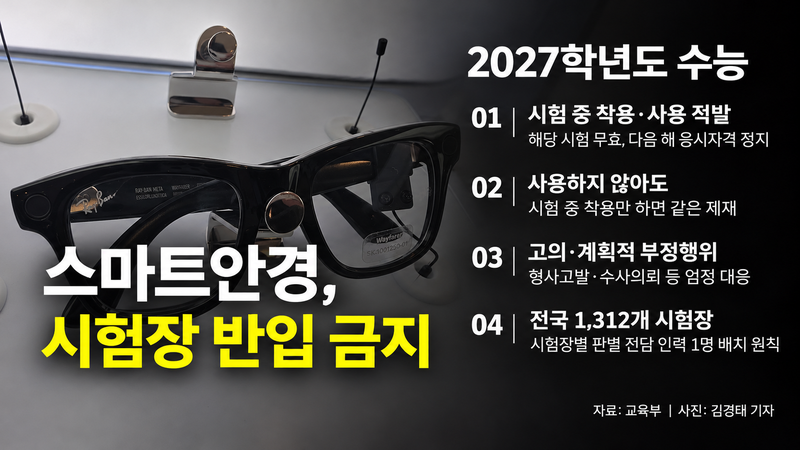
[Financial News] With the College Scholastic Ability Test (CSAT) just a week away, the Ministry of Education has strengthened penalties for using smart glasses at test sites and briefed CSAT invigilators on relevant procedures, but the measures’ effectiveness is being questioned. Critics say the measures have limitations: in situations with a high risk of disputes, it is difficult to catch violations within the limited time, and responsibility is being shifted onto frontline invigilators.
Invigilators must identify smart glasses themselves
According to reporting by Financial News on the 11th, smart glasses look just like ordinary glasses but are advanced devices equipped with tiny cameras and artificial intelligence (AI). Depending on the model, they can exchange information with external devices, solve questions on the wearer’s behalf and provide answers, creating the potential for them to be used for cheating.
In fact, two cases of cheating involving smart glasses were detected at an essay examination at the University of Seoul on the 3rd. A week later, a test-taker wearing smart glasses was caught during an essay examination at Yonsei University.
Accordingly, on the 29th of last month, the Ministry of Education decided that anyone caught wearing or using smart glasses during an exam would have that exam invalidated and be barred from taking the CSAT the following year. The same penalties apply even if the glasses are only worn and not actually used. The ministry will take strong measures, including filing criminal complaints, in cases of deliberate and planned cheating using smart glasses. One dedicated screening staff member will be assigned to each of the 1,312 test sites nationwide.
Professor Ryu Dong-gyu of the Department of Optometry at Shinsung University called the assignment of dedicated staff “meaningful progress,” but said “a major limitation is that screening only begins when an invigilator first becomes suspicious.” Ryu noted that some of the latest models are difficult even for experts to identify by sight alone from the distance between an invigilator and a student, meaning that whether they are detected ultimately depends on each invigilator’s eye for detail.
According to materials posted on the Ministry of Education’s website, the system for identifying smart glasses works as follows: if an invigilator checks and flags suspected glasses, dedicated staff assigned to each test site make the final determination. However, a teacher identified only as Lee, 31, who is due to serve as an invigilator at a CSAT test site in South Gyeongsang Province this year, said, “I haven’t received any separate guidance yet on working with the dedicated staff.” Lee said the ministry’s instructions “shift all responsibility for identification onto staff on the ground.”
Teachers say that even checking suspected glasses after an exam in a particular subject could lead to complaints. The Ministry of Education instructs invigilators to inspect glasses suspected of being smart glasses only after the exam period has ended and the question papers and answer sheets have been collected. But the teacher said, “It seems like it would be difficult to check them after the period ends because of time constraints and other issues,” adding, “In practice, people are suggesting that the student be called in separately after the CSAT is over.” The concern is that if the glasses turn out not to be smart glasses, the invigilator could be held responsible for compensating the student for damages.
A, a teacher in their 30s working in Gangwon Province, also worried about possibly becoming embroiled in a dispute. A said, “While the glasses are being checked to see if they’re smart glasses, only the glasses are taken away and the student spends the break as usual. Another teacher said someone should accompany the student,” adding, “But since they might not be smart glasses, I wouldn’t accompany the student.”
Both teachers had learned how to respond to cheating through school training or official notices, but had not yet received guidance on how to identify AI glasses by examining the actual devices or photos. Critics say that training should be provided using actual products used for cheating or detailed reference materials, so exam invigilators can identify smart glasses at the test site.
Proposal for a “standardized identification checklist” to set out screening procedures
B, an employee in their 20s who sells smart glasses in Seocho, Seoul, said, “The smart glasses used in cheating cases reported in the news seem to include a range of products, such as Chinese-made ones, rather than popular products like those from Meta.” B added, “Invigilators on the ground need to be shown the various products actually used for cheating.”
Professor Ryu also said, “The most important thing is hands-on training,” explaining that “there’s a big difference in identification ability between looking at something on a screen and holding it in your hands and trying it out.” Ryu stressed that setting out items everyone can check in the same order would prevent judgments from varying between people, and proposed standardizing a “standardized identification checklist.”
The Ministry of Education plans to strengthen protective measures against complaints and legal disputes, including extending liability insurance to all invigilators and expanding the coverage and claim period. It is also considering supplying test sites with radio-wave detectors starting with the 2028 CSAT.
[email protected] Lee Dong-hyeok Reporter