Gangwon State’s Budget for Next Year Set at 9.0753 Trillion Won, Marking First Main Budget Above 9 Trillion
- Input
- 2026-11-09 13:20:28
- Updated
- 2026-11-09 13:20:28
【Financial News Chuncheon = Kim Gi-seop, reporter】 Gangwon State’s annual budget has exceeded 9 trillion won for the first time on a main-budget basis.
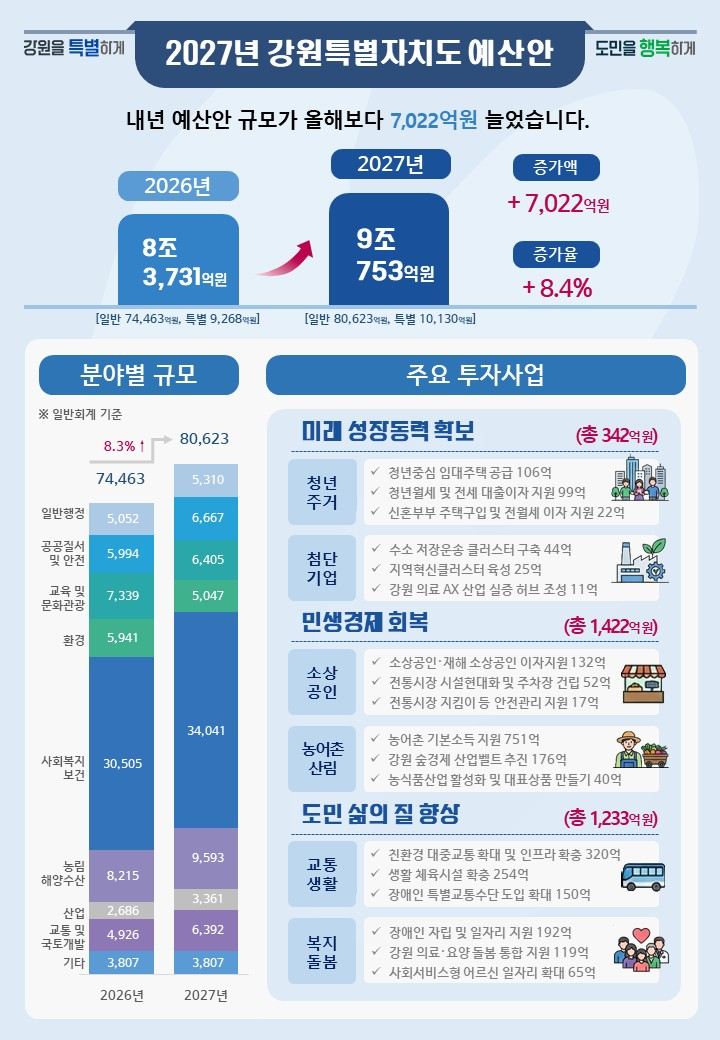
According to Gangwon State on the 9th, next year’s budget proposal totals 9.0753 trillion won, up 702.2 billion won (8.4%) from this year’s original budget of 8.3731 trillion won. The general account amounts to 8.0623 trillion won, and the special accounts to 1.013 trillion won. The proposal will be submitted to the provincial council on the 11th, reviewed by its standing committees and the Special Committee on Budget and Accounts, and finalized at a plenary session on December 11.
The most notable area is support for young people settling in the province. Gangwon State has allocated 24.2 billion won to youth housing and improvements to living conditions. It will spend 10.6 billion won on the supply of youth-focused rental housing, 9.9 billion won on interest support for young people’s monthly rent and jeonse loans, and 2.2 billion won on interest support for newlyweds’ home-purchase and jeonse or monthly-rent loans. Another 10 billion won will go toward building an advanced-industry ecosystem, including the development of a hydrogen storage and transport cluster (4.4 billion won).
A total of 142.2 billion won will go toward revitalizing the local economy. More than half of that amount, 75.1 billion won, is earmarked for basic income support in rural and fishing communities. The budget includes 12.4 billion won in interest support for business-stabilization loans for small-business owners struggling with high interest rates, as well as 5.2 billion won for modernizing traditional-market facilities and building parking lots. Another 10.6 billion won will be invested in developing tourism resources across the region, including creating provincial gardens and upgrading fisheries markets along the East Sea coast.
A total of 123.3 billion won has been allocated to improving residents’ quality of life. The province will spend 32 billion won on expanding eco-friendly public transportation, 25.4 billion won on upgrading community sports facilities, and 15 billion won on introducing dedicated transportation services for people with disabilities. The budget also includes funding for care, such as 11.9 billion won to establish an integrated support system for medical care, long-term care and caregiving, and 1 billion won to cover meal and snack costs for infants at daycare centers.
Fiscal conditions were challenging. Local tax revenue fell, and the transfer of excess domestic tax revenue to the government’s Future Response Fund also limited the increase in ordinary local allocation tax. By securing a record 11 trillion won in central government funding and increasing non-tax revenue, Gangwon State expanded its general account by 616 billion won (8.3%) while keeping routine expenditures to a minimum.
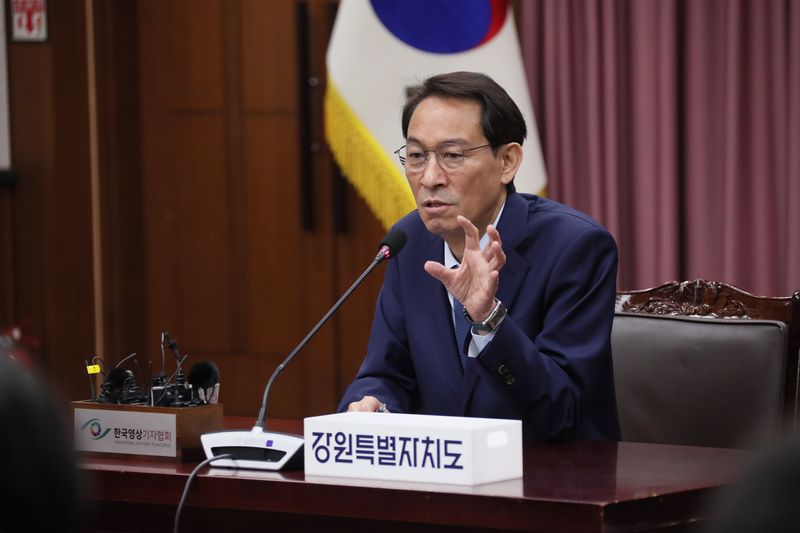
At the press briefing that day, Governor Woo Sang-ho acknowledged that rigid expenditures such as personnel costs account for 70–80% of the budget, while ongoing projects carried over from the previous provincial administration and projects requiring central-government matching funds alone total 800 billion won. As a result, new budget allocations related to campaign pledges amounted to only around 22 billion won.
By sector, social welfare and health accounted for 3.4041 trillion won, or 42.2% of the general account. Agriculture, forestry, oceans and fisheries—which includes expanded payments to farmers and fishers and public-benefit direct payments—followed at 959.3 billion won (11.9%), along with public order and safety, which includes improvements to disaster-prone areas and expanded firefighting infrastructure, at 666.7 billion won (8.3%).
“Our budget is tight, with local tax revenue falling and even allocation grants frozen, but we first directed funds to programs residents can feel directly, such as youth housing, support for small businesses and basic income for rural and fishing communities,” Governor Woo said. “I will complete preparations in advance so the budget can be put to work on the ground as soon as the provincial council finishes its review and approval.”
[email protected] Kim Gi-seop Reporter