Four cases of cheating with AI glasses uncovered... stricter advance submission before exams starting with final exams
- Input
- 2026-11-09 12:00:00
- Updated
- 2026-11-09 12:00:00
The survey was conducted at all middle and high schools nationwide from October 27 to November 3. A total of 5,679 schools were surveyed, including 3,292 middle schools and 2,387 high schools. It covered all internal assessments, including midterm and final exams and performance assessments, at specialized-purpose high schools, specialized vocational high schools and special schools as well.
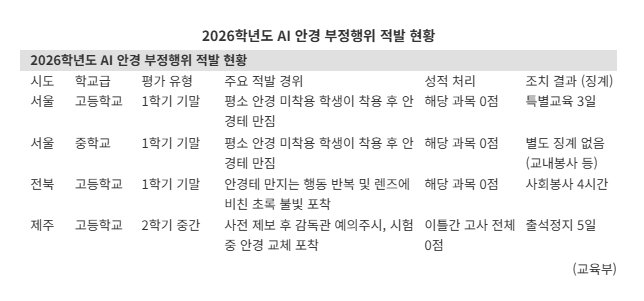
A total of four cases of cheating were uncovered: one at a middle school and three at high schools. All three high schools were general high schools. By timing, three cases occurred during first-semester final exams in the 2026 academic year and one during second-semester midterms. In addition to the two cases in Seoul previously reported by the media, one additional case each was confirmed in Jeonbuk and Jeju.
In all four cases, proctors’ observations and detection of suspicious circumstances proved decisive. In three cases—involving a Seoul high school, a Seoul middle school and a Jeonbuk high school—clues included students wearing glasses they did not usually wear or repeatedly fiddling with their frames. At the Jeonbuk high school, a green light reflected in the glasses was also spotted. At the Jeju high school, a teacher who received a tip from another student that someone “seemed to be wearing smart glasses” saw the student switch glasses during the exam.
Even when teachers noticed signs of cheating, they collected the glasses for inspection immediately after the exam ended. Under the current manual, they check them after the exam because intervening during the test could prompt complaints about disrupting the exam if the glasses turned out to be ordinary. Kim Han-seung, head of the Ministry of Education’s Curriculum Operations Support Division, explained, “Given the nature of internal assessments, teachers and students know each other well, so teachers are aware of whether students usually wear glasses and the like. We believe this made cheating relatively easier to detect than in national exams.”
Under the academic performance management regulations, students caught cheating received a score of zero only in the subject in which the cheating was confirmed. In the Jeju case, the student admitted to wearing the glasses during exams on both the first and second days, and received a zero on each of those exams. Disciplinary measures included three days of special education at the Seoul high school, four hours of community service at the Jeonbuk high school and a five-day suspension from attendance at the Jeju high school. The Seoul middle school conducted additional educational activities, including in-school service. Kim said, “Disciplinary measures are decided under school regulations after comprehensively considering the type of cheating and whether it was intentional.”
The Ministry of Education will distribute educational materials and guidance for students in the third week of November. It also plans to prepare a manual requiring students to declare whether they have smart glasses and submit them on the morning of exam day, and to apply it starting with second-semester final exams. The Student Assessment Joint Management Committee, with participation from the Ministry of Education, metropolitan and provincial education offices, and the Korea Institute for Curriculum and Evaluation (KICE), will also meet online on the 12th and in person in the first week of December to discuss countermeasures.
[email protected] Kim Man-gi Reporter