Busan City drafts 2027 budget of 19.3513 trillion won, focusing on maritime capital and AI transition
- Input
- 2026-11-09 14:09:46
- Updated
- 2026-11-09 14:09:46
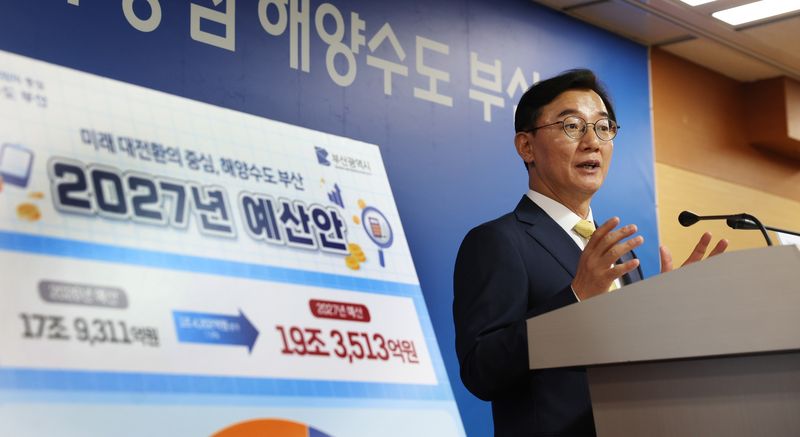
[Financial News] Busan City has drafted a 2027 budget proposal totaling 19.3513 trillion won, focusing on becoming a maritime capital, fostering the artificial intelligence (AI) industry, revitalizing the economy and strengthening residents’ welfare. The budget is up 1.4202 trillion won (7.9%) from this year. The city plans to focus fiscal investment on securing future growth engines and stabilizing residents’ lives.
The city said on the 9th that it had drawn up its 2027 budget proposal and would submit it to the Busan Metropolitan Council on the 11th.
The proposal prioritizes four areas: a maritime capital connecting the world, an innovative economic city opening the way to the future, a balanced-growth city where people can enjoy a good quality of life anywhere, and a healthy, happy city for all residents. The city said it drew up the proposal while expanding strategic investment in key areas and maintaining a stable fiscal management approach, keeping the managed debt ratio at an appropriate level.
The city allocated 1.0089 trillion won to the maritime capital sector, up 30.7% from the previous year. It will provide support in seven areas, including relocation grants of 2 million won per person for employees of shipping companies relocating to Busan and their accompanying family members. It allocated 37.7 billion won in subsidies for companies it attracts and 34.3 billion won in subsidies to promote local investment. Another 104 billion won will go toward the maritime AI transition, laying the groundwork for AI adoption at the Port of Busan and supplying AI work agents to local small and medium-sized enterprises and small businesses.
The city allocated 402.8 billion won to tourism. It will strengthen the competitiveness of stay-based tourism and the global MICE industry by upgrading aging accommodations, expanding tourism infrastructure, boosting cruise tourism and building BEXCO’s third exhibition hall. It will also spend 6.5 billion won to expand special exhibitions at the Busan Museum of Art and the modern art museum.
The city will also invest 237.6 billion won in recreational sports, supporting the expansion of recreational sports facilities and neighborhood sports centers, the creation of bicycle paths, promotion of the Seven Bridges Tour and the hosting of an international marathon.
The city allocated 1.0032 trillion won to the innovative economic city sector, up 24.9% from the previous year. It will stimulate consumption by issuing 1.5 trillion won in local gift certificates and offering 10% cashback throughout the year, and provide 1.322 trillion won in policy financing to small businesses and small and medium-sized enterprises. It allocated 134.3 billion won to expanding startup infrastructure and fostering advanced industries, and 374.2 billion won to research and development and training young talent.
The city will invest 108.9 billion won in youth policies, including expanding incentives for young people who stay long-term at small and medium-sized enterprises, supporting first work experiences for unemployed young people, and providing rent assistance. It will also increase the number of new participants in the Youth Asset-Building Support Program, which helps participants save 100,000 won per month for up to three years, from 6,000 to 7,000.
The city allocated 1.7519 trillion won to the balanced-growth city sector, up 12.8% from the previous year. It will expand major road networks, including Eomgung Bridge and Seunghak Tunnel, and pursue urban regeneration projects. Toll charges will be abolished when the operating period of the Sujeongsan Tunnel private investment project ends next April. The city also plans to introduce a Busan-style integrated public transit pass next May, combining the existing Dongbaek Pass and K-Pass to reduce residents’ transportation costs.
The largest allocation went to the healthy, happy city for residents sector, which received 9.054 trillion won, up 11.9% from this year. Nearly half of that amount, 4.3438 trillion won, will go to the shared-prosperity city sector to strengthen the social safety net.
The city will increase the number of people eligible for Busan-style integrated care from 14,000 to 20,000 and strengthen basic pension and senior care support.
The city allocated 33 billion won to the “Child Welcome Grant,” which provides 10 million won for the birth of a first child, 12 million won for a second child, and 15 million won for a third or subsequent child, on or after July 1 next year. It also plans to expand the age range eligible for child allowances and introduce a basic child allowance of 200,000 won per month. The city will also expand essential medical infrastructure, including pediatric emergency care facilities and the construction of a Busan children’s hospital.
Mayor Chun Jae-soo said, “The 2027 budget proposal is the first step in launching a major transformation for the future of Busan, the maritime capital,” adding, “We worked to fully incorporate key projects so residents can feel the changes and achievements in city administration.”
[email protected] Kwon Byeong-seok Reporter