Jeju budget tops 8 trillion won for the first time; reliance on national funding and local allocation tax reaches 58.5%
- Input
- 2026-11-09 10:32:35
- Updated
- 2026-11-09 10:32:35
【Financial News, Jeju—Jeong Yong-bok】 The Jeju provincial government’s proposed budget for next year has exceeded 8 trillion won for the first time, but the increase in its own local tax revenue was limited to 33.7 billion won. With funds transferred from the central government, including local allocation tax and national subsidies, accounting for 58.5% of total revenue, Jeju’s reliance on central funding has grown further.
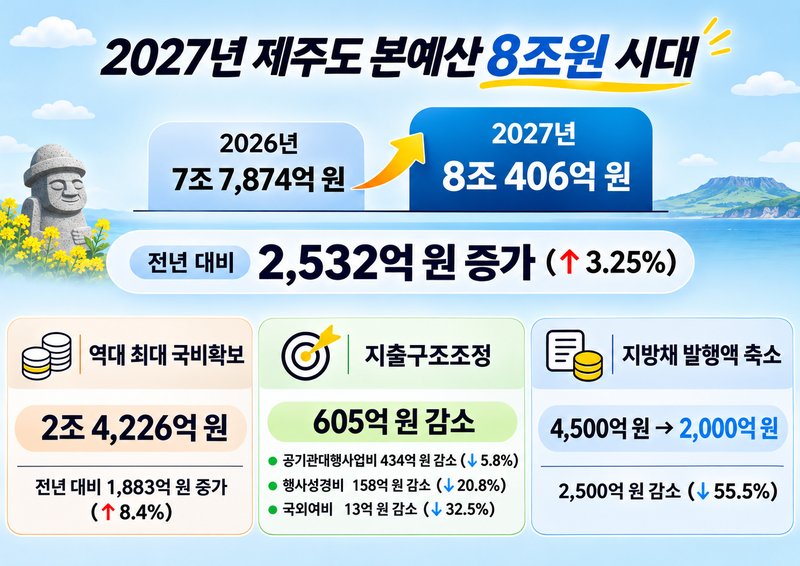
According to Jeju Special Self-Governing Province on the 9th, the 2027 budget proposal totals 8.0406 trillion won, an increase of 253.2 billion won (3.25%) from this year’s initial budget of 7.7874 trillion won. The province submitted the proposal to the Jeju Special Self-Governing Provincial Council on the 6th. It is the first initial budget to reflect key policies of the ninth popularly elected administration led by Wi Seong-gon.
The general account totals 6.667 trillion won, up 309 billion won (4.86%) from the previous year. By contrast, special accounts, which are earmarked for specific projects, total 1.3736 trillion won, down 55.8 billion won (3.90%). The decrease reflects lower annual investment in some major projects, including the modernization of the Jeju Public Sewage Treatment Plant.
The most notable change in revenue is the increase in transfers from the central government. Local allocation tax for next year is set at 2.2804 trillion won, up 310.3 billion won (15.8%) from this year. National subsidies and other such funding are budgeted at 2.4226 trillion won, an increase of 188.3 billion won (8.4%).
The two sources total 4.703 trillion won, an increase of 498.6 billion won from this year. Their share of the overall budget will rise by 4.5 percentage points, from about 54.0% this year to 58.5% next year.
Local allocation tax is funding distributed by the government to help local governments provide basic administrative services. National subsidies are funds the government provides for national or local government projects for designated purposes; depending on the project, local governments must contribute some of the cost as well.
By contrast, local taxes collected by Jeju Province itself total 1.8994 trillion won, an increase of just 33.7 billion won (1.8%). Local consumption tax and local income tax are projected to rise by 52.5 billion won and 17 billion won, respectively, while acquisition tax is expected to fall by 22.1 billion won amid a downturn in the real estate market.
Jeju Province has decided to reduce local bond issuance in response to its limited fiscal capacity. Revenue from local bonds included in next year’s budget proposal totals 200 billion won, down 250 billion won (55.6%) from this year’s 450 billion won.
However, reducing local bond issuance does not mean total debt will fall. The local bond issuance plan previously submitted by Jeju Province to the provincial council includes a total of 232 billion won, including 32 billion won in regional development bonds. The plan projects managed debt of 1.9566 trillion won at the end of next year, 22.6 billion won more than the estimated 1.934 trillion won at the end of this year. The province must manage the burden of repaying existing debt even as it reduces local bond issuance.
On the expenditure side, funding has been allocated to expand social welfare, agriculture, forestry and fisheries, and industry, small businesses and energy, while reducing allocations for culture and tourism, and land and regional development.
The social welfare budget has increased by 136 billion won (6.9%) from this year to 2.1086 trillion won. At 26.2% of the total budget, it accounts for the largest share. The increase reflects higher statutory welfare benefits, including basic livelihood support, assistance for vulnerable groups and caregiving.
The agriculture, forestry, maritime and fisheries budget has risen by 70.2 billion won (9.3%) to 826.1 billion won, while the budget for industry, small businesses and energy has increased by 70.7 billion won (21.5%) to 400.3 billion won. The health budget has also grown by 31.6 billion won (23.7%) to 164.7 billion won.
By contrast, the culture and tourism budget has fallen by 109.6 billion won (25.0%) to 328 billion won, from 437.6 billion won this year. Jeju Province said the decrease reflects the completion of some major investments, including projects related to the National Sports Festival and art museum facilities.
In the local economy sector, 32 billion won has been allocated to issuing and operating the local currency Jeju Pay. A further 38 billion won is earmarked for interest subsidies to ease the loan interest burden on small businesses and small and medium-sized enterprises, and 5 billion won for establishing a regional growth fund.
The budget also includes 27 billion won in allowances for farmers and fishers and 58.2 billion won for the agricultural public-interest direct payment program. The province plans to invest 16.8 billion won in developing regionally specialized rental smart farms and 6.4 billion won in establishing a food tech research support center. Rental smart farms help farmers reduce the burden of initial facility investment and use advanced cultivation facilities.
New and expanded programs for young people and families are also included. The budget allocates 7.4 billion won for rent assistance for young people, 2.8 billion won in marriage support payments, 10.3 billion won in child-welcoming support payments and 2.4 billion won in grandchild-care allowances. A total of 23.4 billion won has been allocated to support essential local medical services, including pediatric, emergency and maternity care.

In future industries, the budget prioritizes artificial intelligence (AI) and the energy transition. It allocates 6.65 billion won to commercialization support for the 5 Poles, 3 Special Zones Growth Engine, and 900 million won to support the growth of the AI industry based on small data centers. The province plans to invest 1 billion won in a pilot program subsidizing residents’ fees for AI services and 3.3 billion won in AI Digital Learning Center education.
The budget for commercialization support under the 5 Poles, 3 Special Zones Growth Engine funds the industrialization of renewable energy convergence systems, small satellite systems and clean bio—areas Jeju is developing. It is separate from the growth-engine research and development budget for which Jeju Province and the provincial council separately asked the National Assembly for an increase.
In the climate and energy sector, 129 billion won has been allocated to subsidies for purchasing zero-emission vehicles, including electric cars. The budget also includes 21.16 billion won for a program to promote heat pumps that convert electricity into thermal energy, and 4.07 billion won to establish a resource-circulation cluster.
Jeju Province has separately selected 152 key investment projects under seven policy goals in this budget proposal and allocated 715.2 billion won to them. The allocations include 275.2 billion won for stabilizing livelihoods, 166.9 billion won for the climate economy, 86 billion won for a basic society and 62.8 billion won for future growth. Investment amounts by policy goal are tabulated separately from the functional classification of the overall budget.
The central government is pursuing expansionary fiscal policy, increasing total spending next year by 12.8% from this year, while the increase in Jeju Province’s initial budget was limited to 3.25%. Although central and local government budgets differ in scope and funding structure, it is clear that the share of central government transfers has risen as growth in Jeju’s own tax revenue remains limited.
Yang Je-yun, head of Jeju Province’s Planning and Coordination Office, said, “The 2027 budget proposal contains an action plan to fully implement the policies of the ninth popularly elected provincial administration, as promised to residents,” adding, “We will work with the provincial council to support people’s livelihoods and invest in future industries.”
The budget proposal will be finalized after review by the Jeju Special Self-Governing Provincial Council’s standing committees and Special Committee on Budget and Accounts. Despite the larger budget, reliance on central government funding and the burden of accumulated debt remain. The effectiveness of new projects and fiscal sustainability are therefore expected to be key issues in the review.
[email protected] Jeong Yong-bok Reporter