Men in their 30s and 40s are obese but say, “I’m not” ... One in three does not manage their weight
- Input
- 2026-11-09 12:00:00
- Updated
- 2026-11-09 12:00:00
[Financial News] One in three people who are obese but do not consider themselves obese made no effort at all to manage their weight, a study found. Conversely, about four in 10 people who were underweight considered themselves obese and tried to lose weight.
The Korea Disease Control and Prevention Agency announced an in-depth analysis of obesity and related health behaviors based on data from the 2025 Community Health Survey. The Community Health Survey conducts one-on-one interviews with about 230,000 adults aged 19 or older each year to assess health behaviors and the prevalence of chronic diseases. The obesity rate is the percentage of respondents whose body mass index (BMI), calculated from their self-reported height and weight, was 25 or higher.
Men more likely to mistakenly think they are “not obese”; women more likely to think they are “obese”
Among people who were actually obese, the rate of attempted weight loss was higher among those who recognized themselves as obese. However, inappropriate weight-control patterns emerged among groups whose perceptions did not match their actual weight.
Of those who were obese but did not consider themselves obese, 36.0% made no effort to manage their weight. Men accounted for 77.4% of this group, and the proportion was higher among people in their 60s and older. Conversely, 39.0% of those who were underweight but considered themselves obese tried to lose weight. Women accounted for 80.6% of this group, and many were in their 30s or 40s.
Last year, the adult obesity rate was 35.4%, or about one in three people. That was up 7.5 percentage points from 26.9% a decade earlier. The rate of attempted weight control (68.5%) and the rate of self-perceived obesity (45.1%) also continued to rise, while the underweight rate kept falling, to 4.2%.
The obesity rate among men was 42.5%, about 1.9 times the rate among women (22.9%). About one in two men in their 30s (52.1%) and 40s (53.1%) were obese, and from their 40s onward, the rate fell as age increased. Among women, the rate was lowest in their 20s (16.4%) and generally rose with age, reaching its highest level among those aged 70 and older (27.4%).
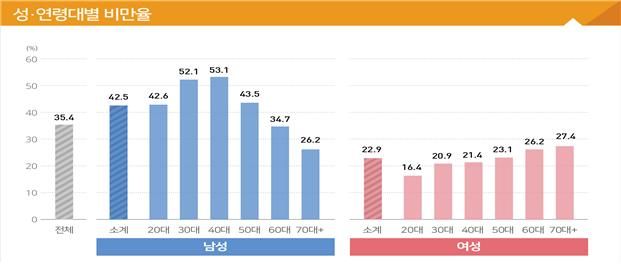
Over the 10-year period from 2016 to 2025, the largest increase for both men and women was among people in their 20s. The obesity rate among men in their 20s rose 43.4%, from 29.7% to 42.6%, while the rate among women in their 20s increased 60.8%, from 10.2% to 16.4%. The obesity rate rose among men in every age group.
The likelihood of obesity was 1.3 times as high among people who did not do strength training and 1.2 times as high among those who slept six hours or less a day. It was also 1.1 times as high among those who skipped breakfast, did not walk for exercise, or drank alcohol.
Obesity rates highest in Ulsan, South Jeolla and Gangwon; lowest in Sejong, Daejeon and Seoul
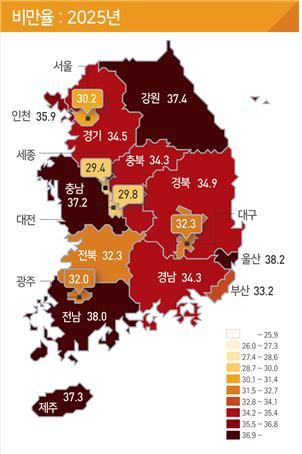
By city and province, obesity rates were highest in Ulsan (38.2%), South Jeolla (38.0%) and Gangwon (37.4%), and lowest in Sejong (29.4%), Daejeon (29.8%) and Seoul (30.2%). Compared with 2016, rates rose in every city and province except Sejong, with the largest increases in Ulsan (12.2 percentage points), South Jeolla (9.7 percentage points) and Jeju (9.1 percentage points).
Based on the average for the most recent three years (2023–2025), obesity rates by city, county and district were highest in Cheorwon County, Gangwon Province (44.2%), Danyang County, North Chungcheong Province (42.9%), and Boeun County, North Chungcheong Province (42.7%). Rates were lowest in Gwacheon City, Gyeonggi Province (23.6%); Bundang District in Seongnam, Gyeonggi Province (24.1%); and Suseong-gu in Daegu and Seo-gu in Daejeon (24.3%).
A comparison of the 10 areas with the highest and lowest obesity rates found that the higher-rate areas had higher rates of hypertension and diabetes diagnoses and high-risk drinking, but lower monthly household incomes and lower rates of walking and strength training. In particular, the rate of diagnosis with hypertension or diabetes was much higher in the higher-rate areas, at 40.6%, than in the lower-rate areas (24.1%).
Lim Seung-gwan, commissioner of the Korea Disease Control and Prevention Agency, said, “Obesity is a major health concern that increases the risk of chronic diseases such as hypertension and diabetes. It is important to have an accurate understanding of one’s weight status and to practice healthy eating habits and regular physical activity.” He added, “The adult obesity rate has continued to rise over the past 10 years. In particular, the rate is high among men in their 30s and 40s, and the increase among men and women in their 20s is pronounced.” He stressed, “Now that disparities between regions have been identified, local governments and relevant agencies need to pursue tailored obesity prevention and management policies that reflect residents’ health behaviors, socioeconomic characteristics and local environments.”
[email protected] Jung Myung-jin, Medical Correspondent Reporter