Herniated cervical disc: For those wondering, “Should I have surgery?”—what does long-term follow-up show about integrative Korean medicine treatment?
- Input
- 2026-11-09 10:01:36
- Updated
- 2026-11-09 10:01:36
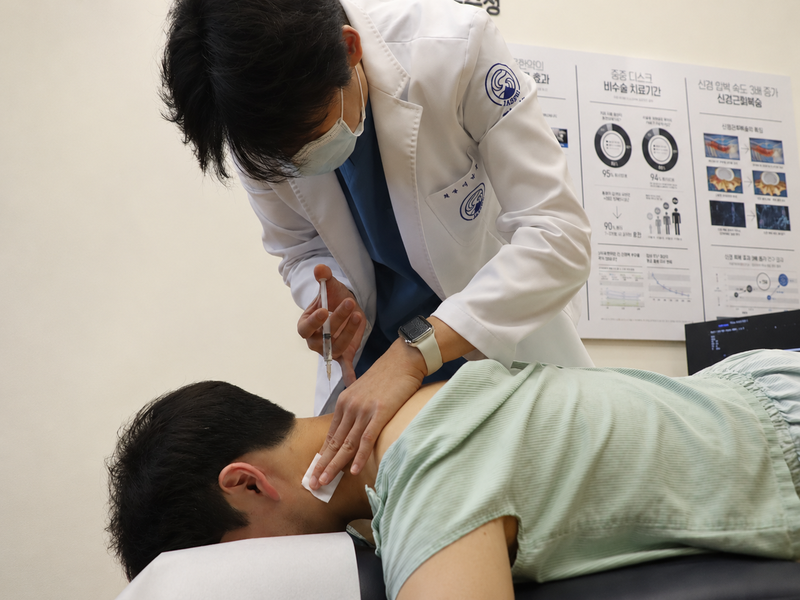
[Financial News] A herniated cervical disc patient’s pain score, which had been in the 7-point range on a 10-point scale, fell to half or less after eight weeks of integrative Korean medicine treatment and remained in the 2-point range even three years later.
A research team led by Lee Su-won, director of the Spine and Joint Research Institute at Jaseng Hospital of Korean Medicine, announced on the 9th that it had published the results of a three-year long-term clinical study of integrative Korean medicine treatment for herniated cervical discs (cervical disc herniation) in the international journal Journal of Pain Research (Impact Factor: 3.1). No patients switched to surgery during the follow-up period.
A herniated cervical disc is a condition in which a disc between the neck vertebrae protrudes and presses on a nerve. It causes neck pain, radiating pain extending down the arm, and numbness. Because it is mainly caused by degenerative changes associated with aging, it often becomes chronic, and patients tend to continue nonsurgical, conservative treatment for a long time. However, there had been few long-term studies confirming whether the effects of integrative Korean medicine treatment last for more than a year.
112 patients followed for 3 years... 93.3% follow-up rate
The research team analyzed interim results from the third year of an ongoing prospective, multicenter observational study aiming to follow patients for five years. From July 2019 to December 2021, the team recruited 120 patients at four Jaseng Hospital of Korean Medicine locations—Gangnam, Daejeon, Bucheon, and Haeundae—whose herniated cervical discs and radiating pain were confirmed by MRI and whose Numeric Rating Scale (NRS, 0–10) score was 6 or higher. Of these, 112 took part in follow-up through the third year, for a follow-up rate of 93.3%.
During the first two months, participants received an average of 15.4 sessions of integrative Korean medicine treatment, consisting of herbal medicine, acupuncture, pharmacopuncture, and Chuna manual therapy (about twice a week). They were then followed up by phone and in clinic visits. The primary outcome measure was the NRS score for whichever was more severe: neck or arm pain. Secondary measures included the Visual Analog Scale (VAS), Neck Disability Index (NDI), quality of life (EQ-5D-5L), patient satisfaction (PGIC), work productivity (WPAI), and cervical range of motion (ROM).
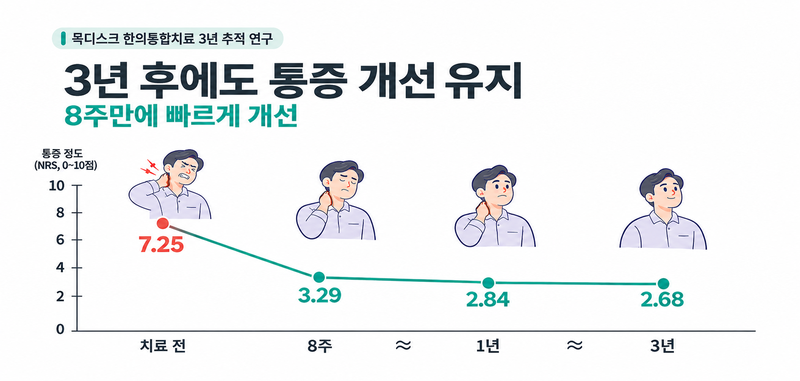
Pain fell by 4.57 points... substantial improvement beyond measurement error
The average pain score (NRS) fell from 7.25 to 3.29 after eight weeks of treatment and to 2.68 in the third year, a total decrease of 4.57 points.
The decrease far exceeded the 2.2-point minimal clinically important difference (MCID), the threshold for a change patients can perceive. It also exceeded the 4.1-point minimal detectable change (MDC), which distinguishes actual change from measurement error. Even allowing for score fluctuations due to a person’s condition or mood, the MDC is the smallest change that can be considered a real difference.
The secondary measures also improved. VAS scores for neck and arm pain (0–100) decreased significantly in the same direction as the NRS scores. The Neck Disability Index (NDI, with lower scores indicating less discomfort) fell by 22.00 points to 17.11, while the quality-of-life measure EQ-5D-5L (with scores closer to 1 indicating higher quality of life) rose by 0.14 points to 0.84. Cervical range of motion, work productivity, and patient satisfaction also improved early in treatment and remained improved through the third year, with no tendency for the effects to diminish between the first and third years.
No additional treatment-related adverse effects or complications occurred during the follow-up period.
The research team attributed the lasting effects to the complementary action of the different treatments. It explained that acupuncture and Chuna manual therapy help relax muscles, restore function, and activate the body’s pain-regulation pathways, while herbal medicine and pharmacopuncture help relieve pain by reducing inflammation and protecting nerves.
Director Lee Su-won said, “Because herniated cervical discs are prone to chronic recurrence, it is important to consider not only the effects immediately after treatment but also how long those effects last. The significance of this study is that it confirmed that improvements in pain and function were maintained up to three years after integrative Korean medicine treatment.” He added, “The fact that no patients switched to surgery during the follow-up period suggests that integrative Korean medicine treatment could be a conservative treatment option worth considering first for patients contemplating surgery. We will continue to build long-term evidence through the ongoing five-year follow-up study.”
[email protected] Jeong Myeong-jin, Medical Correspondent Reporter