Hyundai Motor and Kia to Expand Support for Suppliers’ Greenhouse Gas Reductions... “Cultivating Emissions-Reduction Experts”
- Input
- 2026-11-09 10:07:37
- Updated
- 2026-11-09 10:07:37
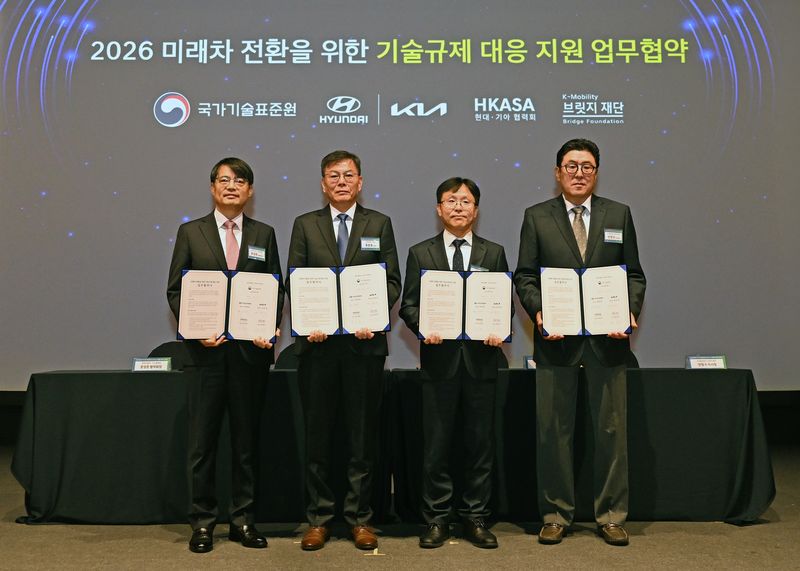
Hyundai Motor and Kia said on the 9th that they had signed an agreement with the Korean Agency for Technology and Standards, the Hyundai Motor and Kia Suppliers Association, and the K-Mobility Bridge Foundation to support responses to technical regulations in the transition to future vehicles in 2026. They also held a seminar for representatives of companies with high greenhouse gas emissions, attended by parts suppliers.
Hyundai Motor and Kia have operated the “Virtuous-Cycle Greenhouse Gas Reduction Mutual-Growth Program” since last year to help suppliers cut greenhouse gas emissions. Until now, the program has focused on equipment support. Hyundai Motor and Kia said they arranged this agreement to help suppliers understand the requirements of global greenhouse gas-related technical regulations and develop response plans suited to their own businesses.
The cooperation has two strands: “resolving on-site challenges” and “developing specialized personnel.” First, Hyundai Motor and Kia will identify suppliers’ on-site challenges, and the Korean Agency for Technology and Standards will use that information to help address difficulties related to environmental and carbon regulations across global supply chains. Hyundai Motor and Kia will also support the standardization of supply-chain carbon management systems and their adoption by industry. The four organizations plan to establish a working-level council as a communication channel to share challenges and coordinate necessary support.
To develop specialized personnel, the Korean Agency for Technology and Standards and the K-Mobility Bridge Foundation will provide training in supply-chain carbon management and responses to overseas regulations, while the Hyundai Motor and Kia Suppliers Association will encourage suppliers to participate. Mentoring on global supply-chain regulatory responses and training to develop greenhouse gas reduction experts will strengthen suppliers’ ability to respond.
At a seminar held after the agreement-signing ceremony, the companies shared Hyundai Motor and Kia’s greenhouse gas management policies and presented awards to suppliers with strong results in emissions-reduction performance evaluations. Hyundai Motor and Kia plan to expand the eligible recipients and funding for the mutual-growth program next year, based on next year’s emissions-reduction performance evaluation.
A Hyundai Motor and Kia representative said, “We will bring together public- and private-sector expertise to help suppliers understand complex global technical regulations and develop response plans.”
The representative added, “We will support emissions reductions and regulatory compliance together to strengthen our suppliers’ export competitiveness.”
[email protected] Kim Dong-chan Reporter