Modu Science: “Specialized dish cuts fertility treatment failures by 30%”
- Input
- 2026-11-09 15:22:29
- Updated
- 2026-11-09 15:22:29

According to industry sources on the 9th, Modu Science recently completed development of a prototype biopsy dish for PGT and is in talks about mass production. The dish combines three work areas—culture, biopsy and freezing—in a single dish, with the aim of simplifying and standardizing the process.
Founded in April 2020, Modu Science is a manufacturer and distributor of fertility-treatment equipment led by co-CEOs Ju-hwan Kim and Eun-jeong Lee. It supplies consumables required for in vitro fertilization, including culture dishes, tubes and pipettes. The company says it has direct business relationships with around 100 fertility clinics and embryo laboratories in South Korea, including CHA Medical Center, Maria-affiliated institutions, Seoul National University Hospital and Kyungpook National University Hospital.
Building on the business network it established through supplying consumables, Modu Science is working to commercialize devices it developed in-house. Product development is focused in particular on reducing embryo transfers, sample mix-ups and differences in how individual staff members handle the biopsy process.
One of its key products is a dish designed specifically for PGT biopsies. PGT is a test that analyzes embryos created through IVF for certain genetic abnormalities and other factors by taking a sample of cells. Separating cells from an embryo requires precise handling, making staff expertise and laboratory conditions important.
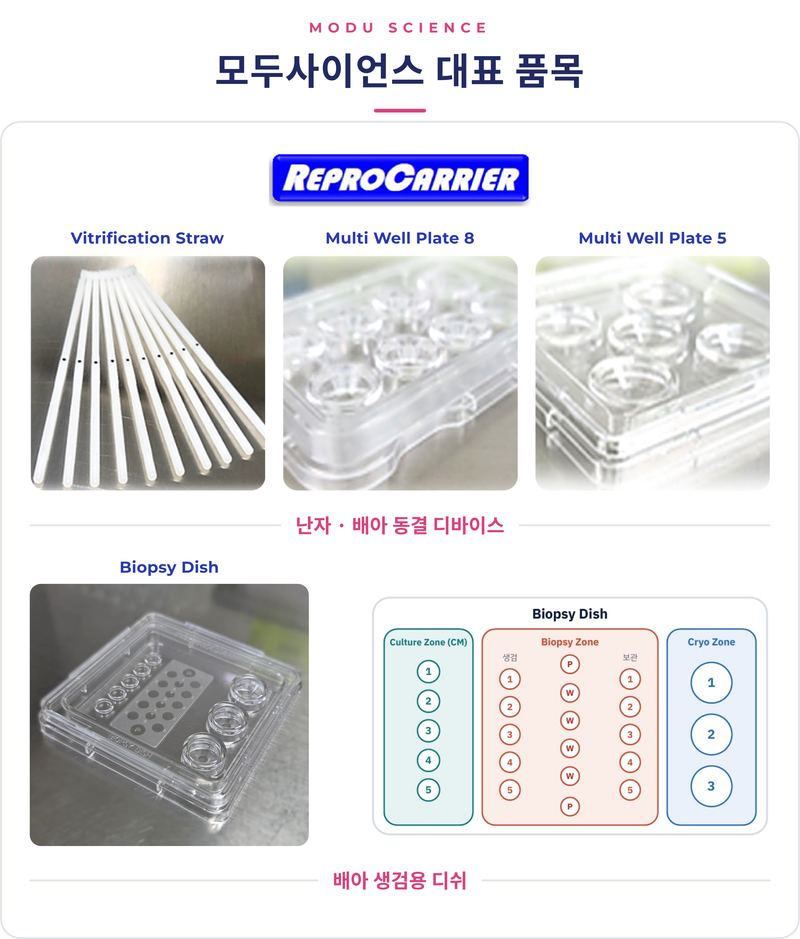
The product developed by Modu Science combines three work areas—culture, biopsy and freezing (Cryo)—in a single dish. It is designed to allow biopsies to be performed sequentially on up to five embryos in one dish.
The dish separates the positions of embryos, isolated cells and wash solution, and lays out the workflow so staff perform biopsies in a set sequence. The aim is to reduce unnecessary embryo transfers and the risk of sample mix-ups, while minimizing differences in how individual staff members handle the process. However, any actual improvement in embryo damage rates or testing accuracy will need to be established through future use and verification in clinical settings.
Modu Science has filed a patent application related to the product and completed its design registration. Following development of the prototype, it is now in talks about mass production and use at medical institutions, and plans to expand supply after on-site validation.
Its existing in-house product, “ReproCarrier,” is also a key business line. The equipment is used in vitrification, a process that rapidly cools and preserves eggs and embryos. The product range includes freezing straws and multiwell plates.
The company is also expanding its business. It is developing an “IVF Lab Total Package” service for new fertility clinics, providing end-to-end support from laboratory design to the supply of equipment and consumables. Its strategy is to increase the share of its in-house products and integrated supply business while maintaining relationships with existing medical institutions.
The company is also preparing to enter overseas markets. According to Modu Science, exports totaled 90 million won last year. This year, it aims to reach annual revenue of 10 billion won by expanding its existing consumables business and developing new devices.
Next year, it plans to expand its export channels by participating in overseas trade fairs and identifying local buyers. It is also considering supplying devices and consumables together in response to demand from overseas fertility clinics for laboratory construction.
In the medium to long term, the company aims to expand into embryo-quality prediction using artificial intelligence (AI) and laboratory data-management services. With 2028 as its target, it plans to link embryo-work videos with standard operating procedures (SOPs) and develop a data platform with AI-based analytical capabilities. It is also considering entering the assisted-reproduction equipment market in the livestock sector, including equipment for producing and freezing fertilized eggs.
“In fertility treatment settings, work methods can vary depending on staff expertise and laboratory conditions,” said Modu Science CEO Ju-hwan Kim. “We are developing a product that incorporates a standardized workflow into the device itself to improve efficiency and consistency in the treatment process.” He added, “Building on our existing fertility-treatment consumables business and supply network serving domestic medical institutions, we will work to commercialize our in-house devices. Going forward, we will expand the business into next-generation culture devices, AI-based analytical support technology and laboratory data platforms.”
[email protected] Kim Hyun-cheol Reporter