“KOSPI Could Rise as High as 7,100” ... Brokerage Analysts Identify Conditions for a Rebound
- Input
- 2026-11-09 08:41:18
- Updated
- 2026-11-09 08:41:18
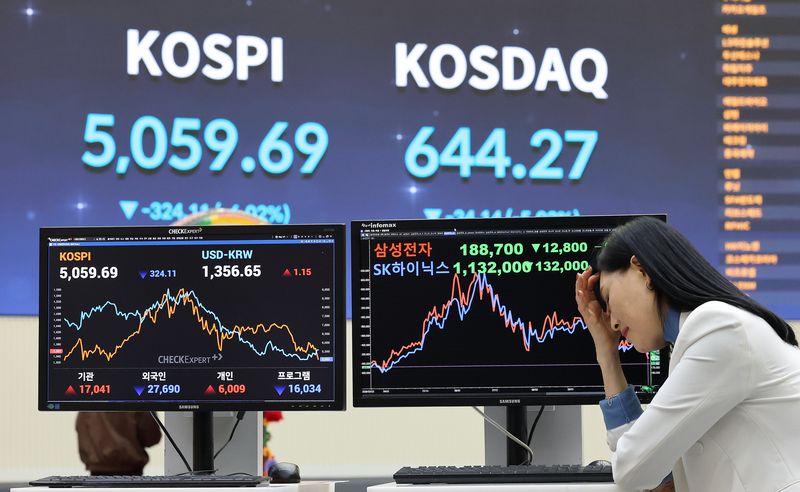
[Financial News] Although the KOSPI plunged to the 5,000 level, brokerage analysts say the steep drop relative to corporate earnings should be used as an opportunity to buy at lower prices. They say investors could increase their stock allocations when the KOSPI is below 5,300, as companies’ earnings forecasts are actually rising.
Lee Kyung-min, a researcher at Daishin Securities, said in a report on the 9th, “Below 5,300 on the KOSPI is where earnings are rising while only prices have collapsed,” calling it “an opportunity to increase exposure with a high probability of a rebound.”
On the 6th, the KOSPI closed at 5,059.69, down 11.7% from the previous week. Selling by foreign investors intensified amid growing concerns that regulations on artificial intelligence (AI) data centers could be tightened following the U.S. midterm elections.
In particular, a circuit breaker was triggered on the 6th amid the sharp drop in stock prices, and the KOSPI fell as low as 4,911.28 during the session.
Daishin Securities said the decline stemmed from unstable supply and demand, including deteriorating investor sentiment and outflows of foreign capital, rather than weak corporate earnings. In fact, net income forecasts for KOSPI-listed companies over the next 12 months have risen 9.7% over the past month. Fourth-quarter operating profit forecasts were also revised up from 264 trillion won to 290 trillion won.
By contrast, the KOSPI plunged 44.5% from its peak on June 22. Over the same period, forecast earnings per share (EPS) for the next 12 months increased 32.9%, from 1,075 points to 1,429 points. Corporate earnings forecasts improved, but stock prices fell sharply.
As stock prices fell and earnings forecasts rose, the KOSPI’s 12-month forward price-to-earnings ratio (PER) dropped from 8.5 times to as low as 3.54 times. This is the lowest level since 2001.
Daishin Securities calculated that a 12-month forward price-to-book ratio (PBR) of 1 corresponds to a KOSPI level of around 5,330. The index is currently holding below that, around 5,000, indicating that stocks are trading at prices below companies’ book value.
Lee also cited the KOSPI’s 12-month forward return on equity (ROE) of 26.8% as evidence that it is undervalued. He said companies are expected to achieve high profitability, but that this earnings outlook is not fully reflected in current stock prices.
The current KOSPI decline has unfolded faster than during past currency or financial crises. An analysis of 10 instances since 1980 in which the KOSPI fell at least 30% from its peak found that the median decline was 44.5%, the same as the current drop.
In particular, this time it took just 93 trading days for the KOSPI to fall 44.5% from its peak. The decline was faster than during the 1997 IMF Crisis, when it took 109 trading days, or the 2008 Global Financial Crisis, when it took 240 trading days.
Statistics also showed that the KOSPI rebounded substantially after past sharp market declines. In cases where the KOSPI fell at least 30% from its peak and then reached a low, median returns afterward were 31% over three months, 41% over six months and 60% over 12 months.
In 80% of cases, the index was higher 12 months later for investors who bought when it had fallen 40% from its peak.
Daishin Securities projected that the KOSPI could rise as high as 7,100 if its 12-month forward PER recovered to around five times. However, that figure assumes that current corporate earnings forecasts are maintained.
Semiconductors topped the list of promising sectors for investment. Following the recent sharp drop in stock prices, the forward PER fell to 2.67 times for Samsung Electronics and 2.2 times for SK hynix.
Foreign investors were net sellers of 7.7 trillion won worth of semiconductor stocks in the first week of November alone. Daishin Securities projected that the market could rebound, led by large-cap semiconductor stocks such as Samsung Electronics and SK hynix, if foreign selling subsides.
It also recommended increasing allocations to IT hardware, machinery, shipbuilding, energy, trading companies and capital goods, and IT and home appliances, sectors whose stock prices have recently fallen sharply and that are undervalued relative to earnings. It advised investors to also consider transportation, insurance and retail, where earnings forecasts are rising.
It said, however, that investors should continue to monitor whether foreign selling subsides and whether credit concerns among AI-related companies ease.
Major U.S. economic indicators and corporate earnings due to be released starting this week are also potential factors. The U.S. Consumer Price Index (CPI) is due on the 10th, CoreWeave is scheduled to report earnings on the 11th, Applied Materials on the 13th and NVIDIA on the 18th.
In the report, Lee said, “Fluctuations below 5,300 on the KOSPI are an opportunity to increase exposure through staggered buying,” and forecast that “breaking above and holding around the 6,000 level will be a turning point for entering the next upward phase.”
[email protected] Han Seung-gon Reporter