Retail investors fret as Samsung Electronics Co., Ltd. plunges; brokerages advise staggered buying from the 170,000-won range
- Input
- 2026-11-09 07:02:32
- Updated
- 2026-11-09 07:02:32
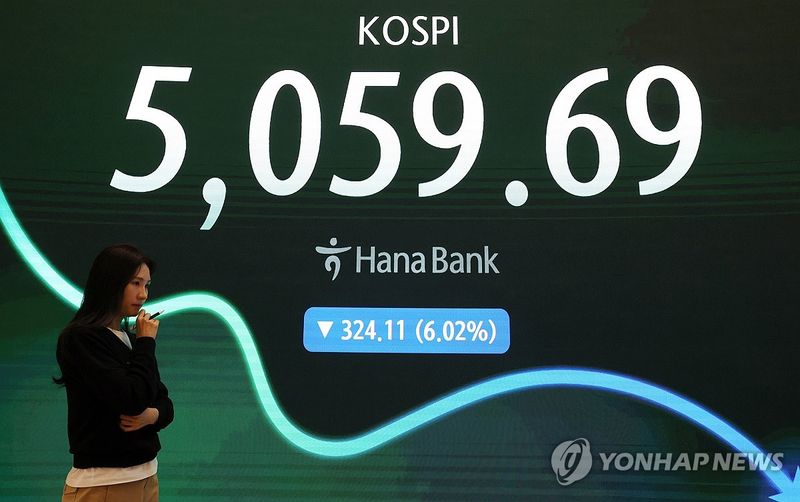
[Financial News] South Korean semiconductor stocks plunged after the so-called “Blue Tsunami,” in which Democrats scored a landslide victory in the US midterm elections. Amid the sell-off, brokerage analysts said Samsung Electronics Co., Ltd.’s share price had neared levels seen at the bottoms of previous downturns. Rather than focus on the reasons for the decline, they said, investors need to use historical valuations to judge when to buy.
According to financial industry sources on the 9th, Hanwha Investment & Securities Co., Ltd. said in a report released on the 6th that Samsung Electronics Co., Ltd. had entered an undervalued range compared with past downturns. The factors that triggered declines and the duration of each correction varied, but troughs generally formed at similar valuation levels, the report said.
Hanwha proposes staggered buying of Samsung Electronics at 170,000–180,000 won; past troughs were around 1x PBR
Hanwha Investment & Securities Co., Ltd. proposed starting to buy in stages if Samsung Electronics Co., Ltd.’s share price reaches around 178,000 won. That price corresponds to a 12-month forward price-to-book ratio (12MF PBR) of 1.03. PBR at previous troughs was 0.95 in January 2019, 1.03 in September 2022 and 0.83 in November 2024.
The reasons for declines in Samsung Electronics Co., Ltd.’s share price differed from one period to another. In late 2017, concerns spread that the memory semiconductor supercycle had passed its peak. In 2021, rapid tightening by the US Federal Reserve (Fed) and a contraction in global information technology (IT) demand weighed on the stock. In 2024, slower demand for commodity memory was compounded by uncertainty surrounding the US presidential election and tariff policy.
The duration of the declines also varied. Samsung Electronics Co., Ltd. underwent a correction for about 14 months, from November 2017 to January 2019. The stock fell for about 20 months from January 2021 to September 2022, and for about four months from July to November 2024.
Despite differences in the causes and duration of the declines, valuations at the share-price troughs fell within a similar range.
Hanwha Investment & Securities Co., Ltd. estimates Samsung Electronics Co., Ltd.’s 12-month forward book value per share (BPS) at 173,079 won. The market consensus, or average forecast, is 171,196 won. Applying the average trough PBR of 0.94 from the three previous downturns to Hanwha’s estimate yields a share price of about 163,000 won.
Based on historical data, the share price could fall further to 163,000 won, but analysts say it is difficult to predict where the actual trough will form.
Hanwha Investment & Securities Co., Ltd. therefore recommended buying in stages from the 170,000–180,000-won range rather than waiting for the stock to fall to a specific price. It cited the average PBR at the 2019 and 2022 troughs, which was 0.99, close to 1.
Unlikely to revisit 2024 low of 144,000 won; hopes rise for stronger HBM competitiveness
Analysts said a renewed fall to 144,000 won—the level corresponding to a PBR of 0.83 recorded in November 2024—was unlikely. At the time, Samsung Electronics Co., Ltd. was slower than competitors to expand supplies of high-bandwidth memory (HBM), heightening concerns over product qualification by major artificial intelligence (AI) accelerator customers and market share.
Concerns that Samsung Electronics Co., Ltd. might not benefit as much as its competitors from an earnings recovery even if the memory semiconductor market improved weighed on its share price, the analysts said.
They said the situation has changed, with expectations now building for expanded HBM supplies and improved product competitiveness. As a result, they said it is very unlikely that valuation multiples will fall to the extreme lows seen in 2024 again.
Shares fell even as earnings grew: three past downturns
Samsung Electronics Co., Ltd.’s operating profit has risen in the past even while its share price was falling. In 2018, after the stock peaked in November 2017, operating profit came to 58.9 trillion won, up 9.8% from the previous year.
Operating profit also rose 43.5% to 51.6 trillion won in 2021, after the January peak. In 2025, the year after the share-price peak in July 2024, operating profit reached 43.6 trillion won, up 33.2% from the previous year.
In all three downturns, annual results improved even after the share price had peaked. The explanation is that stock markets reflect the expected pace of future profit growth and changes in investor expectations before they reflect current results.
Past share-price rebounds began before all the negative factors had been resolved. Even when Samsung Electronics Co., Ltd.’s share price hit a low in early 2019, the US-China trade dispute was still ongoing. Memory prices and the company’s results also deteriorated further.
In September 2022, the Fed was still raising interest rates, while IT demand was declining and memory inventory adjustments continued. Samsung Electronics Co., Ltd.’s share price nevertheless turned upward before those headwinds had eased. Analysts say stocks can rebound even before market conditions improve once negative factors have been sufficiently priced in.
Assuming investors bought Samsung Electronics Co., Ltd. shares at the troughs of the three past downturns and sold at the peaks of the next upcycles, the gains would have reached as much as 163%, 71% and 651%, respectively.
These are maximum gains identified in hindsight and do not mean that investors actually earned those returns. The analysis indicates, however, that buying shares in past undervalued periods offered significant opportunities to profit from subsequent price increases.
“Now is the time to decide what price to buy at, not dwell on why shares are falling”; analysts say stock is near a trough
Park Jun-young, an analyst at Hanwha Investment & Securities Co., Ltd., said, “It is difficult to conclude that uncertainty surrounding the semiconductor sector will be resolved in the short term,” adding, “But in the past, share-price troughs did not coincide with the resolution of negative factors or confirmation of an earnings recovery.”He went on to emphasize, “Rather than delaying purchases simply because uncertainty remains, investors should use historical valuations to decide at what price they are willing to take on risk.”
Analyst Park said historical data indicated that Samsung Electronics Co., Ltd.’s share price had already reached the vicinity of a trough. He advised, “Now is the time to decide, based on valuation, at what price to start buying, rather than looking for and explaining the reasons for the share-price decline.”
[email protected] Han Seung-gon Reporter