“No More Turning a Blind Eye” ... 1,900 Join Joint Statement to Eradicate Sexual Violence in Traditional Korean Music Community in One Day
- Input
- 2026-11-09 01:19:11
- Updated
- 2026-11-09 01:19:11
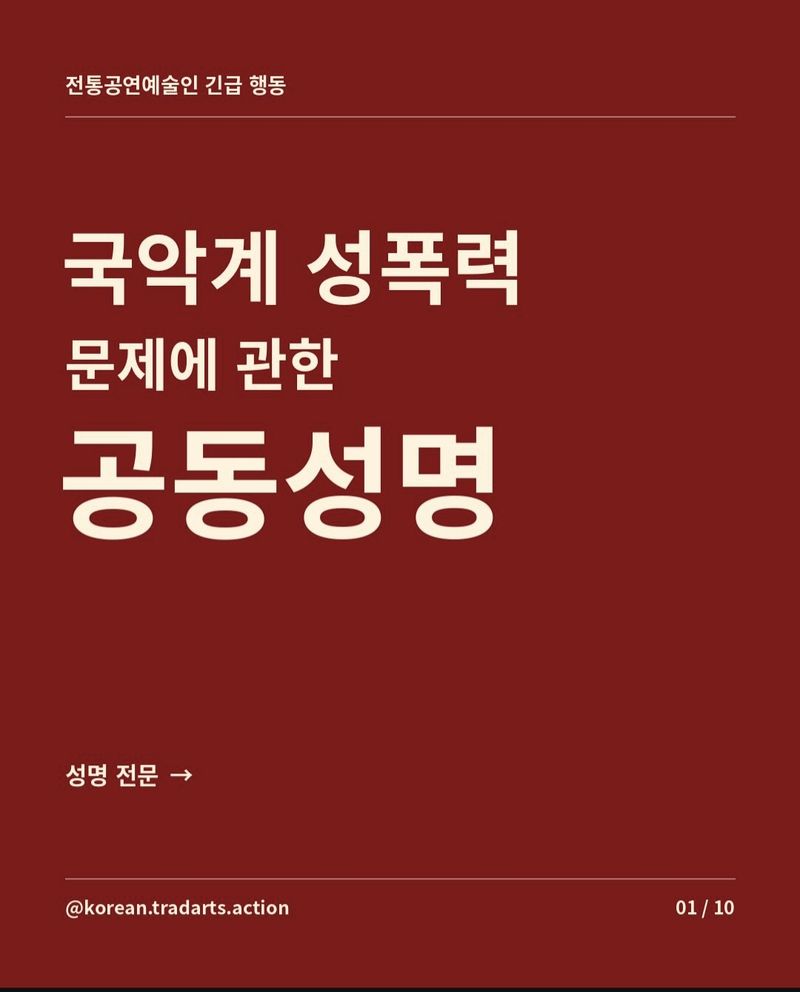
[Financial News] Amid a series of sexual violence cases recently coming to light within the traditional Korean music community, calls for solidarity from the arts community are spreading like wildfire, demanding an end to longstanding abuses and fundamental institutional reform.
On the 8th, Emergency Action by Traditional Performing Artists (hereafter, Emergency Action) said that more than 1,900 people had joined the co-signing of its “Joint Statement on Sexual Violence in the Traditional Korean Music Community,” issued on the morning of the 7th, by the morning of the 8th—just one day later. The statement was initiated by 30 professional artists, including professors Kang Eun-il and Kim Gyeong-a, performer Park Min-hee, and critic Baek So-mang, and drew support from people across society, including not only those working in the traditional Korean music community but also academics, planners, and directors. The co-signing will continue through the 21st.
In its statement, Emergency Action confessed, “We have continually witnessed sexual violence, both major and minor, but have never once stood up to perpetrators or stood in solidarity with victims.” It issued a searing call for self-reflection, saying, “Every member of the traditional Korean music community bears responsibility for the closed culture that made it impossible to speak about abuse. We can no longer teach or learn traditional Korean music in a world like this.”
In particular, the group concluded that the series of sexual violence cases stemmed not simply from “individual aberration,” but from a hierarchical and closed system rooted in apprenticeship-based training and teacher-student relationships, which holds sway over admissions, hiring, and recommendations.
Emergency Action called for three broad measures to address the problem.
First, it called on affiliated institutions and schools to hold those responsible for sexual violence strictly accountable. When a report is received, a swift and independent investigation should be followed by effective disciplinary measures and other actions commensurate with the findings.
Second, it called for a profound reckoning within the traditional Korean music community. It stressed that the community must confront the structural causes that left victims with no choice but to remain silent within a review system wielding power over admissions and performance bookings.
Third, it called on the Ministry of Culture, Sports and Tourism, education authorities, and national and public institutions to develop effective measures to prevent recurrence. Specifically, it urged a large-scale fact-finding survey covering universities, private lessons, and national and public organizations; the establishment of independent reporting and counseling channels that do not require people to go through those who evaluate them; the exclusion of parties with conflicts of interest from investigations; and measures to protect underage victims.
Emergency Action stressed, “An ongoing protection system that can identify risks even before victims come forward is urgently needed,” adding, “Going forward, we will pursue substantive institutional reform through continued public discussion, forums, policy recommendations, and other efforts.”
[email protected] Park Ji-hyun Reporter