Party, Government and Presidential Office Push 2 Trillion Won in Fire Service Funding; Discuss Unifying Comprehensive Real Estate Tax Deduction at 1.4 Billion Won
- Input
- 2026-11-08 20:38:15
- Updated
- 2026-11-08 20:38:15
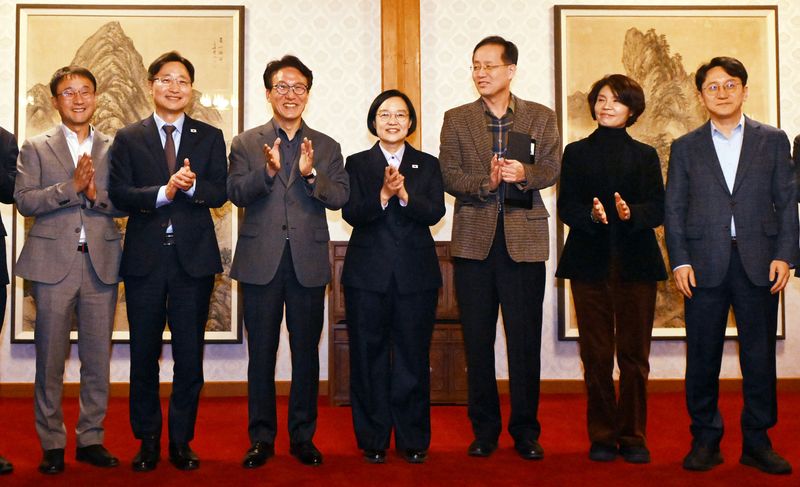
At the 12th Senior Party-Government Council, held on the 8th at the Prime Minister’s Seoul Residence in Samcheong-dong, Jongno District, Seoul, participants held about 90 minutes of intensive discussions on ways to bolster fire service funding. Kim Min-seok, leader of the Democratic Party of Korea (DPK), said, “Bolstering fire service funding is not a choice but a necessity,” stressing that central government funding should be increased in line with the purpose of making firefighters national civil servants and that disparities in fire services between regions should be reduced.
The ruling party and government also agreed to include additional funding in next year’s budget deliberations for firefighting equipment, training facilities and an expanded specialized medical care system for firefighters. DPK chief spokesperson Park Sung-joon said, “We will secure fire service funding of 2 trillion won plus alpha, plus beta.” The aim is to secure additional funding for equipment and facilities, as well as additional tax revenue, on top of the basic 2 trillion won in support.
The use of the Future Fund is also under consideration as a way to raise the funds. In his opening remarks at the meeting, Chief of Staff to the President Im Gwang-hyeon said the government would consult with the National Assembly of the Republic of Korea on providing additional fire service funding in next year’s budget and on using the Future Fund and the portion of local education tax derived from the tobacco consumption tax. The government’s position is that it needs to ease the fiscal burden that remains with local governments even after firefighters became national civil servants and to secure stable funding for fire services.
However, specific funding plans have not been finalized. Kwon Chil-seung, the DPK’s policy committee chair, argued that all revenue from the local education tax on tobacco, which is due to expire, should be redirected to fire service funding. The government, however, said the revenue should be used for multiple purposes, and the two sides failed to reach an agreement. It also remains to be decided whether the 2 trillion won in support will come from the general account or the Future Fund. The ruling party and government plan to reactivate a pan-government task force on fiscal decentralization to coordinate specific funding plans.
The meeting also discussed ways to ease local governments’ fiscal difficulties. The ruling party and government agreed to increase the budget available to local governments next year by using, among other things, tax revenue collected this year in excess of forecasts. They are also considering transferring some taxes collected by the central government to local governments and redistributing responsibilities between the two levels of government. The specific amount of support is to be determined during the National Assembly’s review of next year’s budget.
Meanwhile, the DPK strongly urged the government that day to unify the basic comprehensive real estate tax deduction for owner-occupied and non-owner-occupied homes at 1.4 billion won. Under the current tax revision bill, the deduction thresholds differ: 1.4 billion won for an owner-occupied home and 1.2 billion won for a non-owner-occupied home. DPK Secretary-General Han Jeoung-ae put forward the proposal, but the government has yet to decide whether to accept it.
Park, the DPK’s chief spokesperson, stressed, “If the property tax on homes is levied next July, the property tax on land in September, and the comprehensive real estate tax in December, that will be directly linked to the general election in April 2028,” adding that “this is a very sensitive issue for lawmakers from Seoul.” The point is that, as the burden of property-holding taxes becomes tangible ahead of the election, its impact on public sentiment in the Seoul metropolitan area must be considered. The DPK asked the government to simulate changes in the tax burden and examine them closely. Related discussions are expected to continue during consideration of budget-related bills at the end of this month.
[email protected] Jiwon Song Reporter