Korean Chicken and Sweet Persimmons Win Over Vietnam: ‘Next K-Food’ [On the Ground]
- Input
- 2026-11-08 18:28:48
- Updated
- 2026-11-08 18:28:48
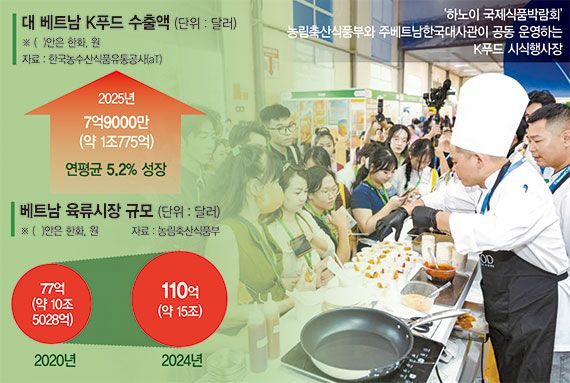
On the 4th, outside the Korean Pavilion at the Hanoi International Food Expo, held at the Hanoi International Exhibition Center in Vietnam. Visitors flocked to the K-food tasting event jointly run by the Ministry of Agriculture, Food and Rural Affairs and the Embassy of the Republic of Korea in Vietnam to try chicken nuggets and kimchi pancakes. The crowd was far larger than expected, keeping event staff so busy cooking food for the tasting that they were practically overwhelmed.
Mai, a housewife in her 40s who tried the chicken nuggets, exclaimed, “Rất ngon!” (“Very delicious!”) and gave a thumbs-up. She said, “Unlike Vietnamese chicken, Korean chicken is crispy on the outside and tender inside, so I think I’ll often buy it as a snack for the kids or for a late-night meal.”
By contrast, booths run by Chinese food companies were relatively quiet. Tao, a 30-something office worker whom we met at a booth run by a Chinese-Vietnamese joint venture, said, “The food tastes fine, but after seeing so much news lately about safety and hygiene issues with Chinese food, I’m reluctant to reach for it.” At the dried seafood booths, too, visitors carefully checked the country of origin and production facilities.
■ From K-chicken to makgeolli and sweet persimmons... Next K-food is taking off
The event, sponsored by the Vietnamese government and organized by state-owned exhibition company Vinexad, featured 11 companies and one integrated organization from Korea, which set up a total of 14 booths. Major buyers also took part, including local retail giant WinCommerce and fresh-fruit distributor Thuy Anh Fruits.
At this year’s event, efforts to identify next-generation export products beyond established favorites stood out. Interest centered in particular on chicken products, as the way opened for exports of processed chicken following the Korea-Vietnam summit last April.
Lee Dae-beom, head of Harim Co., Ltd.’s Vietnam subsidiary, said, “We’re targeting sales of about 70 tons this year, and plan to raise volumes to 40–80 tons a month starting six months after entering the market.” The four products introduced locally were Samgye-tang, chicken nuggets, chicken karaage and Yonggari Chicken. The strategy is to target the premium market by emphasizing the quality of the products made in Korea. Lee said, “We’ll also accelerate our entry into major local retail networks by using the distribution infrastructure we’ve built through exports of spent laying hens. We’ll ramp up sales to local consumers in the first quarter of next year and increase sales by about 200% by the third quarter.”
Following soju, makgeolli is also setting its sights on the Vietnamese market. Kang Hyeon-cheol, branch manager at local distributor Indoco, said, “The makgeolli market is still small, but awareness is rising rapidly under the influence of K-culture. We plan to import a variety of fruit and grain makgeolli products to appeal to Vietnamese consumers, who prefer fruit-flavored alcoholic drinks.”
Sweet persimmons also drew attention as a next-generation K-food in the fruit category. A representative of Korean Sweet Persimmon Export Co., an integrated export organization established by sweet-persimmon-exporting Nonghyup cooperatives in Gyeongsangnam-do, said, “Despite the fierce low-price competition from Chinese sweet persimmons, Korean sweet persimmons are strengthening their premium image by emphasizing their unrivaled sweetness and quality. We’ll further expand our distribution through major local retail channels.”
■ Vietnamese companies join the competition amid K-food’s popularity
Vietnamese kimchi maker Hai Kimchi showcased napa cabbage kimchi, young radish kimchi, cubed radish kimchi and scallion kimchi, among other products. A representative of Hai Kimchi said, “We make kimchi with locally grown Vietnamese cabbage and radishes, following the same recipes used in Korea. As kimchi grows more popular, we’re looking to expand distribution beyond the current network, which mainly serves Korean-owned stores, to reach general consumers.”
FASO, a local company that has distributed Korean food and household goods for 20 years, introduced Jung Food’s Vietnam-tailored rice drink, “Sunshine Packed with Goodness.” It drew an enthusiastic response, with long lines of people waiting to sample it. Ngoc, a university student who tried it, said, “I usually enjoy rice drinks as a breakfast substitute, and they’re convenient,” showing a preference for Korean food.
■ K-food exports to Vietnam grow 5.2% a year
Vietnam is emerging as a key strategic market for K-food. Last year, K-food exports to Vietnam totaled $790 million (about 1.0775 trillion won), growing by an average of 5.2% annually. Major products include prepared chicken products, seasoned laver, beverages, ginseng products and instant noodles; the range has recently diversified to include fresh fruit, convenience foods and health foods. Observers say the foundations for growth in premium K-food are expanding as economic development and a growing middle class drive greater consumer emphasis on health and quality, while distribution channels also diversify.
Kim Hyun-woo, agricultural attaché at the Embassy of the Republic of Korea in Vietnam, said, “The conclusion of quarantine negotiations following the Korea-Vietnam summit last April opened the way for exports of Korean processed chicken products, and it is meaningful that this event has allowed us to introduce K-chicken in earnest to Vietnamese consumers. The government, including the embassy, plans to further strengthen cooperation with the local government so that more livestock products, such as Hanwoo beef and heat-treated pork, can enter the Vietnamese market.”
[email protected] Kim Jun-seok Reporter