“They say home prices in Gangnam are falling?”... Prices in working-class neighborhoods are surging instead, leaving salaried workers feeling betrayed [House Signal]
- Input
- 2026-11-08 19:00:00
- Updated
- 2026-11-08 19:00:00
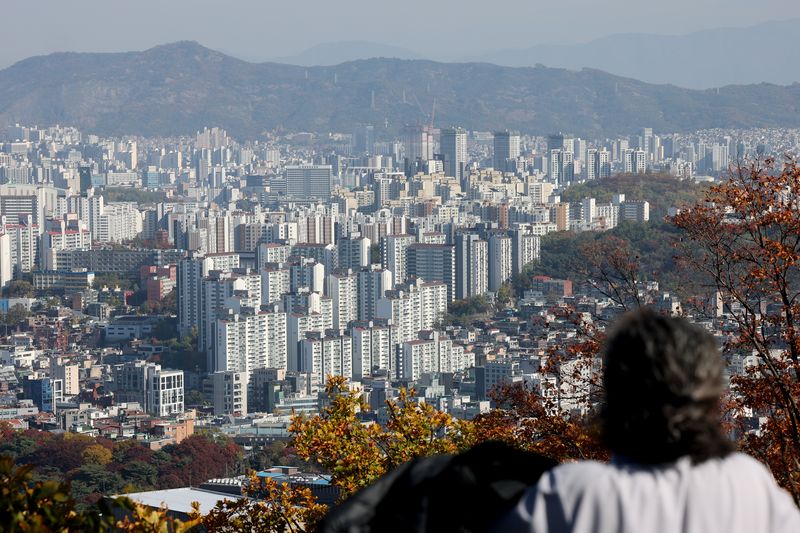
[Financial News] This is a faint hope that an ordinary worker who does not own a home may have felt at least once after seeing recent real estate news.
Analyses are pouring in saying that prices in Seocho and Songpa have turned downward and the real estate market is finally stabilizing. For dual-income couples in their 30s and 40s who spent years waiting and moving from one jeonse rental to another, it seems that at last the chance to own a home of their own has arrived.
But the moment they check actual sale prices in a neighborhood they had their eye on while riding the subway home from work, that faint hope quickly turns into a heavy sigh.
They say luxury apartments in Gangnam, priced at several billion won, are falling by hundreds of millions at a time. Yet prices for two- or three-room apartments on the outskirts of Seoul—the homes ordinary salaried workers were considering buying by stretching themselves to the limit—are continuing to rise without budging.
They say the real estate market is cooling, so why does an ordinary home where our family can lay its head seem to be getting further and further out of reach?
■ Gangnam down 0.39%, while Seodaemun is up 0.31%... Seoul home prices have been turned completely upside down
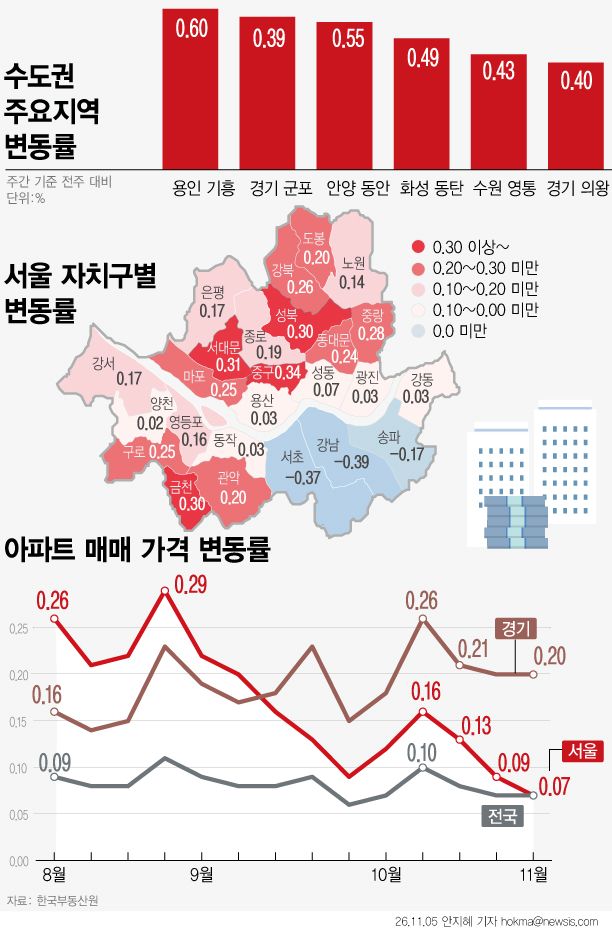
The statistics put a clear number on the sense of deprivation felt by ordinary people without homes of their own. According to the weekly apartment price trends for the first week of November released by the Korea Real Estate Board (KREB), Seoul apartment sale prices rose 0.07% from the previous week, extending their upward streak to an astounding 91 consecutive weeks.
What stands out is the illusion created by the average. A closer look at each area reveals a market split completely in two. Apartment prices in Gangnam District fell 0.39% in a single week, while Seocho District (-0.37%) and Songpa District (-0.17%) also declined. All three of the so-called “Gangnam districts” had fallen at once.
By contrast, non-Gangnam areas, where relatively affordable apartments are concentrated and which are seen as the last chance for ordinary people to buy a home, are on fire. Seodaemun District rose 0.31%, while Seongbuk District and Geumcheon District each jumped 0.30%. As many as 22 of Seoul’s 25 districts rose, including Jungnang District (0.28%), Gangbuk District (0.26%), Guro District (0.25%) and Dobong (0.20%). As expensive apartments in Gangnam fall, the abnormal trend of prices swelling in the outlying parts of Seoul where ordinary people are concentrated is becoming entrenched.
■ “Even saving 2 million a month means 20 months down the drain” ... The painful math behind an 800-million-won apartment
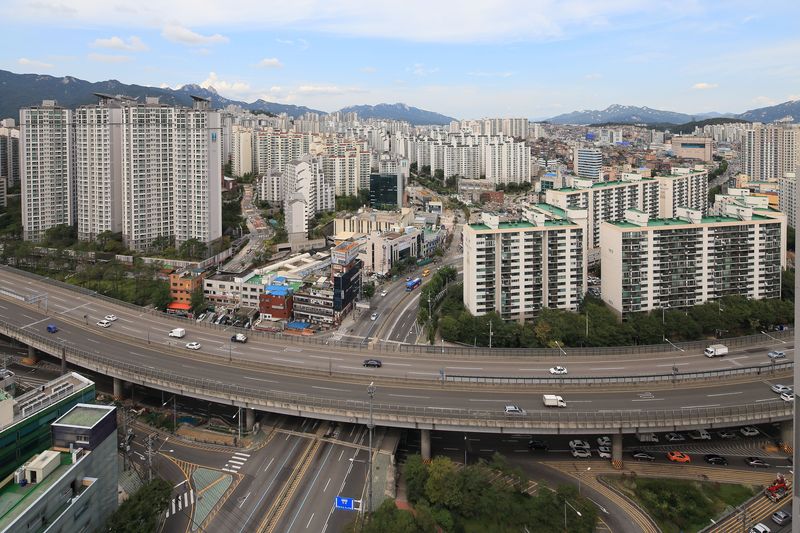
The impact of this disconnect on an ordinary household budget is harsh. Imagine a couple who have spent several years cutting back on dining out and tightening their belts as they prepare to buy an apartment for 800 million won.
Even if the apartment’s price rises by just 5%, it will jump by 40 million won to 840 million won. A household that steadily saves 2 million won every month would need exactly 20 months—that is, one year and eight months—to accumulate 40 million won without spending a single won.
Keeping 2 million won a month is a battle in itself. To save that much while covering food and tutoring costs for the children, interest on a jeonse loan and utility bills, a family has to give up many things in daily life.
All the money painstakingly saved over more than a year then goes up in smoke simply to cover the gap created by a 5% rise in home prices. In a system where the pace of home price increases outstrips the pace at which people can save through hard work, the diligent salaried worker’s dream becomes a mirage: take one step closer, and it moves two steps away.
■ The illusion of a 150-million-won drop in Gangnam... “Ten days” lost as families are pushed to the outskirts
This is why news that “home prices in Gangnam are falling” rings hollow for ordinary people in their 30s and 40s. If a 3-billion-won apartment in Gangnam falls 5%, its price drops by 150 million won.
For some, it may be a massive downturn, but even at 2.85 billion won, the apartment is still beyond the reach of an ordinary salaried worker. It is a league of its own, never an option for them in the first place. For a family breadwinner without a home, the truly despairing news is not the 150-million-won drop in Gangnam, but the reality that the 800-million-won home in Gangbuk they were hoping to buy has risen by 40 million won.
Ultimately, families squeezed by their budgets turn their attention to areas even farther out in Seoul or to Gyeonggi Province. In exchange for lower home prices, parents’ daily commutes grow by an hour. At five commuting days a week and 48 weeks a year, that adds up to a staggering 240 hours—a full “ten days” thrown away on the road.
Those ten days are not just commuting time. They are time to sit down for a meal and look their child in the eye after work, to talk over a can of beer with their tired wife, and to save their energy for the weekend. To cut housing costs, families are effectively selling off at a bargain the pieces of life they should be spending together.
■ The shadow of 91 straight weeks of rising prices... Family time lost while waiting for home prices to fall
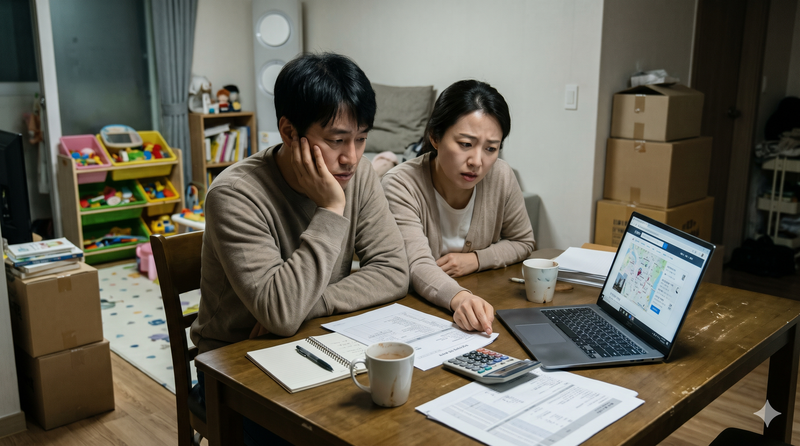
Seoul apartment prices have risen for 91 consecutive weeks—the longest streak since statistics were first compiled in 2012. For people who avoided taking on excessive debt to buy a home and have diligently saved while waiting for the market to stabilize, this record is like a cold punishment.
It is Sunday evening, the second Sunday of November. Tomorrow, countless family breadwinners will once again squeeze onto jam-packed subway trains. They will get through the week holding on to the hope that someday our family, too, will have a real home of our own where we need not fear being forced out.
They say home prices for the rich are falling by hundreds of millions of won at a time, yet the three-room apartment where our family could lay its head moves tens of millions of won further out of reach today. As we move from one jeonse rental to another, waiting for the right moment for prices to fall, the precious “family time” we should have been building in that home, sharing the ups and downs of life with our child, is slipping away just as helplessly.
[email protected] Jeon Sang-il Reporter