“Try it on a computer first, before experimenting”... SPILAB boosts manufacturing R&D efficiency
- Input
- 2026-11-09 14:41:09
- Updated
- 2026-11-09 14:41:09
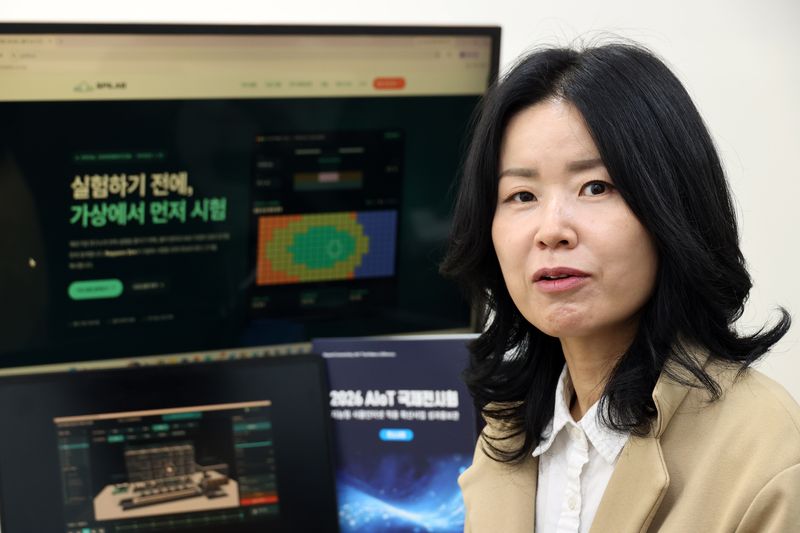
SPILAB CEO Lee Hye-young (photo) said in an interview conducted on the 9th that finding the optimal manufacturing process requires repeatedly testing many different conditions, but each experiment takes considerable time and money. She introduced SPILAB’s “virtual experimentation” technology as a way to address this.
Lee, who founded SPILAB in 2017, described it as “a software company that lets you try things out on a computer before conducting experiments.” The name SPILAB also conveys the idea of “a laboratory that solves problems through scientific methods.”
SPILAB is developing virtual experimentation technology that combines the laws of physics with AI to predict results on a computer before real experiments and identify optimal conditions. It is also developing virtual testing technology to verify in advance the safety and functionality of facilities and systems.
Lee explained, “Although our business areas have changed—from fintech data analytics to the Internet of Things (IoT), predictive maintenance of equipment, and more—our goal of building AI that understands the physical constraints of real-world environments has remained consistent.” She added, “Our accumulated experience in data analytics and anomaly detection led to the business we’re in today.”
SPILAB’s core competitive advantage is that it incorporates the laws of physics into AI. While conventional AI learns from historical data to identify patterns, SPILAB’s AI already understands physical laws—for example, that electric current generates heat and that a material’s properties change as its temperature rises—and operates on that basis.
Lee explained, “Because it starts with an understanding of physical laws, the technology can also be applied to new materials or equipment for which there is almost no data. We first generate virtual data using physical laws, then calibrate it to real-world conditions with a small amount of actual measurement data.”
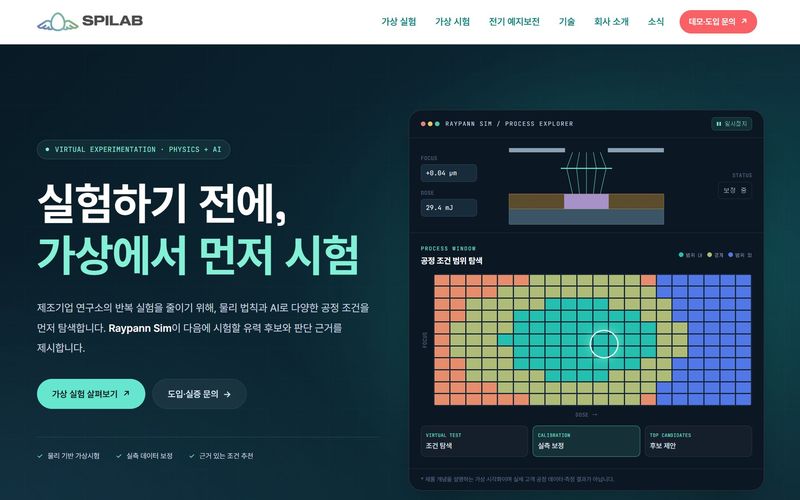
While virtual experimentation is a technology for finding optimal conditions for materials and processes, virtual testing verifies in advance whether facilities and systems will work properly in real-world environments.
SPILAB’s virtual testing technology is designed to recreate actual facilities or sites on a computer and repeatedly test them, from normal operating conditions to extreme and failure scenarios. It simulates movements and hazards countless times and records test results and the basis for its assessments. It can be applied to launch pad equipment, workplace safety, and urban flood response.
Lee explained, “If a problem arises after equipment has been built, the cost of making changes inevitably becomes high. Virtual testing lets us review different scenarios repeatedly during the design phase and identify in advance the conditions under which problems occur.”
SPILAB is a technology-focused organization, with six of its seven staff members working in R&D. Its headquarters is on the campus of Ulsan National Institute of Science and Technology (UNIST) in Ulsan, and it operates a research center in Seoul’s Geumcheon District.
External support that allows the company to focus on R&D is therefore also important. This is one reason it moved into KICXUP, a startup and business support space run by the Korea Industrial Complex Corporation.
Lee said, “The work environment at the facility is stable, and the support programs help us meet experts and find opportunities to collaborate, allowing us to focus on R&D and product development.”
The Korea Industrial Complex Corporation’s open innovation program also gave SPILAB a glimpse of its potential to expand overseas. During a visit to China, Lee came up with the idea of extending virtual experimentation to the robotics industry. That is because the properties and design of components subject to physical forces, such as robot joints and hands, are important.
Lee said, “For the robotics industry to grow, not only hardware but also the materials technology that goes into it must advance.” She added, “Technology that predicts material properties in advance and reverse-engineers conditions to achieve desired performance could also be used in developing robot components.” She emphasized, “SPILAB plans to further develop physics-based AI and virtual experimentation technologies that can be used in real manufacturing settings, focusing on semiconductors, batteries, and chemical-materials processes.”
/Jointly planned by Financial News and the Korea Industrial Complex Corporation
[email protected] Lee Ju-mi Reporter