Foreign tourists flock in, but government and National Assembly ‘foot-dragging’ raises fears of dampening K-tourism’s success
- Input
- 2026-11-08 15:10:42
- Updated
- 2026-11-08 15:10:42
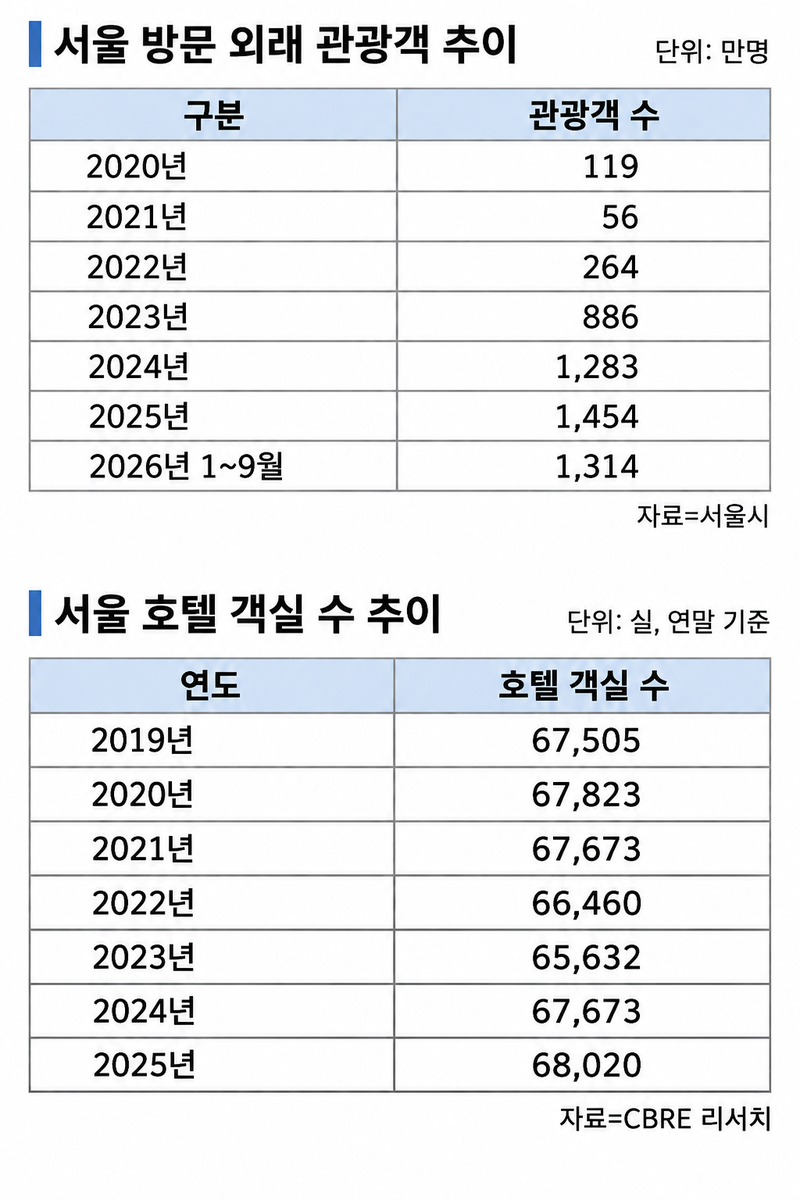
[Financial News] The number of foreign tourists visiting Seoul has climbed to an all-time high, but the lodging capacity available for them is markedly insufficient. Seoul’s requests—including expanded permission for shared accommodation and eased hotel construction regulations—have been held up by the government and the National Assembly of the Republic of Korea for a long time. There are concerns that the government and the National Assembly of the Republic of Korea’s ‘slow response’ could end up pouring cold water on K-tourism’s success.
According to a report recently released on the 8th by global real estate consultancy CBRE, titled ‘How Supply-Demand Gaps Have Changed the Value of Seoul Hotels and Strategies to Enhance Their Value Going Forward,’ the number of rooms in Seoul hotels and tourist hotels grew by an average of just 0.1% annually since 2019.
The number of rooms rose by just 515 over six years, from 67,505 at the end of 2019, before the spread of COVID-19, to 68,020 at the end of 2025. The total growth rate was 0.8%, with an average annual growth rate of around 0.1%.
CBRE explained, “The number of hotel rooms in Seoul increased by an average of 8.5% annually from 2010 to 2019, but new supply has effectively stagnated since 2019. This was due to existing hotels closing or changing their use during the COVID-19 period, as well as the limited development of new hotels.”
By contrast, the number of foreign tourists visiting Seoul is rising rapidly. According to the Seoul Metropolitan Government, the number of foreign tourists visiting Seoul, which had fallen to 560,000 in 2021 due to COVID-19, has risen each year to 8.86 million in 2023, 12.83 million in 2024 and 14.54 million in 2025. In particular, 13.14 million foreign tourists visited Seoul from January to September this year, a 21.5% surge from the same period last year (10.82 million) and a record high for that period.
Hotel room occupancy rates are also high. Cushman & Wakefield, one of the world’s three largest commercial real estate advisory and services firms, found that Seoul’s hotel occupancy rate was 79.2% last year, its highest level since 2017.
The hotel industry considers an average annual occupancy rate of around 80% to mean effectively full occupancy and an especially severe supply-demand squeeze. Given the minimum number of rooms kept vacant for routine inspections, cleaning and other purposes, this means reservations are impossible on weekends and during peak season, while severe accommodation shortages occur even on weekdays.
In response, the Seoul Metropolitan Government proposed regulatory changes to the government to make better use of existing lodging facilities and encourage the supply of new hotels. A key proposal, made last December, was to allow Korean nationals to use properties registered under the foreign-tourist urban homestay category. The proposal would expand eligible users, currently restricted by the Tourism Promotion Act to foreign tourists, to include Korean nationals, and rename the category ‘Urban Homestay Business.’
It also proposed easing construction regulations for small tourist hotels. The plan is to increase the supply of lodging facilities in the city center by relaxing requirements such as setbacks from neighboring lots and mandatory landscaping covering at least 15% of a site.
Following Seoul’s proposal, a plan to formally legalize shared accommodation for Korean nationals was also announced at the 11th National Tourism Strategy Meeting, held in February this year, but regulatory reform remains stalled. A Seoul Metropolitan Government official said, “Some aspects require legislation, so we are waiting for a response from the government.”
The government is also pursuing an amendment to the Tourism Promotion Act to allow Korean nationals to use properties under the foreign-tourist urban homestay category, but the actual implementation of the policy is expected to take time.
An official from the Ministry of Culture, Sports and Tourism said, “We are discussing with lawmakers’ offices an amendment to the law that would allow Korean nationals to use properties under the foreign-tourist urban homestay category,” but added, “Since this is a matter for the National Assembly of the Republic of Korea to decide, it is difficult to predict when the amendment will be made.”
However, easing landscaping regulations for small tourist hotels remains under review. An official from the Ministry of Culture, Sports and Tourism explained, “It is possible through an amendment to the Enforcement Decree of the Tourism Promotion Act, but consultation with relevant ministries, including the Ministry of Land, Infrastructure and Transport, is required,” adding, “We are still reviewing whether to make the amendment.”
[email protected] Sung Cho-rong Reporter