Only 3 in 10 companies are pursuing electrification as high costs slow the transition
- Input
- 2026-11-08 13:30:22
- Updated
- 2026-11-08 13:30:22
[Financial News] Corporate “electrification,” a key task of the Green Transformation (K-GX) for industrial competitiveness and carbon neutrality, remains at an early stage, a report has found. “Electrification” means converting facilities and processes that use fossil fuels such as coal, oil and gas to electricity-based systems.
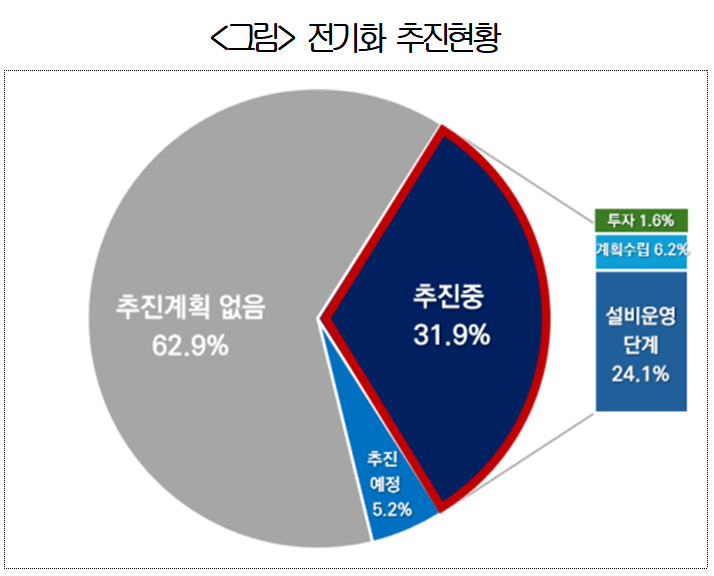
The Korea Chamber of Commerce and Industry said on the 8th that a survey of 307 companies among the top 1,000 by revenue found that only 31.9% were pursuing electrification, while more than half had no plans to do so. The survey was titled “Survey on the Status of Corporate Electrification and Policy Challenges.”
Among companies pursuing electrification, 42.0% said the burden was “somewhat high” and 14.8% said it was “very high,” meaning more than half (56.8%) felt burdened. The main sources of the burden were “high initial investment costs” (84.0%), “high operating costs” (56.2%) and “policy uncertainty” (18.5%), in that order.
Companies identified “incentives to reduce the burden of electricity procurement costs” (66.1%) as the policy most needed to support electrification. Other responses, in order, were “improvements to pricing and market systems” (61.9%), “greater predictability in energy policy” (45.0%) and “technology development and workforce training” (23.1%).
In a report on support for electrification in major countries and its implications, commissioned by the KCCI from Professor Jeong Yeon-je of Seoul National University of Science and Technology alongside the survey, Professor Jeong said, “To accelerate electrification—the replacement of fossil fuels with electricity—the burden of electricity procurement costs for companies must be eased.”
If electricity rates are high, operating costs after electrification may exceed those of using fossil fuels, weakening companies’ incentive to electrify. Professor Jeong went on to stress, “There is a need to establish support programs, as in major countries, that use government funds to reduce companies’ electricity procurement costs and help them electrify.”
Major countries operate support programs that ease electricity procurement costs for companies pursuing electrification and decarbonization. In the United States, some states and utilities offer rate incentives. For example, a Texas utility charges lower electricity rates to companies that use renewable energy, while California plans to introduce rate incentives for companies pursuing electrification. China exempts energy-intensive companies with high energy efficiency from rate surcharges.
Companies had high expectations for the burden-reducing effect of the industrial regional electricity pricing scheme scheduled to take effect next year, including its contribution to electrification: 91.8% responded positively. Specifically, 66.4% said it “would be effective,” while 17.9% reported “somewhat high expectations” and 7.5% “very high expectations.”
Regarding the potential for investment in new or expanded facilities outside the capital region following the introduction of the pricing scheme, 49.8% said it “would give them room to consider” such investment, while 11.4% expected it to “increase somewhat” and 3.3% to “increase significantly.”
Youngjun Cho, director of the KCCI’s Institute for Sustainable Management, said, “Corporate electrification is still at an early stage, and the pace of its spread will vary greatly depending on how the support system is established,” adding, “To ensure that companies do not hesitate to electrify because of the cost burden, we need to put in place both incentives to lower electricity procurement costs and a predictable pricing system.”
[email protected] Lim Su-bin Reporter