“Be cautious about both premature stop-losses and buying the dip”... Investment strategies for a sharp selloff
- Input
- 2026-11-08 16:01:15
- Updated
- 2026-11-08 16:01:15
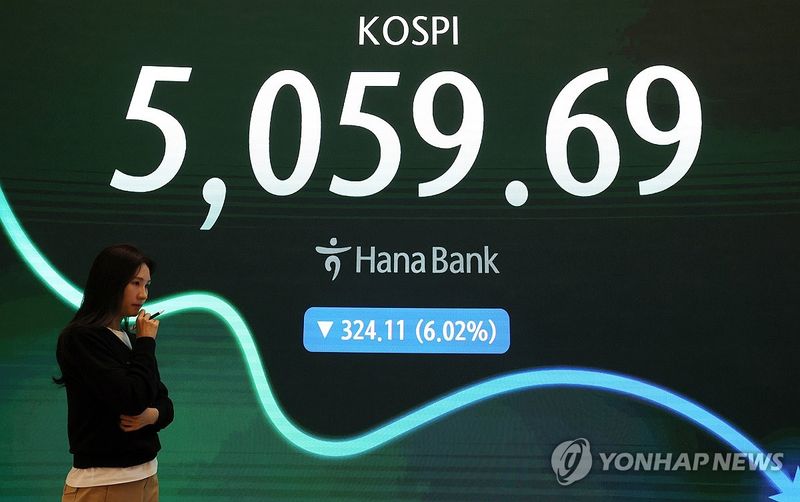
[Financial News] The so-called “blue tsunami”—a landslide Democratic victory in the U.S. midterm elections—sent the KOSPI below the 5,000 mark intraday on the 6th. Fear is spreading among investors, but asset management industry professionals advise against impulsive trading and recommend waiting to see how the market develops. They say the stock market’s fundamentals remain solid, although a further short-term correction cannot be ruled out amid concerns surrounding artificial intelligence (AI).■ “Political issues are short-lived, but investors should prepare for further correction” According to the Korea Exchange (KRX) on the 8th, the KOSPI closed at 5,059.69 on the 6th, down 324.11 points (6.02%) from the previous trading day. At one point during the session, it also slid to the 4,900 level.
The sharp market downturn stemmed from fears that the Democratic Party, which won the U.S. midterm elections, would regulate AI investment.
Asset management industry experts also said policy uncertainty and unsettled supply and demand would be difficult to resolve in the short term. They said this is a time for investors to assess the direction of stock prices rather than actively buying and selling.
Choi Hong-seok, head of the ETF Solutions Division at Woori Asset Management, said, “Policy events have always been short-lived,” but added, “Policy uncertainty is dampening investor sentiment, and a short-term correction seems inevitable as leveraged positions are unwound and quantitative selling takes place.” He continued, “Stock prices have already fallen too far, so this is not the time to cut losses. The fundamentals have not changed, so a recovery is possible; it would be appropriate to wait and see for a while.”
Hong Eun-pyo, head of the Quantitative Management Division at DB Asset Management, also said a holding strategy is effective during a sharp selloff accompanied by significant volatility. “With individual investors’ capacity to make additional purchases dwindling, if foreign investors start selling, there won’t be enough capital to absorb the selling, so stock prices are bound to fluctuate sharply,” Hong said. “Conversely, if market uncertainty eases and signs of a rebound emerge, stock prices will recover quickly, even amid volatility,” he predicted.
Some advise that investors who need funds in the short term should consider a different strategy. An official at an asset management firm said, “If you need the money within six months, you should consider selling some of your holdings and looking for other options later, rather than remaining exposed to volatility.”■ The “memory discount” persists... Potential shift in market leadersBecause the domestic stock market is highly dependent on semiconductors and can swing sharply in response to AI-related issues, volatility is seen as a risk to watch. Lee Kyung-jun, head of the ETF Management Division at KIWOOM, added, “The domestic stock market is overly dependent on memory semiconductors, making it vulnerable to changes in industry conditions. When memory prices rise, concerns about a slowdown in AI investment grow; when prices fall, concerns about a downturn in the semiconductor industry intensify. This ‘memory discount,’ which leaves the domestic market relatively undervalued, is persisting.”
The broad view is that although semiconductor stocks are undergoing a sharp correction, their position as market leaders is unlikely to be easily shaken, given the growth of the AI industry. However, analysts say the concentration in semiconductor stocks will ease as investors spread their interest across other sectors.
“It doesn’t seem that investors are moving entirely out of semiconductors and into value or dividend stocks,” Hong said. “The leading stocks will remain in place, while investors rotate into sectors with lower valuations.”
Others expect leadership to shift from semiconductors to financial stocks. The view is that as the semiconductor sector struggles, investors’ attention could turn to financial stocks, which are expected to benefit from their appeal as dividend payers and the government’s policy to advance the capital market.
“I think financial holding companies and mega-sized investment banks (IBs) will be the real beneficiaries,” Choi said. “Even if foreign investors enter the market, I think a lot of their investment could flow into those sectors.”
[email protected] Seo Min-ji Reporter