Jeju, the only province without a National Treasure, considers elevating Gwandeokjeong Hall... Proving its value, not its status as a “former National Treasure,” is key
- Input
- 2026-11-08 11:29:44
- Updated
- 2026-11-08 11:29:44
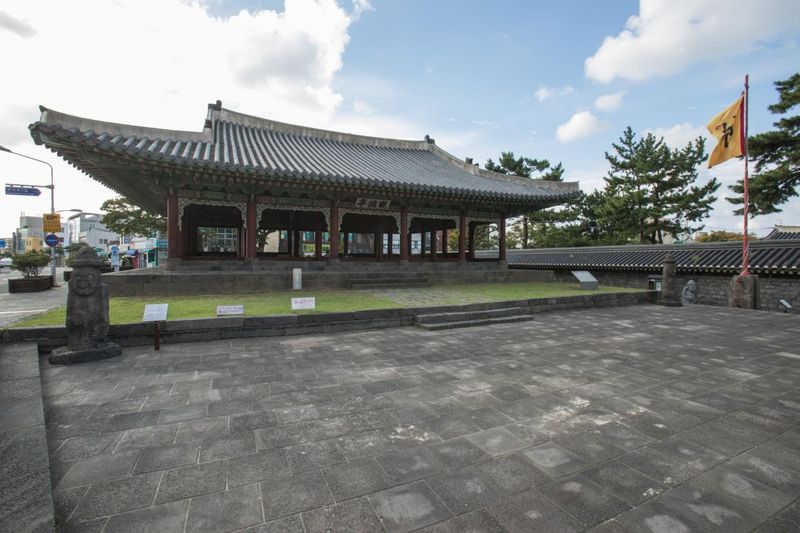
【Financial News, Jeju = Reporter Jeong Yong-bok】 A proposal has been made to objectively demonstrate the architectural rarity and historical value of Jeju’s Gwandeokjeong Hall as a basis for elevating it to National Treasure. Jeju is the only one of the country’s 17 provinces and metropolitan cities without a National Treasure. The central issue is how to connect its past designation history with today’s criteria for National Treasure status.
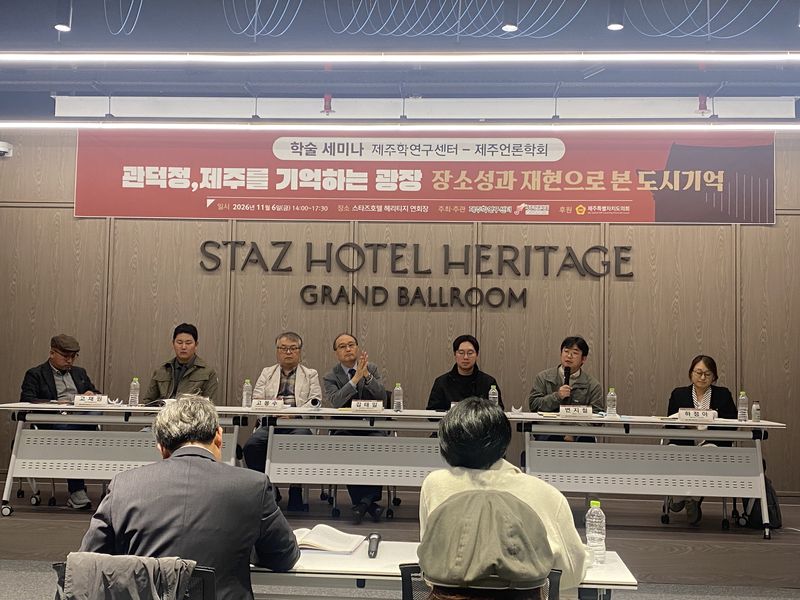
According to the Jeju Studies Center (Director Kim Wan-byeong) and the Jeju Journalists Association (President Jeong Yong-bok) on the 8th, the possibility of elevating Gwandeokjeong Hall to National Treasure and ways to use the site as a historical and cultural space were discussed at an academic seminar held on the 6th at the Starz Hotel Heritage in Jeju City. The seminar was titled “Gwandeokjeong Hall, a Plaza That Remembers Jeju: Urban Memory Through Place and Representation.”
The issue is to distinguish between the fact that Gwandeokjeong Hall was once a National Treasure and whether it meets the requirements for that designation today. The hall was designated National Treasure No. 478 in 1959. It was reclassified as Treasure No. 322 in 1963, during a reorganization of the national cultural heritage designation system following the enactment of the Cultural Heritage Protection Act in 1962.
This history alone does not prove that the hall’s heritage value diminished at the time. Conversely, the fact that it was once a National Treasure does not automatically restore that status today.
The current Act on the Preservation and Utilization of Cultural Heritage stipulates that heritage designated as a Treasure may be elevated to National Treasure, following deliberation by the National Heritage Committee, if it is highly valuable from the perspective of human culture and is rare or without precedent.
To be elevated to National Treasure, Gwandeokjeong Hall must undergo an academic assessment demonstrating, through comparison with other heritage sites, its architectural originality, historical significance and state of preservation.
In a presentation titled “Perspectives on Gwandeokjeong Hall: Historic Architecture and Sense of Place in Jeju’s Old Downtown,” Kim Tae-gon, head of the Cultural Heritage Division at the Jeju World Heritage Headquarters, outlined the possibility of elevating the hall to National Treasure by linking its architectural distinctiveness with the urban structure of Jeju Eupseong Fortress.
Built in 1448, Gwandeokjeong Hall stood, unlike ordinary pavilions, at the military and administrative center of Jeju Eupseong Fortress. It was connected to the Jeju-mok government office, a plaza and a road network, while features such as the elevated platform in front and the stone-paved area also reflect its character as a public building. Kim emphasized that the hall is a historical heritage site that illustrates not only the building itself but also the governing system of Jeju Eupseong Fortress and the formation of its urban space.
Cases of pavilions around the country being elevated to National Treasure show what Gwandeokjeong Hall must do. Yeongnamnu Pavilion in Miryang and Jukseoru Pavilion in Samcheok were elevated to National Treasure in December 2023. In July this year, Gwanghallu Pavilion in Namwon was designated a National Treasure, 63 years after it was designated a Treasure in 1963.
Gwanghallu Pavilion’s 2023 review for elevation to National Treasure was put on hold because historical research on its construction period and style was insufficient, and further investigation followed. Findings that established the construction period through methods including analysis of tree rings in the timber became important evidence in the subsequent review. Gwandeokjeong Hall, too, must demonstrate that its value meets the criteria for National Treasure designation through nationwide comparative research on architectural heritage and verification of historical records.
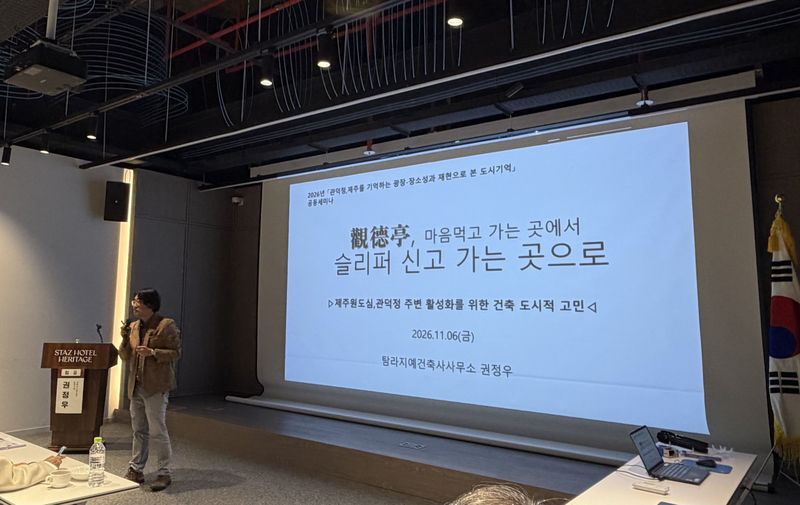
Separately from the question of National Treasure status, participants also discussed ways to connect Gwandeokjeong Hall’s historical sense of place with residents’ everyday lives. In a presentation titled “From a Place You Make a Special Trip to Visit to One You Can Walk to in Slippers,” Kwon Jeong-u, director of the Tamna Jie Architecture Office, proposed redesigning the area around pedestrian access, linking the wall-side path of the Jeju-mok government office with Jeju Buk Elementary School and nearby neighborhood businesses.
The idea is to connect Jeju Buk Elementary School’s Centennial Memorial Hall and Kim Young-su Library as historical and cultural spaces, improve disconnected pedestrian routes, and make the area around Gwandeokjeong Hall a place residents use in their everyday lives.
However, creating pedestrian paths and altering spaces around the walls will require consideration of national heritage preservation standards, school safety, and the interests of residents and business owners. The feasibility and procedures for these plans must be assessed separately, regardless of whether the hall is elevated to National Treasure.
How to preserve and convey the historical memory of Gwandeokjeong Hall was also raised as an important issue.
In his opening remarks, Kim Wan-byeong, director of the Jeju Studies Center, described Gwandeokjeong Hall and the plaza in front of it as a space where changes in Jeju’s politics and administration, as well as its society and culture, have accumulated. He stressed the importance of preserving the physical form of cultural heritage while also passing on the stories of the people connected to it and creating new value.
In his welcoming remarks, Jeong Yong-bok, president of the Jeju Journalists Association, described Gwandeokjeong Hall as a site of governance during the Joseon Dynasty and a plaza where the lives, resistance and suffering of citizens in modern and contemporary times intersected. Referring in particular to the March 1 Independence Movement Day shooting in 1947, which sparked the Jeju April 3 Incident, he posed the question, “How can we preserve memories of the past while making room for life today?”
President Jeong explained the sense of place of Gwandeokjeong Hall by drawing connections between Pierre Nora’s “sites of memory,” Henri Lefebvre’s “production of space” and Barbie Zelizer’s “journalism and memory.” He also emphasized the need to reflect on what histories the media have recorded and which voices they have failed to represent adequately.
The panel discussion addressed ways to document vanished buildings in the old downtown area and recreate history using artificial intelligence (AI).
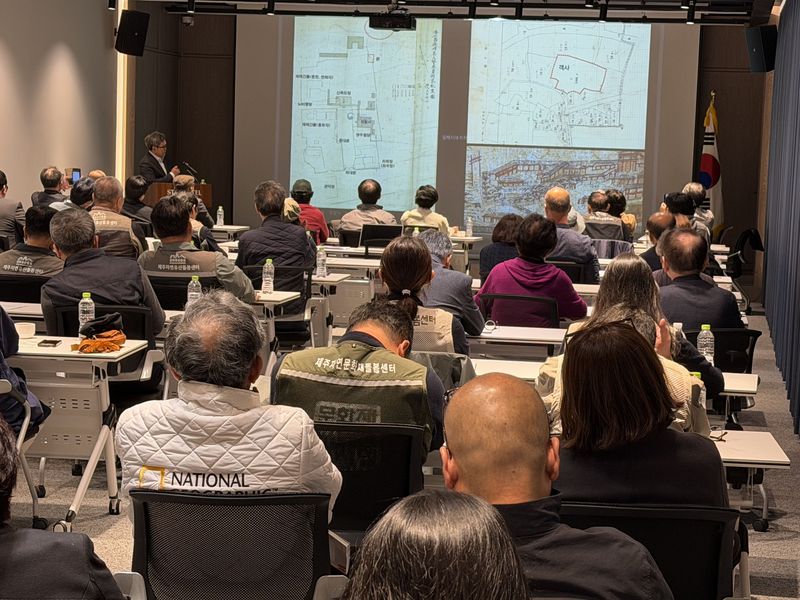
Ko Sang-hyun, a reporter for Jeju CBS, cited the Dongyang Inn, the Hyundai Theater and the former Jeju City Hall building to call for preserving residents’ lived histories and memories during urban regeneration.
Ko Byeong-jeong, a professor at Cheju Halla University, divided the digital representation of Gwandeokjeong Hall into documentation, restoration and expansion, and proposed using old photographs, historical records and media archives. He stressed that scenes reconstructed with generative AI should be distinguished from verified historical facts, and that the views of bereaved families and the local community should be reflected when representing the memories of victims of the Jeju April 3 Incident.
Byeon Ji-cheol, a reporter for Yonhap News Agency, proposed making activities recorded in the “Tamna Sunryeokdo,” including the presentation of citrus and tribute horses and archery, regular public-participation history programs, so that Gwandeokjeong Hall and the Jeju-mok government office would become historical and cultural spaces that people visit throughout the year.
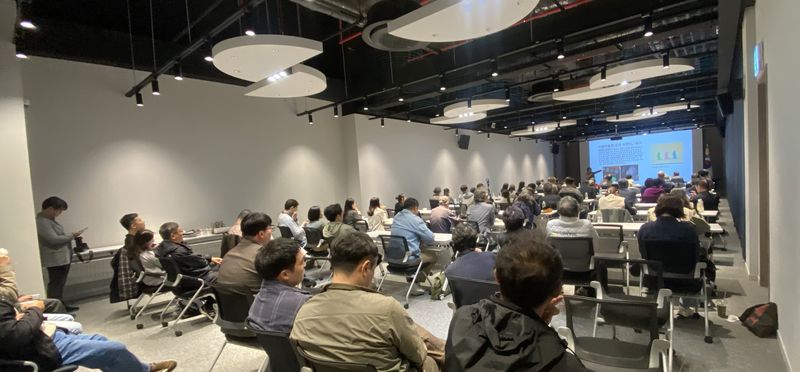
The seminar was jointly organized and hosted by the Jeju Studies Center and the Jeju Journalists Association, with support from the Jeju Special Self-Governing Provincial Council. The panel discussion, moderated by Kim Tae-il, a professor at Jeju National University, included Ko Bong-su, Ko Sang-hyun, Ko Jae-won, Ko Byeong-jeong, Byeon Ji-cheol and Ha Jeong-a, among others.
The debate over elevating Gwandeokjeong Hall to National Treasure involves two distinct challenges: the national heritage designation process and the use of space in the old downtown area. Its past National Treasure designation should be reconsidered, but academic evidence that meets current standards must also be secured, along with ways to connect the site to residents’ daily lives without damaging historical memory.
The fact that Jeju has no National Treasures can be a starting point for raising the issue, but it cannot substitute for grounds for designating one. The direction of the debate over elevation is likely to depend on how persuasively Gwandeokjeong Hall’s historical and architectural value can be demonstrated in comparison with national heritage sites across the country.
[email protected] Jeong Yong-bok Reporter