Robots handle hydrogen refueling with ease... Hyundai Motor Group accelerates commercialization of the hydrogen industry
- Input
- 2026-11-08 09:26:04
- Updated
- 2026-11-08 09:26:04
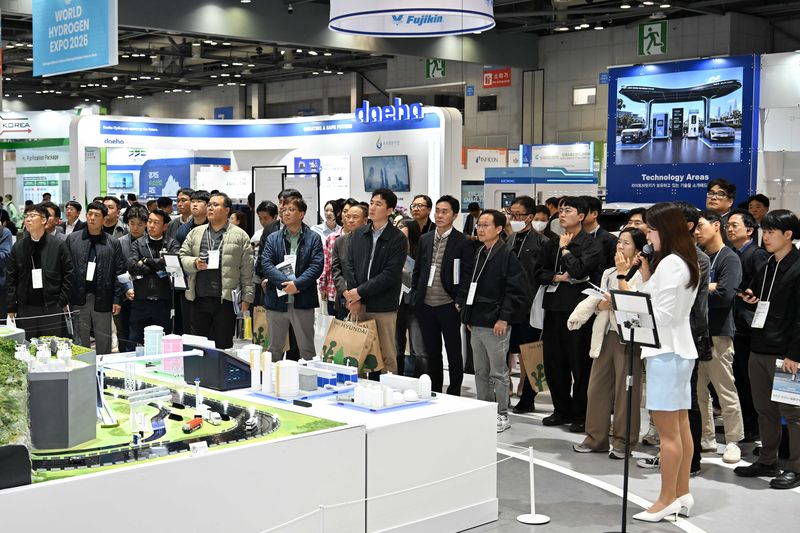
[Financial News] Hyundai Motor Group is accelerating efforts to build a hydrogen industry ecosystem linking hydrogen production, mobility and urban infrastructure. Showcasing AI-powered hydrogen refueling robots, large-scale water electrolysis facilities and operating systems for hydrogen commercial vehicles, the group highlighted its capabilities in bringing technologies to market, beyond simply developing them. It is also seeking to generate real demand for hydrogen by discussing the adoption of hydrogen mobility and expansion of refueling infrastructure with domestic and international transportation and logistics industries.
■ From hydrogen production to refueling...commercialization technologies unveiled
Hyundai Motor Group said on the 8th that it had wrapped up its exhibition at World Hydrogen Expo 2026 (WHE 2026), held from the 4th to the 6th at KINTEX in Goyang, Gyeonggi Province. This year’s event drew 197 companies and institutions from 12 countries and around 18,600 visitors over three days.Hyundai Motor Group set up a 720-square-meter exhibition pavilion showcasing technologies that connect hydrogen production and mobility with future urban infrastructure. It unveiled for the first time its configuration for a 5-MW-class electrolyzer stack module (ESM), a commercial fuel cell system with improved durability, and an automatic refueling robot for hydrogen fuel cell vehicles.
In the hydrogen production field, the group introduced a proton exchange membrane (PEM) water electrolysis plant and W2H (Waste-to-Hydrogen) technology, which converts waste resources into hydrogen. The PEM electrolysis technology combines 12 stacks into a 5-MW-class module; connecting these modules in parallel makes it possible to scale up to a large plant with a capacity of hundreds of megawatts.
In the mobility field, the group exhibited the 2027 Hyundai Nexo, a model of a hydrogen-powered locomotive, and fuel cell modules for railways. An automatic refueling robot for hydrogen fuel cell vehicles drew visitors’ interest as it demonstrated how it recognizes a truck’s refueling port and fills it. The technology received an Excellence Award at the H2 Innovation Award during the event.
Hyundai Motor Group also unveiled BlueLink Uptime Care, an integrated monitoring system for hydrogen commercial vehicles. The plan is to expand its hydrogen commercial vehicle business beyond supplying vehicles by offering an operating solution that also supports vehicle status monitoring and maintenance.
■ 181 take rides on hydrogen buses...global cooperation expands
The event also offered a chance to assess the real-world operability of hydrogen commercial vehicles. Hyundai Motor Group presented a Hyundai Elec City hydrogen-powered low-floor metropolitan bus, which it is developing in response to the requirement to introduce low-floor metropolitan buses in 2027.A total of 181 people took part in test rides on the Universe hydrogen fuel cell bus and the New XCIENT hydrogen fuel cell truck, including domestic and international transportation and logistics industry representatives from Taiwan, Japan and China. Participants experienced the quietness and ride comfort of hydrogen commercial vehicles on a 6.2-kilometer route around the exhibition venue.
The group also discussed ways to cooperate with domestic and international transportation industry representatives on introducing hydrogen buses, expanding refueling facilities and producing clean hydrogen. Park Sang-wook, CEO of Zero Cool Tour, said, “We operated around 40 hydrogen buses this year and found that satisfaction was high. Passengers responded especially well to the quiet ride and the pleasant driving environment without exhaust emissions.”
In the hydrogen ecosystem field, the group unveiled a model for a future industrial city centered on the Saemangeum AI Valley, linking renewable energy, hydrogen, AI data centers and robotics. It also presented ways to use hydrogen tailored to regional characteristics, including urban living, port logistics and manufacturing.
Hyundai Motor Group also took part in the Global Hydrogen Industry Conference held on the 4th, where it discussed ways to boost investment in hydrogen projects and promote international cooperation.
Hydrogen Council CEO Ivana Jemelkova observed that the hydrogen industry is shifting its focus from technological feasibility to building viable business models. She said South Korea has significant potential to expand into water electrolysis and industrial applications, drawing on its experience in building a hydrogen mobility ecosystem.
At a panel discussion, Hyundai Motor Group emphasized, “Hydrogen mobility is an important foundation for expanding the hydrogen industry by creating real demand for hydrogen and driving growth in refueling infrastructure, supply chains and the materials, parts and equipment industries. The government, industry and academia must work together to create a virtuous cycle in which demand growth, investment and infrastructure development are organically linked.”
[email protected] Kim Dong-ho Reporter