Strike activity falls, but production losses surge 45%... Labor warning signs in autos and shipbuilding
- Input
- 2026-11-08 08:38:37
- Updated
- 2026-11-08 08:38:37
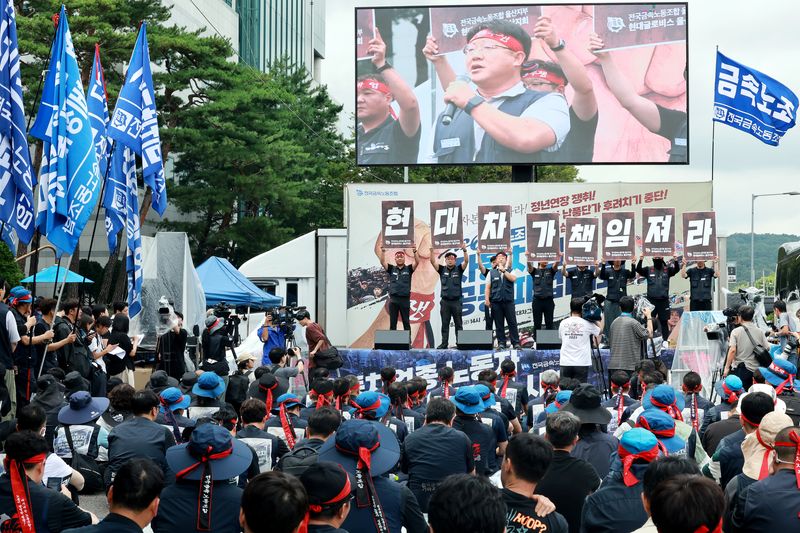
[Financial News] The number of labor disputes in South Korea fell this year, but lost workdays surged by at least 45% as strikes in key manufacturing industries such as autos and shipbuilding dragged on. Repeated strikes at major workplaces, including Hyundai Motor Company, HD Hyundai Heavy Industries and Hanwha Ocean, have been followed by labor-management conflicts at HL Mando, a key auto-parts supplier, heightening concerns about supply-chain instability across industry. It has been pointed out that companies are facing higher labor costs and greater management uncertainty as union demands have expanded to include distributing a fixed share of corporate profits as performance bonuses, extending the retirement age and making new hiring mandatory.
■ Strike-related losses surge 45%... Hyundai Motor faces 2.3 trillion won in lost sales
According to data released on the 8th by the Korea Enterprises Federation (KEF) on labor-management relations in major manufacturing industries such as autos and shipbuilding, there were 88 labor disputes in South Korea as of the end of September this year, 11 fewer than the 99 recorded during the same period last year. By contrast, the number of workdays lost due to strikes and other causes rose 45.2% to 489,190, up from 336,800 in the same period a year earlier. Although the number of labor disputes fell, repeated strikes, particularly at major manufacturing workplaces, increased the scale of disruption on the ground.Hyundai Motor Company was a prominent case. During this year's wage negotiations, its union demanded a 149,600-won increase in base pay, performance bonuses equal to 30% of the previous year's net profit, and an extension of the retirement age to 65, among other things. After staging repeated partial strikes beginning in July, the union held an eight-hour full-scale strike on August 21, the first in 10 years since 2016.
This year, strikes by the Hyundai Motor Company union totaled 60 hours across members' shifts, while actual production-line shutdowns totaled 120 hours. Industry estimates put the resulting production disruption at about 55,200 vehicles and lost sales at at least 2.3 trillion won.
Hyundai Motor Company and its union ultimately agreed on a 100,000-won increase in base pay, a performance bonus of 400% plus an additional 12.7 million won, 15 shares of stock and 500,000 won in welfare points, among other items. Wage negotiations concluded after 61.55% of union members voted in favor on August 31.
The shipbuilding industry saw a similar situation. HD Hyundai Heavy Industries' union staged a total of 11 partial strikes, demanding a base-pay increase and the sharing of at least 30% of operating profit, among other things. On October 18, the union branch head also began a sit-in atop a crane at the company's facility.
HD Hyundai Heavy Industries and its union reached an agreement that included a 120,000-won increase in base pay, a lump-sum payment of 11.5 million won and 200%, and 300,000 won in welfare points. They finalized negotiations on the 27th of last month.
Strikes at Hanwha Ocean also continued from late August, disrupting production, including a shutdown of the Goliath crane, a key piece of production equipment at its Geoje plant. Following a sit-in atop a crane by the union branch head and a strike by all union members, the two sides agreed on the 29th of last month to a 140,000-won increase in base pay and a lump-sum payment of 8.5 million won, among other terms.
■ HL Mando conflict drags on... strain on automakers' supply chains
The KEF said that although labor-management conflicts in the auto and shipbuilding industries had subsided for now, strikes in the auto-parts industry were emerging as a new supply-chain risk. In particular, it warned that a prolonged labor dispute at HL Mando, a key parts supplier, could affect vehicle production at automakers including Hyundai Motor and Kia.The HL Mando union has refused overtime and weekend work since the 9th of last month, and staged partial strikes on the 28th of last month and the 2nd of this month. It has also announced plans for further labor action.
HL Mando is a key parts supplier, accounting for about 50.3% of the brakes, 50.4% of the steering systems and 75.8% of the suspension systems supplied to Hyundai Motor and Kia. Given the nature of the auto industry, automakers use just-in-time (JIT) production to minimize parts inventories, so a disruption in the supply of key components could spread across entire production lines.
As of last year, 292 suppliers did business with HL Mando's domestic operations. These suppliers employed about 40,880 people in total, while HL Mando's annual purchases amounted to about 1.5 trillion won. Analysts say that if labor-management conflict drags on, it could affect production and employment at suppliers beyond the individual workplace.
In this year's wage and collective-agreement negotiations, the HL Mando union is demanding regular payments of 15% of operating profit as special bonuses, an extended retirement age without wage cuts, and the automatic hiring of permanent employees within two months whenever positions become vacant through natural attrition, among other things. Other issues include expanding paid union activities for union officers and delegates, and a severance-pay calculation method that allows employees to choose the three months of the year most favorable to them.
The KEF expressed concern that these demands could raise companies' fixed labor costs and constrain the flexibility of workforce management needed to respond to changes in production volumes and equipment automation.
In particular, demands for workers to receive a fixed share of company profits stood out in this year's labor disputes at major manufacturers. The Hyundai Motor Company union sought 30% of net profit as performance bonuses, the HD Hyundai Heavy Industries union sought 30% of operating profit, and the HL Mando union sought 15% of operating profit.
The KEF said that if demands to share profits following short-term improvements in business performance lead to an extended retirement age, increased fixed bonuses and mandatory new hiring, companies could face a heavier cost burden when business conditions deteriorate.
A KEF official stressed, “Major manufacturing industries such as autos and shipbuilding are connected to numerous suppliers and upstream and downstream industries, so labor-management disputes at individual workplaces can spread across industry as a whole,” adding, “Labor and management need to take a comprehensive view of not only short-term results but also global competition, the need for future investment and the effects on suppliers in order to establish sound bargaining practices.”
[email protected] Kim Dong-ho Reporter