Vietnamese wages have risen 4.5-fold, but Korean companies say, “We’re not leaving”... Why?
- Input
- 2026-11-08 11:00:00
- Updated
- 2026-11-08 11:00:00
[Financial News] Although labor costs in Vietnam have risen more than 4.5-fold in 14 years, nine out of 10 Korean companies operating there plan to maintain their businesses, a survey found. They believe Vietnam remains more cost-competitive than other countries in production, procurement and logistics, despite rising labor costs. In particular, as Vietnam emerges from a mere production base into a key overseas hub with a domestic market of its own, Korean companies are also changing their strategies for operating there.
■ 92% say they will “stay in business” despite wages rising 4.5-fold
According to a report released on the 8th by the Korea International Trade Association’s Institute for International Trade (IIT), 92.0% of the 113 Korean companies operating in Vietnam said they had no intention of withdrawing from their local businesses. The survey was conducted from July 27 to September 16.Vietnam’s monthly minimum wage, converted to U.S. dollars, rose more than 4.5-fold, from $45.4 in 2010 to $205.3 in 2024. Its average annual rate of increase was 11.4%, the highest among major Asian countries. Nevertheless, companies seeking to maintain their businesses there continued to rate Vietnam’s cost competitiveness highly.
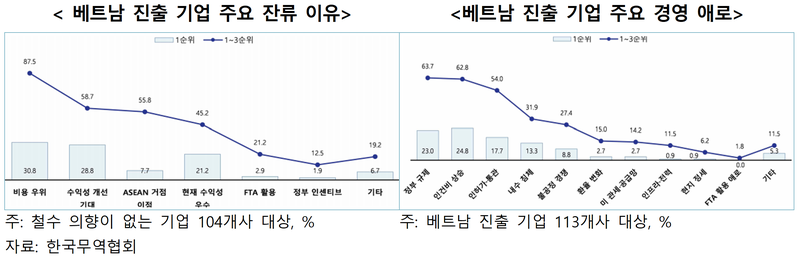
Among the 104 companies with no intention of withdrawing, the most commonly cited reason for staying was “cost advantages over other countries,” named by 87.5%. This means Vietnam is considered more competitive than other countries not simply because labor is cheaper, but when productivity, the ability to secure workers, and procurement and logistics conditions are taken into account as a whole.
Korean companies’ view of Vietnam is also changing. Whereas it was once seen as an export production base leveraging low wages, more companies are now using it as a business hub targeting the local consumer market.
Asked why they had entered Vietnam, the largest share of respondents, 54.9%, cited “domestic sales.” This was followed by “ASEAN hub” (50.4%), “exports to third countries” (38.9%) and “supply to Korea” (25.7%). The analysis is that more companies are entering Vietnam with an eye not only to cutting production costs but also to the growth potential of the Vietnamese market itself.
■ Emerging as a key hub... regulatory burdens remain a challenge
The outlook for future business is also positive. A total of 59.3% of the companies surveyed expected business conditions in Vietnam to improve over the next 3–5 years. Only 12.4% expected them to worsen. In particular, 71.7% said Vietnam would continue to be a key overseas hub.However, the outlook differed sharply by industry. In textiles, apparel and footwear, 53.8% expected business conditions to worsen, far more than the 15.4% who expected improvement. The analysis is that rising wages are creating a growing burden, particularly in labor-intensive industries.
The main business challenges cited by companies operating in Vietnam included government regulations (63.7%), rising labor costs (62.8%), and licensing, customs clearance and quarantine procedures (54.0%). In other words, while cost competitiveness remains high, regulations and administrative procedures are obstacles to business expansion.
The Korea International Trade Association cautioned that Vietnam’s competitiveness should not be judged solely on the basis of its past low-wage structure. It said companies should review costs and contributions to profitability by function, including production, procurement, logistics and sales, and adjust their business structures to reflect changes in demand in the local consumer market.
It also stressed that companies seeking to diversify their production bases across other countries should take into account not only the savings in labor costs but also the costs of relocating equipment, obtaining permits again, logistics, delivery times and quality control.
Im Yun-ho, a researcher at the Korea International Trade Association, said, “The sustainability of business in Vietnam depends on leveraging the advantages of existing locations while strengthening operational capabilities to meet changing conditions. Rather than maintaining businesses solely on the basis of past cost advantages or expectations of future growth, companies should continually review productivity, local demand, how they respond to regulations, and organizational management.”
[email protected] Kim Dong-ho Reporter