“Retail investors can’t sleep”...KOSPI plunges 11.71%; what are securities firms forecasting?
- Input
- 2026-11-08 08:54:06
- Updated
- 2026-11-08 08:54:06
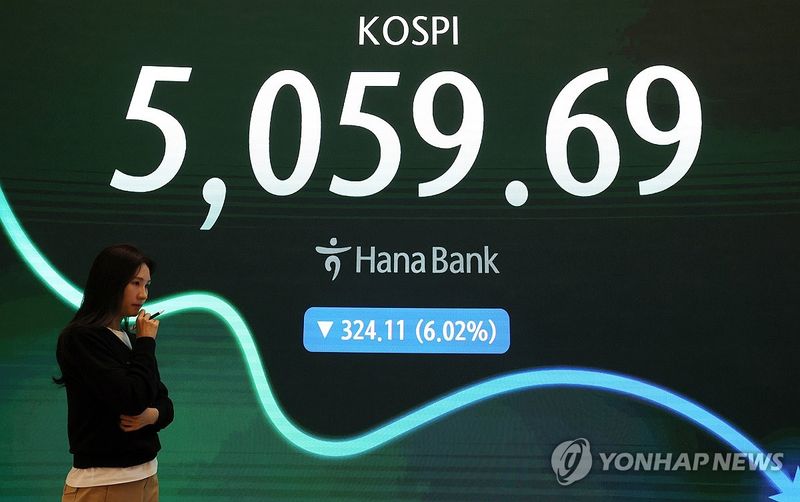
[Financial News] The KOSPI plunged more than 11% in a week amid concerns that AI investment would contract—concerns that spread after the U.S. midterm elections—and heavy foreign selling. The so-called “blue tsunami,” referring to a sweeping Democratic Party victory, raised the prospect of tighter regulations on AI data centers and sent shock waves through South Korea’s stock market.
The main factors to watch in the stock market this week are results from U.S. AI infrastructure company CoreWeave and inflation data. Some expect a rebound after the recent plunge if concerns about AI investment ease and foreign selling subsides.
Intraday drop below 5,000 for the first time in nine months...down 11.71% in a week
The KOSPI fell 11.71% last week (November 2–6), dropping to the 5,000 level. According to the Korea Exchange on the 8th, the KOSPI closed at 5,059.69 on the 6th, down 671.05 points (11.71%) from 5,730.74 on October 30, the final trading day of the previous week.
The decline was concentrated on the 5th and 6th. The KOSPI plunged nearly 11% over the two days, and on the 6th, the index fell more than 8% shortly after the market opened, triggering a circuit breaker.
That day, the KOSPI fell as low as 4,911.28 intraday, slipping below the 5,000 mark. It later recouped some of its losses, keeping the index above 5,000 at the close. The last time it fell below 5,000 intraday was about nine months earlier, on February 6.
The U.S. midterm election results contributed to the plunge. The Democrats won control of both chambers of Congress and also won gubernatorial races in major areas where data centers are concentrated, including Texas, bringing the prospect of tighter regulation of AI infrastructure into focus. Concerns spread that construction of new data centers could be delayed as a result.
The financing burden of the massive AI capital spending planned by U.S. big tech companies also weighed on the market. As questions grew over whether they could generate sufficient returns relative to the scale of their investments, investor sentiment deteriorated rapidly, particularly toward semiconductor stocks.
Heavy net selling by foreign investors also fueled the KOSPI’s decline. Foreign investors’ net selling on the KOSPI market last week amounted to 10.381 trillion won.
Analysts say the KOSPI’s recent losses have been excessive. However, they believe foreign selling must first subside for a meaningful rebound to take hold.
Ha Jang-kwon, an analyst at Hanwha Investment & Securities, said the intensity of foreign selling had already passed its peak, but that it was necessary to wait for further confirmation of whether foreign capital would return to the domestic stock market in earnest. He explained that when foreign capital flowed in steadily in the past, the won strengthened, the dollar weakened and real interest rates fell together, making it crucial to see whether concerns about further U.S. rate hikes would ease.
NH Investment & Securities expected the KOSPI to trade in the 5,000–6,000 range this week. It said that easing concerns over AI data center regulations and stable oil prices and interest rates could help lift the index, while continued outflows of foreign capital could put further downward pressure on it.
Na Jeong-hwan, an analyst at NH Investment & Securities, said the possibility of a complete halt to data center construction was limited, since the Democrats also support competing with China for AI dominance. He explained that the regulations are focused not on banning data center construction itself but on reducing residents’ electricity bills.
AI investment sustainability put to the test...CoreWeave results and U.S. inflation in focus
This week, the market is expected to focus on CoreWeave’s results and U.S. inflation data, which could help determine whether investment in AI infrastructure is sustainable.
CoreWeave has put the financing burden facing AI infrastructure companies in the spotlight, as its corporate bond yields and credit default swap (CDS) premiums have risen sharply in recent weeks. As a result, this earnings report is expected to be assessed not only on the scale of revenue growth but also on cash flow, interest expenses and future financing plans.
The trajectory of U.S. inflation is also expected to affect whether the stock market rebounds. The U.S. October Consumer Price Index (CPI) is due to be released on the 10th (local time), followed by the Producer Price Index (PPI) on the 13th. If inflation eases, Treasury yields could stabilize, potentially lifting share prices, particularly for growth stocks that have fallen sharply recently.
[email protected] Han Seung-gon Reporter