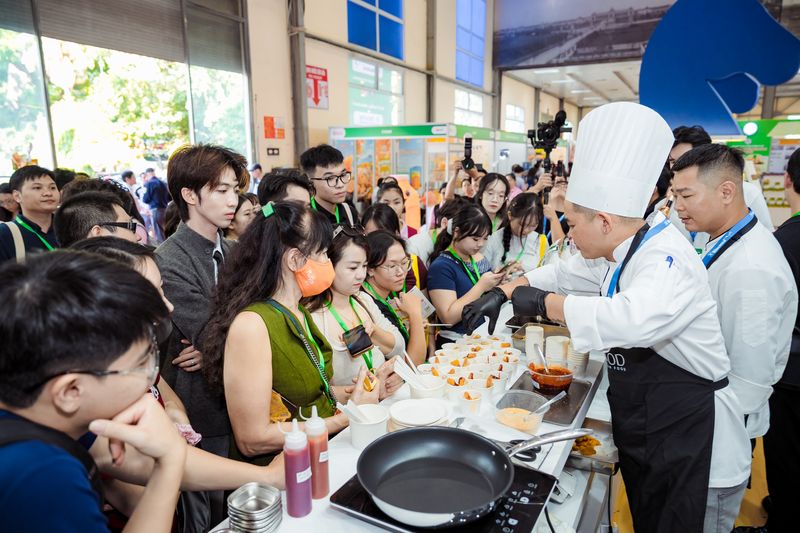
On the 4th, Vietnamese visitors flocked to the K-food tasting event jointly run by the Ministry of Agriculture, Food and Rural Affairs and the Korean Embassy in Vietnam, outside the Korean pavilion at the Hanoi International Exhibition Center, where the Hanoi International Food Expo was being held. They came to try chicken nuggets and kimchi pancakes. Photo: Korea Agro-Fisheries & Food Trade Corporation (aT) 【Hanoi, Vietnam = Correspondent Kim Jun-seok】
“Em ơi, một miếng nữa (Excuse me, one more, please)!”Outside the Korean pavilion at the Hanoi International Food Expo, held on the 4th at the Hanoi International Exhibition Center in Vietnam, a huge crowd gathered in front of the K-food tasting event jointly run by the Ministry of Agriculture, Food and Rural Affairs and the Korean Embassy in Vietnam, eager to sample the prepared chicken nuggets and kimchi pancakes. Far more people than expected kept streaming in, and staff at one side of the venue were busy cooking food for sampling without a break.
Mai, a homemaker in her 40s who tried the chicken nuggets, exclaimed “Rất ngon” (very delicious) and gave a thumbs-up. Hearing that Korean companies, including Harim, had begun exporting heat-treated chicken products to the local market in earnest, Mai was thrilled. “Unlike Vietnamese chicken, which tends to be somewhat chewy, Korean chicken is crispy on the outside and very tender inside, so I think I’ll often buy it as a snack for my children or for a late-night meal,” Mai said.
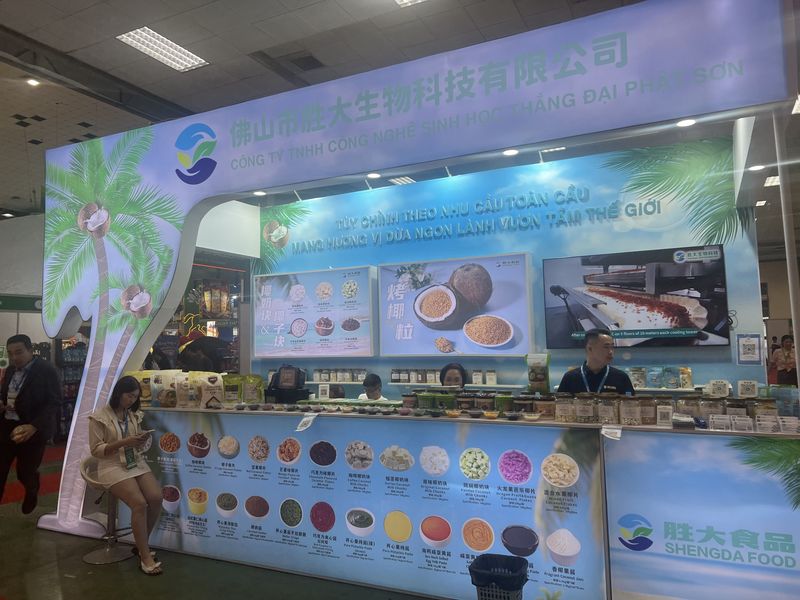
The booth of Shengda Foods, based in Foshan, Guangdong Province, China, at the Hanoi International Food Expo, held on the 4th at the Hanoi International Exhibition Center in Vietnam. Photo: Correspondent Kim Jun-seok By contrast, booths run by Chinese food companies were quiet compared with the bustling Korean pavilion. The reporter met Tao, an office worker in their 30s, in front of a booth run by a specialty spice and sauce company jointly operated by Chinese and Vietnamese firms. “The food seems all right, but I’ve been seeing a lot of news lately about food safety and hygiene issues involving Chinese food, so I’m hesitant to try it,” Tao said before walking away.
At the dried seafood booth they visited next, attendees asked pointed questions such as “Where was the fish caught?” and “Where is the factory?” When asked why the questions kept coming, one local visitor replied, “Because it’s food my family will eat.”
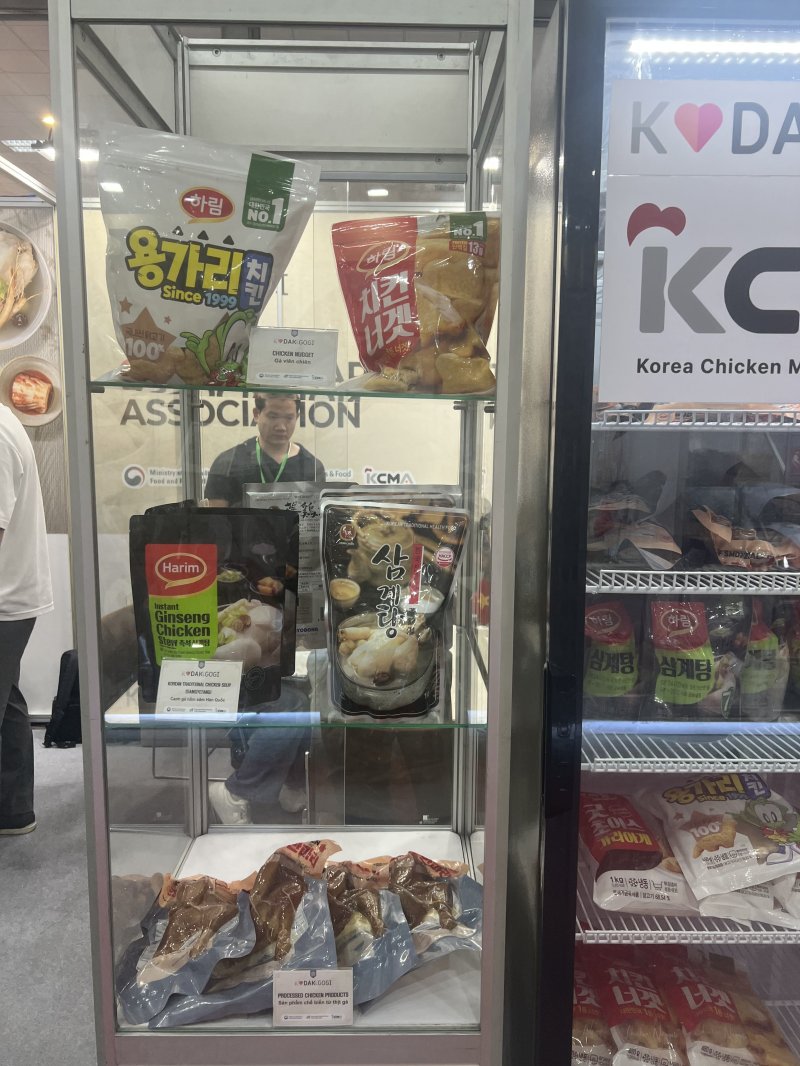
Harim’s processed chicken products on display in front of the Chicken Export Council booth in the Korean pavilion at the Hanoi International Food Expo, held on the 4th at the Hanoi International Exhibition Center in Vietnam. Photo: Correspondent Kim Jun-seok ■ Harim: “Betting on the premium market with products made in Korea”The Korean pavilion featured 11 companies and one integrated organization, with a total of 14 booths, including an information desk run by the Korea Agro-Fisheries & Food Trade Corporation (aT). To help expand exports and secure K-food distribution networks, major local buyers were also invited, including WinCommerce, Vietnam’s leading distributor under Masan Group (the country’s largest food company) and operator of WinMart, and Thuy Anh Fruits, a distribution channel specializing in fresh fruit.
At the Korean pavilion, efforts to identify the “next K-food” beyond established popular items such as tteokbokki, ginseng products, ramen and sauces also stood out. In particular, interest focused on chicken products after President Lee Jae-myung’s visit to Vietnam this past April paved the way for exports of processed chicken products.
Lee Dae-beom, head of Harim’s Vietnam subsidiary, told this publication that the company is targeting sales of about 70 tons this year and plans to increase volumes to 40–80 tons per month starting six months after entering the market. The four products currently available in Vietnam are samgyetang (ginseng chicken soup), chicken nuggets, chicken karaage and Yonggari Chicken. Unlike companies that typically enter a market by adapting their products to local tastes, Harim plans to emphasize the premium quality of products made in Korea.
Lee said the company would use the distribution infrastructure it had already built through exports of spent hens to accelerate its entry into major local retail networks. “We’ll begin selling in earnest to local consumers in the first quarter of next year and increase sales by about 200% by the third quarter,” Lee said.
■ Makgeolli and sweet persimmons, too ... Preparing for the “next K-food”Following soju, makgeolli is also knocking on the door of the Vietnamese market and joining the ranks of the “next K-food.” Kang Hyeon-cheol, branch manager at Indoco, a prominent local Korean business whose main focus is distributing Korean food and consumer goods, said, “The makgeolli market is still small, but awareness is rising quickly under the influence of K-culture.” Kang added, “We plan to import a variety of fruit- and grain-based makgeolli products to appeal to Vietnamese consumers, who prefer fruit-flavored alcoholic drinks.”
Following pears, strawberries and Shine Muscat grapes, sweet persimmons are also attracting attention as the next K-food product in the fruit category. The event also featured Korea Sweet Persimmon Export Co., Ltd., a government-backed integrated export organization established under the leadership of the Gyeongnam Agricultural Cooperative Federation to unify shipping channels for sweet-persimmon-exporting cooperatives in Gyeongsangnam Province. A representative of the organization said, “Even amid the fierce low-price push by Chinese persimmons, Korean persimmons are cementing their premium image by highlighting their unrivaled sweetness and quality.” The representative added, “We will further expand our sales channels through major local distributors.”
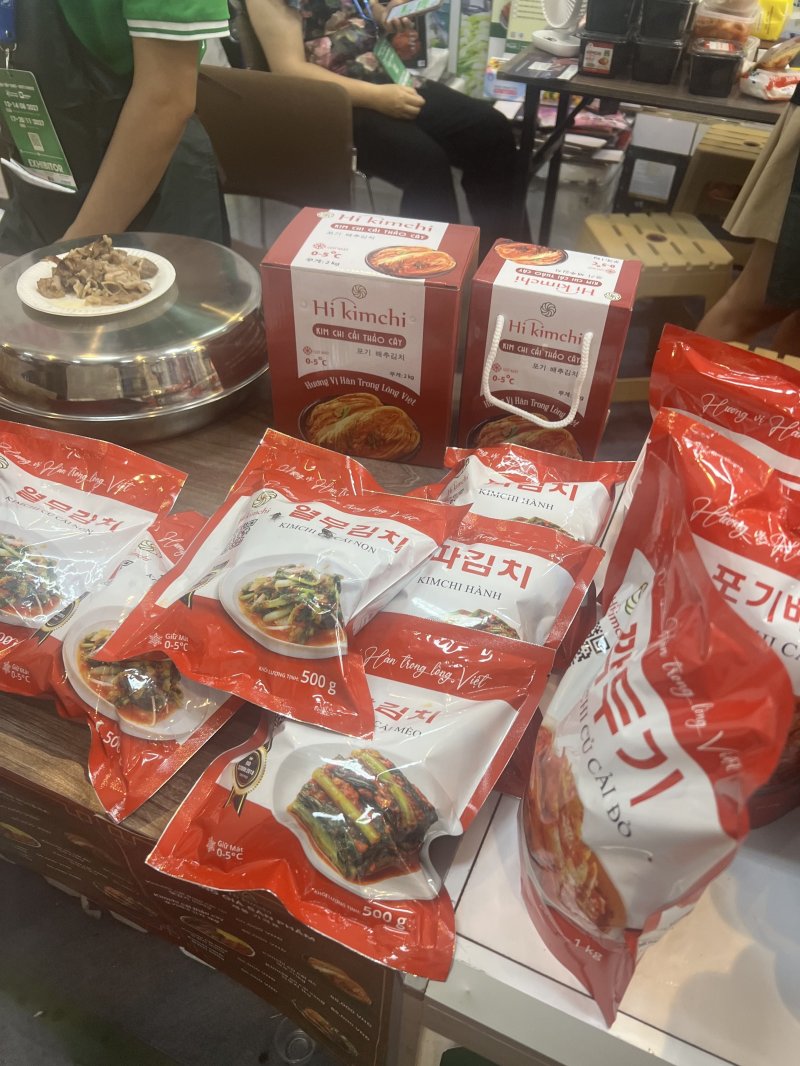
Kimchi products, including napa cabbage kimchi and young radish kimchi, on display at the booth of Hai Kimchi, a Vietnamese food company, at the Hanoi International Food Expo, held on the 4th at the Hanoi International Exhibition Center in Vietnam. Photo: Correspondent Kim Jun-seok ■ Kimchi and grain drinks ... Vietnamese food companies join the K-food arenaVietnamese food companies also drew attention by showcasing K-food. Visitors continued to sample products at the booth of Hai Kimchi, a major kimchi manufacturer based in Hanoi. The company attracted interest with products including young radish kimchi, cubed radish kimchi and green onion kimchi, in addition to napa cabbage kimchi. A Hai Kimchi representative said, “We make kimchi using locally grown Vietnamese cabbage and radishes, following the same recipes as in Korea.” The representative said the products were initially distributed mainly through Korean-run distributors and Korean restaurants, adding, “Now that awareness and popularity of kimchi are growing, we want to expand our sales channels to general consumers.” Hai Kimchi representatives repeatedly emphasized to visitors that the kimchi is made using a recipe 100% identical to that of Korean kimchi. Lan, in her 40s, who visited the expo with her daughter, said, “Kimchi is spicy, but it also has the natural sweetness of vegetables such as cabbage and radishes, so it tastes healthy,” and helped herself to each variety.
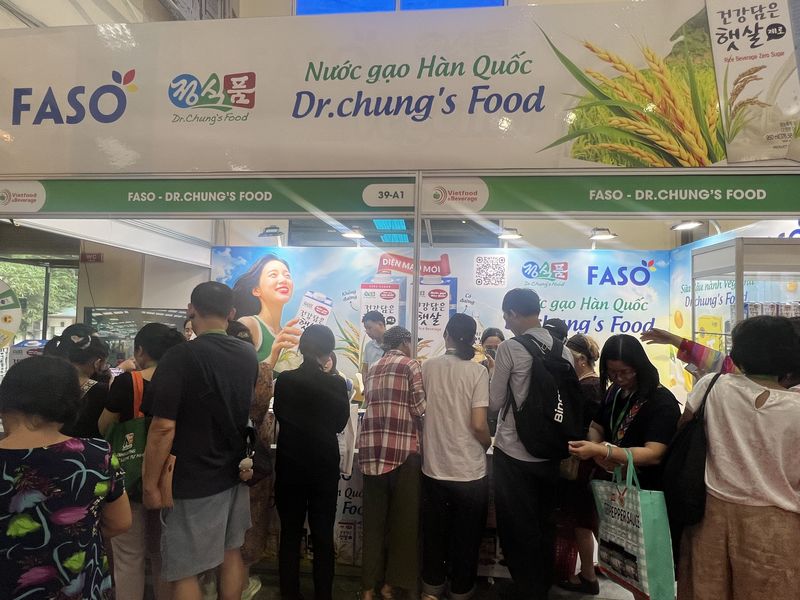
A tasting of Jeong Sik Food’s rice drink underway at the booth of FASO, a Vietnamese importer of Korean food, at the Hanoi International Food Expo, held on the 4th at the Hanoi International Exhibition Center in Vietnam. Photo: Correspondent Kim Jun-seok FASO, a mid-sized local distributor that has imported and supplied high-quality Korean food, household goods and cosmetics to the Vietnamese market for 20 years, presented Jeong Sik Food’s rice drink tailored for Vietnam, “Health-Filled Sunshine,” at the expo. Ngoc, a university student who took part in the tasting, said, “I usually enjoy rice drinks as a substitute for breakfast, and they’re convenient.” Asked about her preference for Korean food, Ngoc added, “I like Korean food so much that I make tteokbokki at home every week,” and “Among Korean food companies, I especially like Daesang Corporation’s products.”
■ K-food exports continue to grow steadily by at least 5% a yearReflecting the enthusiasm at the event, Vietnam is rapidly emerging as a key strategic market for K-food. Last year, K-food exports to Vietnam totaled $790 million (about 1.0775 trillion won), with steady average annual growth of 5.2%. Major export items include processed chicken products, seasoned seaweed, beverages, ginseng products and ramen. With the Korean Wave spreading and awareness of K-food rising, exports have recently been diversifying into fresh fruit, snacks and convenience foods, and health foods.
As economic development and the growth of the middle class have spread consumer preferences that prioritize health and quality, the market for premium products continues to expand. The diversification of online and offline distribution channels, including supermarkets and convenience stores, has also improved consumer access and supported K-food’s growth.
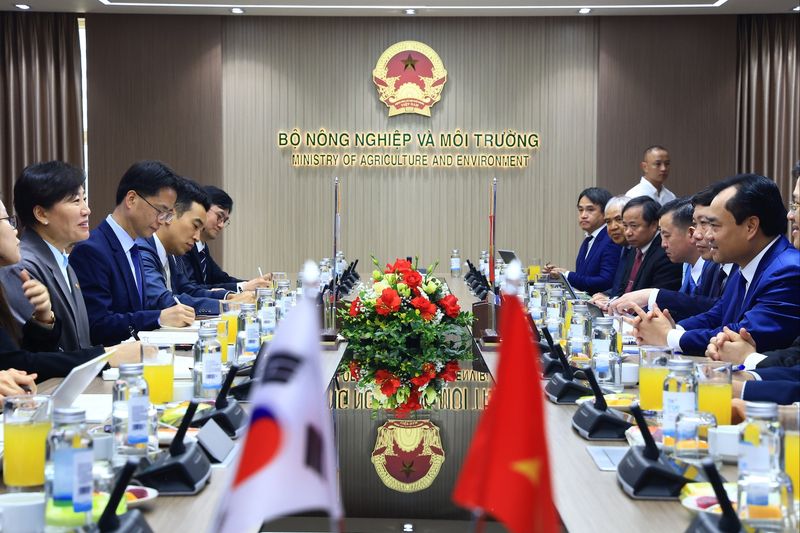
Song Mi-ryeong, Minister of Agriculture, Food and Rural Affairs, meets with Trinh Viet Hung, Vietnam’s Minister of Agriculture and Environment, in Hanoi on April 21. Provided by the Ministry of Agriculture, Food and Rural Affairs Kim Hyeon-woo, agricultural attaché at the Korean Embassy in Vietnam, said, “The quarantine negotiations were concluded following the Korea-Vietnam summit in April, opening the way for exports of Korean processed chicken products. It is meaningful that this event has allowed us to introduce K-chicken in earnest to Vietnamese consumers.” Kim added, “Going forward, the government, including the embassy, plans to strengthen cooperation with the local government further so that more livestock products, including Korean beef and heat-treated pork, can enter the Vietnamese market.”
[email protected] Kim Jun-seok Reporter