Government Calls for an “All-Out Push,” but Projects Remain Hobbled by Land Compensation and Construction Conditions
- Input
- 2026-11-08 14:26:00
- Updated
- 2026-11-08 14:26:00
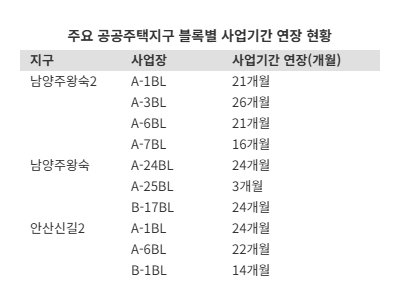
According to a notice issued on the 8th by the Ministry of Land, Infrastructure and Transport approving changes to public housing construction project plans, the project timelines for four blocks in Namyangju Wangsuk 2, a third-phase new town—A-1BL, A-3BL, A-6BL and A-7BL—were each extended by 16 to 26 months. In particular, the timeline for A-6BL was extended by 21 months to account for delays in land compensation and a recalculation of the number of working days for construction, while A-7BL was extended by 16 months, also due to delays in land compensation.
Further extensions were reported in nearby Namyangju Wangsuk. The timelines for three blocks—A-24BL, A-25BL and B-17BL—were extended by 24 months, 3 months and 24 months, respectively. Similar cases were found in Ansan Singil 2: A-1BL was extended by 24 months and A-6BL by 22 months. The changes were attributed to delays in land compensation and the time required to treat soft ground, among other factors.
The problem is not limited to individual project sites. According to data submitted by Korea Land and Housing Corporation (LH) to People Power Party lawmaker Jeong Hee-yong, a member of the Land, Infrastructure and Transport Committee of the National Assembly, LH public housing projects that had received approval but could not begin construction totaled 209,270 units across 111 districts nationwide.
Of these, 167,283 units could not begin construction because land conditions—including land compensation and securing infrastructure—were not in place, accounting for 79.9% of the total. The remaining 41,987 units (20.1%) had not begun construction due to delays in consultations with relevant agencies and other factors.
The problem is that conflicts arising during land compensation are difficult to resolve quickly. In the development of public housing districts, there have been cases in which owners of land and affected structures object to the assessed compensation amounts or refuse to relocate.
Moreover, if residents do not vacate even after the compensation process is complete, additional legal proceedings, such as eviction lawsuits and compulsory enforcement, may be necessary, sometimes adding considerable time before construction can begin.
The government is emphasizing the need to shorten land compensation procedures. On October 20, President Lee Jae-myung visited the Incheon Gyeyang public housing district and called for a shorter compensation period, saying, “Why does it take a whole year? Couldn’t it be done in, say, two or three months?” At the public redevelopment site in Jangwi District 9, Seoul, on the 4th, he also stressed the advantages of publicly led projects, saying, “When the public sector does it, things move faster and there is less scope for corruption.”
However, critics say that simply shortening administrative procedures may not be enough to reduce project timelines, since land compensation is directly tied to owners’ property rights. Disagreements over assessed compensation amounts and lawsuits can drag on, while schedules may also change depending on actual construction conditions, including infrastructure development and ground treatment, even after compensation has been paid.
Industry insiders believe that publicly led housing supply, particularly in third-phase new towns, could have a meaningful impact on supply in the current market, but say it will be difficult to significantly shorten compensation periods. “It won’t be easy to shorten the process because property owners’ complaints continue throughout the appraisal process,” one industry insider said.
[email protected] Choi A-young Reporter